
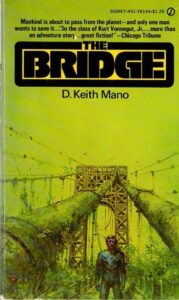
By D. KEITH MANO (Signet; 1973/74)
One of the bleakest, nastiest, most despairing dystopian novels of the 1970s (when THE BRIDGE had some serious competition in the category of despairing dystopias), written, ironically enough, by a devout Christian. Yes, the late D. Keith Mano (1942-2016) took his faith seriously, beginning as an Episcopalian and concluding as an Eastern Orthodox Christian, and he was a staunch conservative to boot, proudly authoring a column in the NATIONAL REPUBLIC. Yet Mano was also a self-described “Christian pornographer” who was known to incorporate a lot of non-Christian approved elements into his novels (which included envelope-pushers like HORN, THE PROSELYTIZER and TOPLESS).
That was certainly the case with THE BRIDGE, set in a 21st Century dystopia ruled by practitioners of a religion founded by the aptly named Dominick Priest, “our second Adam.” The rituals of this faith include ritual murder and cannibalism, denoted by a man whose convictions were forged by a lengthy trudge he made at age 40 across the downed George Washington Bridge during the “Age of Ecology.”
It was then that environmental extremism gave rise to a fascistic ruling class that forbade killing of any sort. So too the taking of drugs (because “they destroyed unconscionably high numbers of bacteria”), with humanity forced to subside on a nutrition-free “E-diet” as civilization was quickly overtaken by wild animals and unchecked vegetation. Eventually it was decreed “that men, in spontaneous free will and contrition, voluntarily accede to the termination of their species” via mass suicide.
Priest’s epic bridge walk was undertaken to reunite with his estranged wife Mary, prior to her decreed self-deletion. Denoted in a lengthy flashback that takes up two thirds of the book, the jaunt involves dangerous animals, masses of hornets and a variety of perverts and psychopaths. Among the latter are Xavier Paul, an elderly minister who remembers the days before the Age of Ecology and teaches Priest the rudiments of Christianity. Xavier dies, of course, as does most everyone with whom Priest comes into contact (many of them at his hand), leaving him much wiser than he previously was, but also hopelessly insane. Hence the twisted religion Priest brings into being, in which the flesh eating and blood drinking of the Eucharist are taken quite literally.
What are we to make of this novel, which more than one critic dismissed as “repellent?” A warning against liberal overreach? A demented spoof of Christian fanaticism? Or perhaps an authentic celebration of genuine Christian beliefs (for confirmation of which you’ll admittedly have to dig pretty deep)? Truthfully, I’m not sure.
What I can say for certain is that the novel is well imagined and descriptive, with lengthy descriptions of mutant flora that read like demented variants on J.G. Ballard’s seminal DROWNED WORLD. To its credit, THE BRIDGE eschews the annoying preachiness of right-leaning dystopias like THE CAMP OF THE SAINTS and VALHALLA, although the anger and disillusionment with which it was conceived comes through loud and clear.