
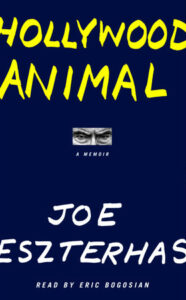
By JOE ESZTERHAS (Knopf; 2004)
This 700-plus page memoir by a Hollywood insider was to the aughts what Julia Phillips’ notorious YOU’LL NEVER EAT LUNCH IN THIS TOWN AGAIN (1991) was to the previous decade: a relentlessly self-aggrandizing self-portrait by a decidedly unpleasant person. Joe Eszterhas was at one time the highest paid screenwriter in Hollywood, a title he kept well-oiled through an omnipresent media blitz in which his overbearing personality assumed prominence, just as it does in HOLLYWOOD ANIMAL.
Born in WWII-era Hungary, Eszterhas grew up in Cleveland, OH, where, in a definite portent of things to come, he led a rough-and-tumble adolescence involving much fighting and petty crime. He got into further trouble during the early 1970s, as a journalist for publications like THE PLAIN DEALER and ROLLING STONE before turning his attention to Hollywood, and the scripting of high profile flicks like F.I.S.T. (1978), FLASHDANCE (1983) and JAGGED EDGE (1985).
He (in)famously feuded with Creative Artists Agency co-founder Michael Ovitz in the early nineties and, according to this book, received death threats because of it. Eszterhas also claims director Paul Verhoeven clashed with Sharon Stone on the set of the Eszterhas-penned BASIC INSTINCT (1992) because she refused to sleep with him, while Elizabeth Berkley, who headlined the subsequent Eszterhas-Verhoeven collaboration SHOWGIRLS (1995), won her role solely because she submitted to her director’s amorous demands.
Further unflattering cameos are made by Sylvester Stallone, Jane Fonda, Robert Evans, Michael Douglas, Michael Eisner and the author’s own wife and children, who he shunned in favor of Naomi, the young wife of a colleague (who in turn ran off with Sharon Stone!). Throughout it all, Eszterhas comes off like the blustering egomaniac he is, which often makes for compulsive reading.
Often, but not always, as HOLLYWOOD ANIMAL is wildly uneven. The show business portions are quite juicy, as are the details of the author’s father and his monstrous WWII activities (including the writing of the “Hungarian MEIN KAMPF”), which Eszterhas didn’t learn about until decades after the fact (a development, it turned out, that closely parallelled Eszterhas’ already-written screenplay for the 1989 pic MUSIC BOX). Far less compelling are the copious childhood flashbacks that frequently interrupt the narrative, and the story of Eszterhas’ relationship with Naomi (the inspiration for SHOWGIRLS’ heroine “Nomi”), which, in contrast to the terseness of much of the rest of the book, is agonizingly drawn-out.
Following the poor reception of the Eszterhas scripted pics JADE (1995) and AN ALAN SMITHEE FILM: BURN HOLLYWOOD BURN (1997), he withdrew from Hollywood and, he claims, became a devout Catholic. That aspect of his life was chronicled in a later book, CROSSBEARER (2008), but I say the one to read is HOLLYWOOD ANIMAL, in which Eszterhas offers a self-portrait that’s much more salacious, and, hence, much more characteristic.