
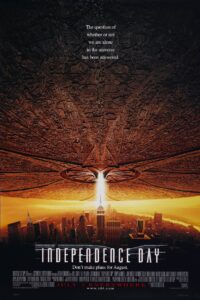
Here’s a movie that without question has not dated well. A quintessentially nineties example of blockbuster moviemaking, INDEPENDENCE DAY was a massive hit in the summer of 1996 (when it competed with TWISTER and MISSION: IMPOSSIBLE) and kick-started the disaster movie craze that overtook the latter part of the decade. What it offered was an updating/rip-off of WAR OF THE WORLDS with several examples of what at the time were considered big name actors (Bill Pullman, Judd Hirsch, Mary McDonnell, Margaret Colin, Harvey Fierstein, James Duvall and Randy Quaid), along with an enduring Hollywood mainstay (Jeff Goldblum) and a couple up-and-comers (Will Smith and Vivica A. Fox).
INDEPENDENCE DAY (1996) Trailer
The film’s creators were director/co-writer Roland Emmerich and producer/co-writer Dean Devlin, who had previously turned out UNIVERSAL SOLDIER (1992) and STARGATE (1994). Back in 1996 INDEPENDENCE DAY—or, as it was known, ID4—seemed the apotheosis of the Emmerich/Devlin aesthetic, but now it feels like a step backward.
INDEPENDENCE DAY’s most ingenious gambit was the fourth of July setting, which portended both a lucrative summer release date and Hollywood’s increasing global ambitions (as articulated in the line “the Fourth of July will no longer be known as an American holiday, but as the day the world declared in one voice: ‘We will not go quietly into the night!’”). The film actually begins on July 2, when, to the sounds of R.E.M.’s “It’s The End of the World As We Know It (And I Feel Fine),” several massive spaceships enter the Earth’s atmosphere and hover over various major cities.
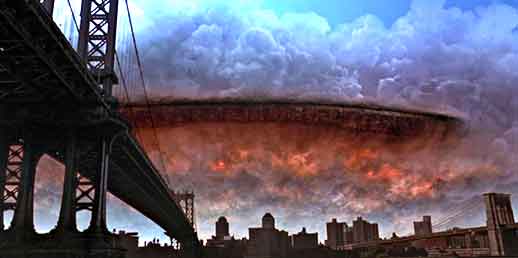
Caught up in the ensuing melee are President Thomas Whitmore (Pullman); ex-fighter pilot and alleged alien abductee Russell Casse (Quaid); Captain Steven Hiller (Smith); Hiller’s exotic dancer wife Jasmine (Fox); and scientist David Levinson (Goldblum). President Whitmore, incidentally, was one of several 1990s movie variants on then-President Bill Clinton (others were featured in THE AMERICAN PRESIDENT and AIR FORCE ONE), whose immediate family was replicated in President Whitmore’s hard-headed wife (McDonnell) and comely teenage daughter (Mae Whitman).
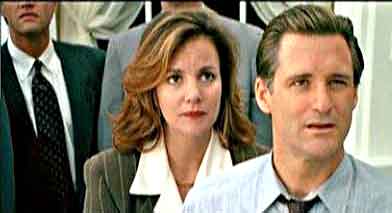
Margaret Colin, Bill Pullman
Anyway: on July 3, the hovering alien space ships reveal their true purpose, which is to blow up everything in sight, including the White House (in a shot that became ubiquitous in the film’s advertising campaign). These alien visitors are, according to President Whitmore, “like locusts. They’re moving from planet to planet…After they’ve consumed every natural resource they move on.” The President and several staffers are ferried by Air Force One to a restricted military base in Roswell, New Mexico, where they plot a July 4 takedown of the aliens.
The major components of this gambit are an unconscious alien, punched out by Capt. Hiller, and a spaceship from the Roswell crash of 1947. Hiller and Levinson, utilizing knowledge gleaned from an autopsy of the unconscious alien, pilot the Roswell spacecraft into the alien mother ship (because apparently the aliens haven’t bothered to upgrade their technology since 1947) and introduce a computer virus into its circuitry (in contrast to the bacterial one in WAR OF THE WORLDS). Will they succeed? Not to give anything away, but the answer is: yes, they will.

Will Smith
There is quite literally nothing in this movie that isn’t derivative, with shameless borrowings–narrative, visual and otherwise—from STAR WARS, CLOSE ENCOUNTERS OF THE THIRD KIND, ALIEN, THE THING (1982), TOP GUN, PREDATOR and quite a few other films. Even the soundtrack contains its share of recycled material (including the 1958 instrumental rock tune “Rumble” by Link Wray & the Wraymen, which just happened to have been utilized in PULP FICTION two years earlier).
The film is reasonably well made, although the direction, in common with the script, isn’t exactly unprecedented. The films of Steven Spielberg and George Lucas, unsurprisingly, are heavily aped in the lenses, camera placement and use of music, with David Arnold contributing a very rousing (albeit not especially memorable) John Williams-esque score.
The acting is uniformly broad and caricatured in a very old-timey manner, with Mary McDonnell faring best as the too-virtuous-to-be-believed first lady. McDonnell actually appears to be taking the material semi-seriously, which puts her at odds with the rest of the cast, Will Smith in particular, whose primary purpose was to make anti-extraterrestrial wisecracks (“just a little anxious to get up there and whoop E.T.’s ass,” “Welcome to Earth,” etc.). Acting, however, isn’t the film’s main selling point; that honor went to the state-of-the-art special effects, which have inevitably lost their luster. The film’s major problem is that there’s very little of any lasting appeal to be found outside those effects. This explains, in part, why the 2016 follow-up INDEPENDENCE DAY: RESURGENCE didn’t work at all, being a definite case of Better Never Than Late.
Vital Statistics
INDEPENDENCE DAY
Twentieth Century Fox
Director: Roland Emmerich
Producer: Dean Devlin
Screenplay: Dean Devlin, Roland Emmerich
Cinematography: Karl Walter Lindenlaub
Editing: David Brenner
Cast: Will Smith, Bill Pullman, Jeff Goldblum, Mary McDonnell, Judd Hirsch, Robert Loggia, Randy Quaid, Margaret Colin, James Reghorn, Harvey Fierstein, Adam Baldwin, Brent Spiner, James Duval, Vivica A. Fox, Lisa Jakub, Ross Bagley, Mae Whitman, Bill Smitrovich, Kiersten Warren, Harry Connick, Jr., Giuseppe Andrews, John Storey, Frank Novak, Devon Gummersall