
It’s a sad fact that posthumous success rarely ever works out the way it’s supposed to. Many an author has gained newfound fame after his or her death, yes, but that fame often takes untold years to arrive. Example: the late Harry Stephen Keeler, an insanely prolific, utterly distinctive mystery novelist whose greatest success occurred in the 1930s; by the time of his 1967 demise, Keeler’s name had completely faded from the public’s consciousness, and it took another forty years for his fiction to get its rightful due.
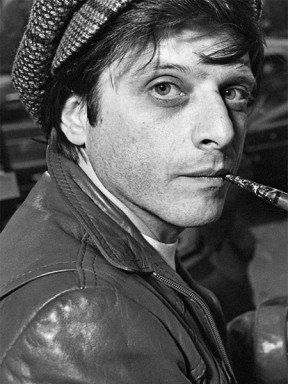
Harlon Ellison
I’ll admit I expected the late Harlan Ellison, who passed in 2018, to have a similar trajectory. Ellison was a huge and hugely controversial name in the science fiction field, and in the 1970s and 80s found fame as an essayist and TV personality. His writing, which formed the bedrock of his renown, was rich, imaginative and, in common with the man himself, top of the voice, winning every award in the SF sphere and inspiring many a budding scribe (this one in particular).
By 2018, however, Ellison was known only to a few diehard cultists, with illness, inactivity and miscellaneous bad behavior having greatly decreased his literary output. His post-millennial publications tended to consist of repackaged old stories, as he was unable to write anything new (Ellison apparently tried for decades to pen a story called “Pet,” whose plot he outlined in a 1985 interview, yet all he managed to come up with was a single page of incomplete text, followed by a 20 page explanation of why he couldn’t continue it).
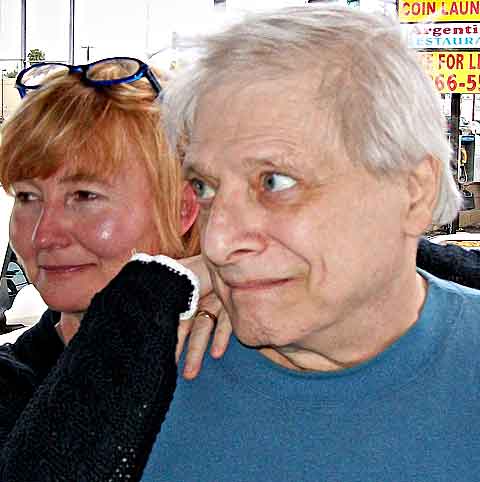
Harlan Ellison and his wife, Susan
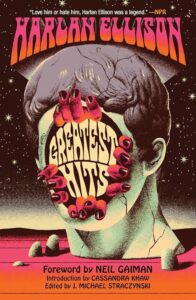
This explains why I initially turned up my nose at the 2024 publication of the J. Michael Straczynski edited HARLAN ELLISON GREATEST HITS. The stories contained in the book (which include classics like “‘Repent, Harlequin,’ Said the Ticktockman,” “I Have No Mouth and I Must Scream,” “Mefisto In Onyx” and “Shatterday”) do indeed constitute Ellison’s “Greatest Hits” (although Ellison masterworks like “Along the Scenic Route,” “A Boy and His Dog” and “Croatoan” are conspicuously absent), but all are readily available elsewhere. The book is, in short, yet another repackaging job.
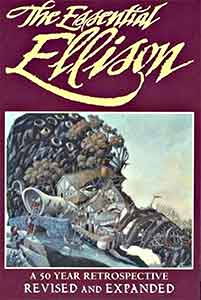
Furthering the negatives were an Amazon.com blurb comparing these stories to the work of Ray Bradbury, Ursula K. Le Guin and Isaac Asimov (whereas the only truly acceptable Harlan Ellison comparison is Harlan Ellison), and an obnoxious “Note on the Text” warning us about “outdated cultural representations and language” (if you’re concerned about such things you probably shouldn’t be reading Harlan Ellison). What’s more, a Best-of-Ellison volume already exists in the form of 1991’s THE ESSENTIAL ELLISON, which is indeed an essential volume in my view.
But a surprise was in store for me and most everyone else: HARLAN ELLISON GREATEST HITS has become a success. The book may not be a bestseller, but in the space of just two years it’s been a strong and consistent seller, with a reported 132,560 copies in print. That dwarfs the sales figures of most modern SF books, and of anything Ellison put out in the last 20 years; regarding his final self-published books, the sales were limited, Straczynski claims, to “a few thousand here and there, with some even less.” Here’s another feat HARLAN ELLISON GREATEST HITS accomplished that Ellison’s self-published books didn’t: the majority of its sales are apparently going to “readers discovering Harlan for the first time” and “it’s still selling!”
Yes, in defiance of my expectations Harlan Ellison is quickly becoming a posthumous success story. I must admit that HARLAN ELLISON GREATEST HITS, for all its faults, is a good starting point for the Ellison novice (THE ESSENTIAL ELLISON is another), although one wonders why none of these newfound fans noticed Ellison’s talent prior to 2024, the GREATEST HITS’ contents being, once again, not at all difficult to find.
The primary reason for this newfound Ellisonia, of course, is that his work is simply too damn good to languish in obscurity. Yet I feel there’s another, less obvious explanation, aptly summed up by a quote from Stephen King: “Sometimes, dead is better.”
Harlan Ellison was, in the words of one Reddit commentator, “a bitter, combative, litigious ass,” and made little effort to tone down his abrasive nature when promoting his books. Some people (this one in particular) found Ellison’s antics funny and entertaining, but not everyone was amused. In either case, the man, in all his outspoken glory, was impossible to separate from his writing, which is now free of that burden. With Harlan Ellison out of the picture, his writing is destined to speak for itself and, as HARLAN ELLISON GREATEST HITS proves, it’s very well spoken indeed.