
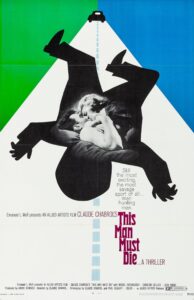
France’s late Claude Chabrol directed many clunkers in his day, but when the man was on his game, he was hard to beat. He was definitely on his game with THIS MAN MUST DIE (Que la bête meure; 1969), a French-Italian co-production that followed Chabrol’s THE UNFAITHFUL WIFE (La femme infidèle; 1969) and preceded THE BUTCHER (Le boucher; 1970), masterworks both.
THIS MAN MUST DIE (1969) Trailer
Based on a 1938 thriller by the Anglo-Irish novelist Cecil Day-Lewis (1904-1972), a.k.a. Nicholas Blake, THIS MAN MUST DIE was unusual in the Chabrol cannon because it got a US release under an English language title (whereas most Chabrol films were released in America under their original French language monikers). That title, however, was considerably less compelling than the one that graced the film’s European release and the Blake novel: THE BEAST MUST DIE.
The beast in question is Paul Decourt (Jean Yanne), who runs down a young boy (Stéphane Di Napoli) with his sports car and then speeds off. The boy is the son of Charles Thénier (Michel Duchaussoy), a novelist who, as is made clear in voice-over diary entries, grows determined to enact revenge on the murderer. First, Charles will have to identify this individual, which seems undoable at first, but enters the realm of possibility when Charles is put in touch with the actress Hélène Lanson (Caroline Cellier). She, it transpires, was riding in the car that killed Charles’ son, being the sister-in-law of Mr. Decourt, a loutish and abusive scumbag.
Charles seduces Hélène and succeeds in worming his way into the household of Paul, who’s hated by nearly all his relatives. In fact, Paul’s wife Jeanne (Anouk Ferjac) and young son Phillippe (Marc Di Napoli) both want to kill the beast themselves, and fully recognize the same impulse in Charles—who nearly gets a chance to do what he most desires when Paul slips on a seaside cliff. Charles is unable to complete the killing, however, and so decides to stage a deadly “accident” during a sailing expedition with Paul.
It was around this point that the Nicholas Blake source novel abandoned its initial form, as a diary by the protagonist, in favor of a whodunnit dominated by private detective Nigel Strangeways (Blake’s answer to Hercule Poirot). Screenwriter Paul Gegauff (who collaborated with Chabrol on 14 films) wisely refrains from duplicating that viewpoint shift, maintaining the narrative momentum established in the early scenes over a bevy of plot twists and an appropriately maudlin fade-out.
Unhappy endings were a Chabrol trademark, as were gracefully rendered group meals, of which this film contains one of the most memorable, and elegantly refined visuals, which are likewise on display in THIS MAN MUST DIE. That Chabrol was able to work his magic on a novel by the quintessentially Anglo-centric Nicholas Blake and make the material his own was a testament to his peculiar genius. With THIS MAN MUST DIE, Chabrol turned out a gripping suspense drama that also satisfies as an art film.
Pivotal to the effect is the use of voice-over dialogue to explain what’s happening. This proves (for once) to be a good idea, as the protagonist is otherwise quite distant and closed-off–in contrast to the antagonist, who’s boorish and disagreeable to a cartoonish degree. As was often the case with Chabrol’s films, it’s the female performers who fare the best, with Caroline Cellier and Anouk Ferjac offering up varied and nuanced characterizations that contrast mightily with the one-dimensionality of the men in their midst.
SEE ALSO: ALICE OR THE LAST ESCAPADE; R. I. P. CLAUDE CHABROL
Vital Statistics
THIS MAN MUST DIE (Que la bête meure)
Les Films de la Boetie/Rizzoli Film
Director: Claude Chabrol
Producer: André Génovès
Screenplay: Paul Gegauff
(Based on a novel by Nicholas Blake)
Cinematography: Jean Rabier
Editing: Jacques Gaillard
Cast: Michel Duchaussoy, Caroline Cellier, Jean Yanne, Anouk Ferjac, Marc Di Napoli, Louise Chevalier, Guy marly, Lorraine Rainer, Dominique Zardi, Stéphane Di Napoli, Raymone, Michel Carrel, France Girard, Bernard Papineau, Robert Rondo, Jacques Masson, Georges Charrier, Maurice Pialat, Jean-Louis Maury