
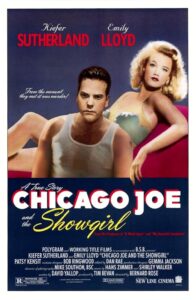
An early feature by the UK’s Bernard Rose that appeared between PAPERHOUSE (1988) and CANDYMAN (1992), CHICAGO JOE AND THE SHOWGIRL (1990) was based on an October 1944 crime spree committed by Karl Hultén, a Swedish born American serviceman, and Betty Jones, a teenage waitress, that concluded with the murder of taxi driver George Edward Heath. The film was part of a loosely knit collection of 1990s British true crime dramas that included THE KRAYS (1990), LET HIM HAVE IT (1991) and THE YOUNG POISONER’S HANDBOOK (1995), and very likely the least successful of the bunch.
CHICAGO JOE AND THE SHOWGIRL (1990) Trailer
Bernard Rose (who according to co-star Emily Lloyd was “a bit overly arrogant” during filming) called CHICAGO JOE “the greatest British film ever made.” That accords with the brazenness of the film’s opening proviso, “This is a true story…No names have been changed…No events have been altered,” which is about as accurate as Rose’s estimation of the film’s quality.
According to screenwriter David Yallop (author of several nonfiction criminal exposés), the madness commenced in a Hammersmith, London café on October 3rd, 1944, where Betty Jones (Emily Lloyd) spies the married Hultén (Kiefer Sutherland) flashing a pistol. Immediately intrigued, she enthusiastically joins Hultén on a nighttime joyride in a stolen army truck.
Jones, addled by sanitized Hollywood depictions of crime, views herself as a glamorous showgirl and Hultén a Chicago gangster. During the night he rips part of a woman’s fur coat off her back to impress his partner and causes much miscellaneous mayhem. More outrages occur the following evening, and the night after that Jones and Hultén attempt to kill a woman hitchhiker (Alexandra Pigg) they pick up, beating her unconscious and throwing her into the ocean. The madness reaches its apex the next night, when Hultén shoots a taxi driver (Harry Jones) in the back and leaves the corpse in a roadside ditch—which attracts police attention and puts a permanent end to Jones and Hultén’s spree.
This film is not, I’d argue, the disaster many commentators have made it out to be. It’s quite innovative in its juxtaposition of idealized fantasy and harsh reality, and at times (as in the downright skin-crawling depiction of the attempted killing of the hitchhiker) attains a BADLANDS-like air of inverted morality. The many problems facing Bernard Rose, however, ultimately prove insurmountable.
Those issues start with the fact that the budget was too scant to properly convey the gritty portrait of WWII-era London that was intended. Another issue is with the screenplay, which fails to delineate the mindset and motivations of its protagonists, who come off as dour and remote.
That’s especially true of Ms. Jones, whose incarnation by Emily Lloyd is rather severely mis calibrated. Lloyd was admittedly undergoing mental health issues and wasn’t fully engaged with the role. That explains why she comes off as more a petulant child then the wise-beyond-her-years seductress she was supposed to be, and why Rose devotes so much screen time to Patsy Kensit as Hultén’s long-suffering wife; this wouldn’t be an issue were it not for the fact that Kensit is much sexier and more charismatic than Lloyd, suggesting that the film’s issues may boil down to a simple case of miscasting.
Vital Statistics
CHICAGO JOE AND THE SHOWGIRL
Polygram/Working Title Films
Director: Bernard Rose
Producer: Tim Bevan
Screenplay: David Yallop
Cinematography: Mike Southon
Editing: Dan Rae
Cast: Kifer Sutherland, Emily Lloyd, Patsy Kensit, Keith Allen, Liz Fraser, Alexandra Pigg, John Lahr, Harry Fowler, Angela Morant, John Surman, Janet Dale, John Dair, Stephen Hancock, Hugh Millais, Harry Jones, John Junkin, Gerard Horan, Colin Bruce