
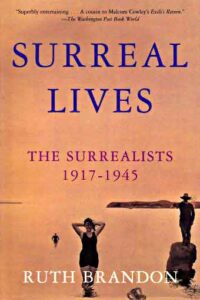
By RUTH BRANDON (Grove Press; 1999)
SURREAL LIVES is a most welcome history of the Surrealists, marked by richly detailed, narratively informed prose. You could argue, of course, that such a straightforward approach is wrong, given that surrealism is all about irrationality and disconnection, but I feel author Ruth Brandon’s thoroughly researched, no-frills account is necessary, especially since so many misconceptions about surrealism persist in popular culture.
Brandon begins her account in Paris, circa 1917, when the avant-garde poet Guillaume Apollinaire first coined the term surrealism. The movement was formed by Andre Breton, a friend of Apollinaire who was possessed of enormous erudition and charisma. Initially an outgrowth of the 1916 incepted Dadaist movement, Surrealism was concerned with anarchy and the subconscious, and attracted a notoriously eccentric bunch of writers and artists that included Louis Aragon, Man Ray and Marcel Duchamp.
In later years the movement was joined by the lunatic Spainards Luis Bunuel and Salvador Dali, the latter of whom all-but overtook Breton and became the public face of Surrealism. Unfortunately, Dali grew perilously addicted to fame and distanced himself from his Surrealist colleagues (the claim that Dali “died surrounded by vultures,” while not made here, seems especially appropriate to Brandon’s characterization). Another blow to the movement was World War II, during which Breton was forced to flee Nazi occupied France for the US, which he came to really hate. The book concludes in the year 1945, when Surrealism was displaced in popularity by the existentialist viewpoint espoused by Jean-Paul Sartre and Albert Camus.
Brandon keeps this account fast moving and lively in the manner of a novel rather than a history, and never gets too precious or hero-worshipy about her subjects. The Surrealists, as she repeatedly makes clear, were flawed men mining a belief system that freely advocated a sense of anarchy and civil disobedience that none of its proponents were willing to actually put into practice. An example of that would be Breton’s oft-quoted late 1920s claim that “The purest surrealist act is walking into a crowd with a loaded gun and firing into it randomly,” which he spent the remainder of his life walking back.