
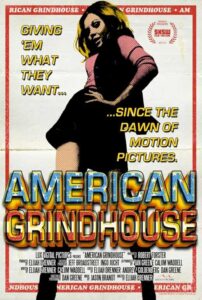
A feature length documentary overview of “Grindhouse” exploitation filmmaking, and a strong one. Co-scripted by author Calum Waddell (of JACK HILL: THE EXPLOITATION AND BLAXPLOITATION MASTER, FILM BY FILM) and narrated by the late Robert Forster, AMERICAN GRINDHOUSE (2010) contains a plethora of poster art, clips from dozens of films and a classically-infused score that samples Rossini’s “The Barber of Seville,” Mussorgsky’s “Night on Bald Mountain” and Strauss’s “Vienna Blood Waltz.”
AMERICAN GRINDHOUSE (2010) Trailer
Interviewees include the directors John Landis, William Lustig, Fred Olen Ray, Lewis Teague, Joe Dante, Larry Cohen, Jonathan Kaplan, Ted V. Mikels and Herschell Gordon Lewis (surprisingly, grindhouse guru Quentin Tarantino is absent), as well as the film historians Eddie Muller and Kim Morgan, and actors like David Hess, Fred Williamson and Bob and Judy Minor. Most of these folk offer third party analyses, although there are some first-hand recollections.
It starts quite literally at the beginning, when “Exploitation and the dawn of film went hand in hand.” TRAFFIC IN SOULS, released in 1913, was the prototypical exploitation film, an unabashedly sleazy white slavery expose that grossed a then-astronomical $450 thousand. More sleaze followed, along with several well-documented 1920s era scandals and the release of Tod Browning’s notorious FREAKS (1932), which led to widespread public condemnation and the establishment of a Hollywood production code, which had the paradoxical result of giving rise to an “Adults Only” cinematic underground. According to this film, Dwain Esper’s notorious MANIAC (1934) was the major example of this particular strain of exploitation, whose subject matter included birth (graphic footage of which is shown) and sexual hygiene, and was dominated by the so-called “forty thieves,” a group of renegade exhibitors that included David F. Friedman and Kroger Babb.
The Paramount Decision of 1948, which effectively ended the monopolistic reign of the major Hollywood studios, caused the production code to fall apart, and led to the Burlesque film explosion whose operative phrase was “Bump and Grind”—which of course gave rise to the term Grindhouse. There followed the teen exploitation films made, more often than not, by American International pictures, and Russ Meyer’s IMMORAL MR. TEAS (1959), which jump-started the nudie-cutie cycle.
It was the nudie-cuties that birthed the roughies, in which violence was intermixed with the expected nudity. The Herschell Gordon Lewis helmed SCUM OF THE EARTH (1963) was the first such film, and it was followed by the enormously influential BLOOD FEAST (1963), which is here compared, non-ironically, with PSYCHO (1960).
From there we got counterculture themed exploitation like LAST HOUSE ON THE LEFT (1972), the Blaxploitation film cycle that commenced with Melvin van Peebles’ SWEET SWEETBACK’S BAADASSSSS SONG (1971), the women in prison films that followed THE BIG DOLL HOUSE (1971), and Nazi exploitation cinema like ILSA: SHE WOLF OF THE SS (1975), which are, according to Joe Dante, “beyond any concept of taste whatsoever.” What followed was hard core pornography and DEEP THROAT (1972), which destroyed the soft-core porn model and marked the beginning of the end for the grindhouse era explored here—but as the filmmakers make sure to remind us, “The spirit of Grindhouse lives on.”
I say a bit more info could have been included on the venues that played grindhouse fare (in which, according to William Lustig, “When you go into these theaters, there’s an ever-present feeling of danger”). The film could have also offered a more in-depth treatment than the one it provides; as it is, it’s fast, furious and unabashedly trashy, and so much very like the films it celebrates.
Vital Statistics
AMERICAN GRINDHOUSE
Lux Digital Pictures
Director/Producer: Elijah Drenner
Screenplay: Elijah Drenner, Calum Waddell
Cinematography: Dan Greene
Editing: Elijah Drenner, Andrew Goldenberg, Dan Greene
Cast: Robert Forster, Allison Anders, Judy Brown, Larry Cohen, Joe Dante, Don Edmonds, David Hess, Jack Hill, Jonathan Kaplan, Jeremy Kasten, John Landis, Herschell Gordon Lewis, William Lustig, Ted V. Mikels, Bob Minor, Kim Morgan, Eddie Muller, Fred Olen Ray, Eric Schaeffer, Lewis Teague, James Gordon White, Fred Williason