
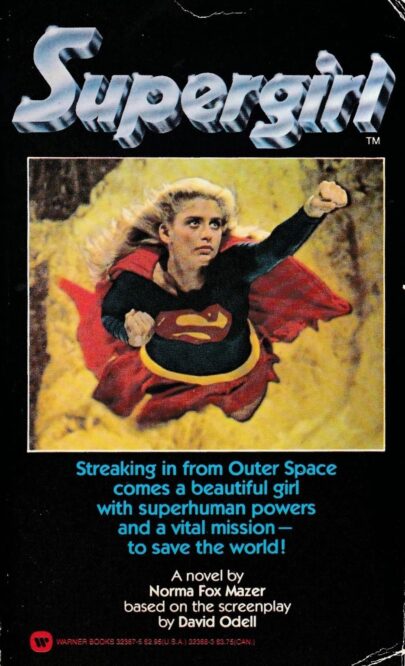
 By NORMA FOX MAZER (Warner Books; 1984)
This is about what you would expect quality-wise from a novelization of what was (until the 1987 release of the Cannon made SUPERMAN 4: THE QUEST FOR PEACE) the worst of the SUPERMAN movies. A box office flop, the twice-rebooted SUPERGIRL (1984) suffered from a cinematic treatment that, in a development that wasn’t at all unusual then or now, prized special effects over all else.
This novelization, credited to the late YA author Norma Fox Mazar (1931-2009), throws the script’s failings into uncomfortably sharp relief. Kara, a.k.a. Supergirl, is bland and personality-free, and Selena, the witchy villain, is weak and unmenacing. Most damaging of all, the narrative is silly, with Kara tasked with finding a magic thingamajig to take back to her home world (unlike Superman, who was forced to live on an unfamiliar planet), and Selena using the thing to her advantage (unlike Lex Luthor, who used intelligence to hatch his evil schemes).
More specifically, Kara (played by Helen Slater) is Superman’s cousin. She’s a resident of Argo City, an inner space based environ comprised of exiles from Krypton, that’s powered by the Omegahedron, a spherical object with magical properties. When the object is lost Kara steals a spaceship to pursue it, and winds up busting up from a lake (“In slow motion, as it were”) in the midwestern town Midvale. There she becomes Linda Lee, a schoolgirl whose roommate is Lucy Lane (Maureen Teefy), Lois’ younger sister (it seems that nearly all the women in the Superman universe have “LL” names).
Also afoot in Midvale is Selena (Faye Dunaway), an ex-fortune teller who’s dating Nigel, one of the professors at Linda and Lucy’s school. Selena resides in a deserted funhouse and dreams of world conquest; while she’s picnicking with Nigel one day, the Omegahedron lands in the lobster sauce, and Selena discovers the means to make her dreams a reality.
You can blame studio executives for the oddly contained nature of the narrative, with Selena confining her ambitions to Midvale (the initial conception apparently had her threatening the whole of America), in which she causes a mountain to appear, and upon that mountain a fortress where she resides. Kara/Linda, meanwhile, gets trapped in the apparently impregnable Phantom Zone, together with an elderly refugee from her homeland named Zaltar (Peter O’Toole), yet manages to find her way out of the Zone with remarkable ease.
This book doesn’t succeed in negating any of the film’s problems, and nor does it try to. What Norma Fox Mazar offers in place of complexity and subversion (as provided by novelizations like those of 9/30/55 and BUCKAROO BANZAI) is a self-aware air that subtly calls attention to the screenplay’s shortcomings in the form of “as ifs” (“as if to remind her of the seriousness of her quest, on her wrist Zaltar’s berry bracelet flickered to life,” “she flew straight up, as if rejoicing in her freedom,” “she turned a puzzled glance skyward, as if wondering where that coconut had come from,” etc.). This does nothing to improve matters, but does at least make for an at times enjoyable read.