
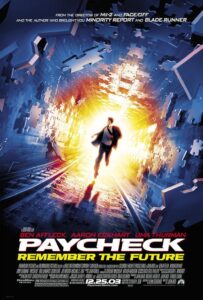
Further proof that Hollywood is incapable of doing justice to the work of Philip K. Dick. The irony in this case is that Dick’s 1952 story “Paycheck” was one of his more movie-friendly tales, an easily digestible, action-oriented account that the makers of this 2003 movie both simplify and needlessly complicate. That PAYCHECK was a box office disappointment that did irreparable damage to the careers of its director John Woo (coming off the 2002 mega-flop WINDTALKERS) and lead actor Ben Affleck should surprise absolutely no-one.
PAYCHECK (2003) Trailer
Affleck plays Michael Jennings, an engineer employed by the all-powerful tech giant Allcom who voluntarily undergoes a three year memory wipe (to ensue he won’t divulge any sensitive information) in exchange for $92 million worth of company stock. Upon regaining consciousness after the memory wipe, Jennings discovers that he inexplicably gave away his stock in favor of an envelope containing several innocuous items. He initially believes a mistake has been made, but after being detained by the FBI for a crime he doesn’t remember committing, and finding that some of the items in the envelope allow for an escape, Jennings realizes that he must have somehow known what was going to happen—and constructed a time machine to see into the future. This appears to be confirmed by a winning lottery number on TV that matches the numbers written on a fortune cookie message found in Jennings’ envelope.
Back at Allcom, Jennings’ boss James Rethrick (Aaron Eckhart) tries to use the time machine, but it’s been programmed to automatically shut down in Jennings’ absence. Rethrick tracks Jennings’ movements, precipitating a chase involving Jennings and Dr. Rachel Porter (Uma Thurman), an Allcom employed biologist with whom Jennings became romantically involved during his forgotten three year stretch. The items in the envelope allow for Jennings and Rachel to outwit their pursuers, infiltrate Allcom and activate the time machine. It all ends happily, of course.
“One take John” Woo’s B-movie aesthetic tended to work quite well in Hong Kong action movies like A BETTER TOMORROW (Ying hung boon sik; 1986), THE KILLER (Dip huet seung hung; 1989) and HARD BOILED (Lat sau san taam; 1992), but not here. Woo elected to play down the story’s futuristic aspects, which wasn’t a bad idea in theory (as SF trappings generally tend to detract from the storytelling), but what we’re left with is generic early-00s scenery (lensed, like so many other Hollywood films then and now, in Vancouver, BC). Nor is Woo above some gratuitous self-homage, as when two characters point guns at each other (which occurs more than once) in a Mexican standoff, a dove appears in the climax and a lengthy motorbike chase offers a direct flashback to the ending of the Woo directed MISSION: IMPOSSIBLE II (2000).
The direction, however, isn’t PAYCHECK’s greatest drawback. The screenplay by Dean Georgaris insists on twisting the story into an elaborate and confusing action-time travel scenario that never feels very Phil Dickian. The acting is another liability, with Affleck barely passable in the lead role and Uma Thurman very, very bad as Rachel, with her primary motivation, and those of most everyone involved, most likely summed up by the title.
Vital Statistics
PAYCHECK
Paramount Pictures/Dreamworks Pictures
Director: John Woo
Producers: John Davis, Michael Hackett, John Woo Terence Chang
Screenplay: Dean Georgaris
(Based on a story by Philip K. Dick)
Cinematography: Jeffrey L. Kimball
Editing: Kevin Stitt, Christopher Rouse
Cast: Ben Affleck, Aaron Eckhart, Uma Thurman, Paul Giamatti, Colm Fiore, Joe Morton, Michael C. Hall, Peter Friedman, Kathryn Morris, Ivana Milicevic