
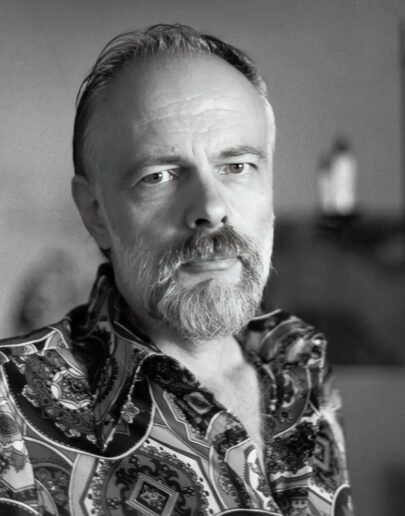
Philip K. Dick
Having read a fair amount of the mind-twisting, reality-warping fiction of the late Philip K. Dick (1928-1982), I’ve concluded that PKD was very likely the least understood SF writer of the Twentieth Century. I base that on the media that followed in Dick’s wake, which included pastiche novels like THE LATHE OF HEAVEN (1971) by Ursula K. Le Guin and NIGHT OF DELUSIONS (1972) by Keith Laumer, which can be said to have replicated aspects of Dick’s work while completely missing the greater picture.
Specifically, both THE LATHE OF HEAVEN and NIGHT OF DELUSIONS focused on lone men faced with an increasingly irrational universe. Loneliness and irrationality were certainly hallmarks of Dick’s fiction, but so were normalcy and the pressures of day-to-day living. True weirdness simply isn’t possible without an equally solid grasp of the mundane, and even at his nuttiest (as in THE THREE STIGMATA OF PALMER ELDRICH and VALIS), Dick was a dedicated chronicler of the ordinary. If anything, Le Guin and Laumer were more in line with the paranoid fiction of Dick’s contemporary, Richard Matheson (a not-unusual situation, as reported by PKD biographer Emmanuel Carrere, who maintains that his surreal fantasy novel THE MUSTACHE was inspired primarily by Matheson, even though reviewers insisted on invoking Kafka).
Nowhere is the disconnect between what PKD was about and what his progenitors think he was about more pronounced than in the film adaptations of his work. Dick has proven to be quite a popular source of content for adventurous filmmakers; according to the imdb, there are currently 53 films, TV shows, music videos, etc. adapted from his work. That’s not quite up there with Stephen King (who has a whopping 416 credits) or Ray Bradbury (who has 132), but it does handily beat out the filmographies of major SF figures like Theodore Sturgeon (15), Robert A. Heinlein (23) and Arthur C. Clarke (19).
Are these PKD adapted films, as Dick biographer Lawrence Sutin claims, “dreadful?” Not entirely. Have they been especially faithful? Despite the presence of Electric Shepherd Productions, consisting of Dick’s children Isa Dick Hackett, Christopher Dick and Laura Leslie (who since the late 2000s have strictly vetted all prospective PKD adaptations to make sure they align with their father’s intentions), the answer to that question is a firm no.
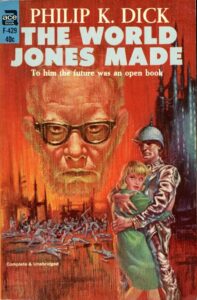
In recent weeks Netflix and Electric Shepherd have announced that THE FUTURE IS OURS, a miniseries adaptation of Dick’s 1956 novel THE WORLD JONES MADE, is in the works. Many changes have been made to Dick’s imaginings, including the swapping of nuclear war with environmental collapse and the jettisoning of the alien invasion that powered Dick’s narrative. It seems rather pointless to purchase a novel to adapt and then change everything around, but let’s not forget PKD’s 1982 claim that “you wouldn’t want to see my novel on the screen because it is full of people conversing, plus the personal problems of the protagonist. These matters don’t translate to the screen.”
The novel he was referring to in that quote was DO ANDROIDS DREAM OF ELECTRIC SHEEP? (1968), which formed the impetus for the first major PKD adaptation BLADE RUNNER (1982). Dick involved himself quite closely in the production, offering public dismissals of the initial Robert Jaffe penned script and a subsequent draft by Hampton Fancher, which were apparently “like Cinderella’s two older sisters: each was uglier than the other.” Inspiring far greater enthusiasm was David Webb Peoples’ rewrite, which Dick called “one of the most high-quality, professional screenplays I’ve ever read.” Tragically, Dick died mere weeks before BLADE RUNNER’s June 1982 premiere, although he was shown 20 minutes’ worth of special effects footage (and commented that “the opening is simply the most stupendous thing I have ever seen in the way of a film. It’s simply unbelievable”).
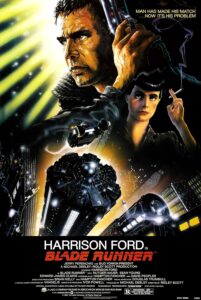
Compounding the irony was the fact that BLADE RUNNER, despite Dick’s praise for the shooting script, was completely antithetical to both the source novel and the viewpoint of its author. In contrast to the everyman character who headlined the text, the film’s Harrison Ford essayed protagonist is a suave loner whose relationship to his surroundings is indicated by more than one shot of him looking down at them from a great height.
The emphasis, moreover, was on action, violence and a film noir atmosphere, with the novel’s intellectual charge played down. So too its overall conception, involving an underpopulated future LA in which the creation of android animal replications comes to extend to humans; in BLADE RUNNER that future world is overpopulated, which largely negates the logic of its premise (humanity might seem precious in an underpopulated world, but in an overpopulated one not so much).
That BLADE RUNNER turned out to be a most unlikely great film, and a never-ending source of inspiration for subsequent filmmakers, owes nothing to Philip K. Dick. Its influence has, in fact, proven detrimental to the man’s cinematic legacy, with action and violence having become the main ingredients of PKD films. See IMPOSTER (2001), MINORITY REPORT (2002) and PAYCHECK (2003), action-fests that simplified Dick’s source texts considerably and, in the case of MINORITY REPORT, altered its conception even more radically than BLADE RUNNER did.
THE MINORITY REPORT (2001) Trailer
The Philip K. Dick story “Minority Report,” initially published in 1956, concerned a future world in which psychic “precogs” are charged with reporting on future crimes. The system’s founder, upon finding himself charged with an upcoming murder, attempts to commute his sentence via a dissenting, or minority, prediction. In the Steven Spielberg directed film adaptation the protagonist, played by Tom Cruise, is given a melodramatic backstory involving a dead relative (as in every other sci-fi movie of the past 30 years) and an arc that rubbishes the minority report gambit, as it’s the majority report that turns out to be accurate.
An outlier in the PDK filmography is director Jerome Boiven’s French language BARJO (Confessions d’un Barjo; 1992). An adaptation of Dick’s 1975 novel CONFESSIONS OF A CRAP ARTIST, it follows the letter of the text but not the spirit, being an antic (and very French) comedy that misses the psychotic edge that powered the novel, about a deeply disturbed young man who’s far removed from the film’s loveably eccentric protagonist. For once, however, there’s no action to be found, which renders BARJO something of a breakthrough.
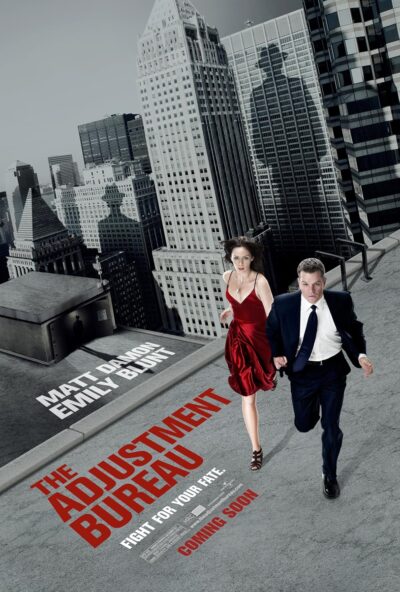
THE ADJUSTMENT BUREAU (2011) Trailer
THE ADJUSTMENT BUREAU (2011) replaced the expected action and sensation with excess chatter. Just about every other scene features the Matt Damon played protagonist having things explained to him by Terence Stamp as the head of an alien bureau that secretly controls reality, which may seem more in keeping with Dick’s 1954 story “The Adjustment Team,” but in truth wasn’t much of an improvement over the abovementioned trio. Character detail, let’s not forget, was part and parcel to the PKD universe, and was something THE ADJUSTMENT BUREAU’s pretty but hopelessly bland protagonists, played by Matt Damon and Emily Blunt, lacked.
The Dan O’Bannon scripted TOTAL RECALL (1990) and SCREAMERS (1995), adapted from the Dick stories “We Can Remember It For You Wholesale” (1966) and “Second Variety” (1953), contained their share of action and violence. The Paul Verhoeven directed former film was, like BLADE RUNNER, a long-in-the-works production that for much of its 1980s-era gestation was slated to be helmed by David Cronenberg. It’s no coincidence that the latter’s 1999 film eXistenZ was a very Phil Dickian concoction that contained several direct shout-outs to PKD’s fiction (such as a restaurant called “Perky Pat,” a name that will resonate with PKD fans).
PKD was also referenced in Richard Linklater’s hallucinatory animated wonder WAKING LIFE (2001), and directly adapted by Linklater in A SCANNER DARKLY (2006). The latter was the first film to procure the services of Electric Shepherd Productions (which gets a “Special Thanks” credit), and its take on the 1977 novel, which Dick proclaimed his personal favorite, was quite faithful, down to the listing of actual people whose lives had been irretrievably altered by drug abuse (including “Phil” himself), which is replicated in the end credits. What’s missing is the druggy intensity that fueled the novel, with Linklater’s laid-back, observational treatment proving a most inadequate substitute.
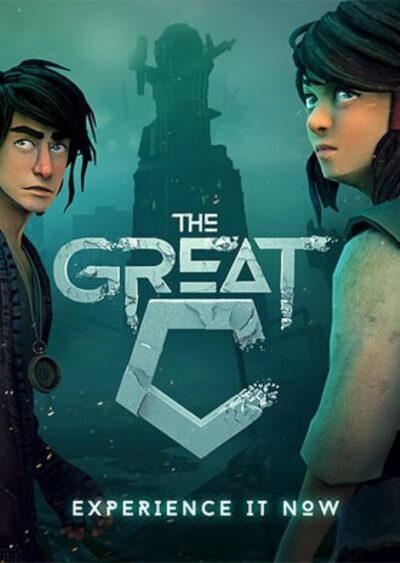
THE GREAT C (2018) was another animated PKD adaptation, exhibited in virtual reality. I’m told it was quite a mind-roaster when experienced in a VR helmet, but in 2d flatscreen form it’s a bust, with character designs that resemble 1970s Disney cartoon renderings and additions to Dick’s 1953 narrative that include a plucky young heroine who dismantles the supercomputer that rules the film’s dystopian landscape, a dismantling she accomplishes with remarkable ease (making one wonder how this contraption ever managed to enslave mankind in the first place). Once again, Dick was misunderstood onscreen, and that understanding was most likely deliberate.
Perhaps the upcoming PKD adaptations, which include the aforementioned FUTURE IS OURS and the Amazon MGM production T-MINUS (based on the 1974 story “A Little Something for Us Tempunauts”), will reverse the misunderstandings about PKD’s work that continue to persist. I’m not too optimistic, though, as Dick’s peculiar genius was fundamentally incompatible with the PDK-defined “great unwritten rule” that governs SF films, which must “end not with a whimper but a bang. And maybe that’s as it should be, in the best of all visual galaxies.”