
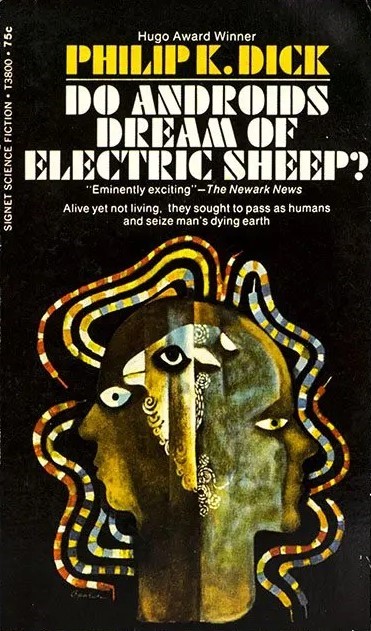
By PHILIP K. DICK (Signet; 1968/69)
One of the late Philip K. Dick’s most famous novels was DO ANDROIDS DREAM OF ELECTRIC SHEEP?, the basis for BLADE RUNNER. That 1982 film was a VERY loose adaptation, yet Dick’s 1968 novel was reissued in lieu of a newly drafted novelization, showing that it and its formerly little-known author were already gaining the renewed appreciation they currently enjoy.
This novel hails from Dick’s middle period, which saw the publication of classics like DR. BLOODMONEY (1963), THE THREE STIGMATA OF PALMER ELDRITCH (1964) and UBIK (1966), as well as hastily written money-grabbers like THE ZAP GUN (1964) and OUR FRIENDS FROM FROLIX 8 (1969). DO ANDROIDS DREAM OF ELECTRIC SHEEP? hews closer to the former category, although it’s not, in my view, entirely deserving of all the adulation given it by people who (I assume) haven’t read many Dick books (because if they had they’d know he was capable of far better).

Philip K Dick in the 1960s.
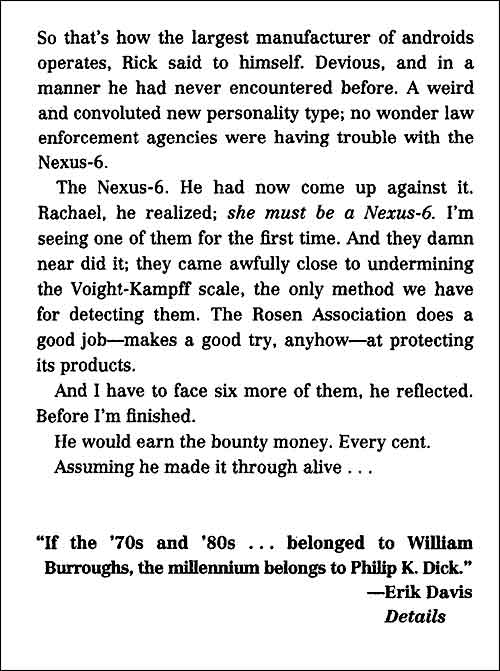
Rick Decker is a bounty hunter who in the far-off year 1992 is tasked with hunting and “retiring” renegade androids in a post-nuclear San Francisco, much of whose populace has migrated to an outer space colony. Said androids (the term “replicant,” FYI, was invented by BLADE RUNNER’s screenwriters) look and act like everyone else, so Deckard and his fellow hunters are forced to administer a “Voight-Kampff” test that measures a person’s level of empathy, apparently the only way to truly distinguish between human and non. But the androids Deckard hunts are far more intelligent than he initially suspected, and set up a fake police force to make Decker believe he’s an android and that his whole life is a hallucination—which, truth be told, it may just be.
Another important element in the book (which didn’t make it into the movie) is the presence of mechanical animals engineered to be indistinguishable from the real things, which have died out. Yet people still have a need for pets, hence the android animals—and if people can love mechanical dogs and cats then why not robotic humans? Deckard is forced to grapple with that very question when an android woman named Rachel enters his life—which is all the more problematical when it turns out that one of the androids he’s pursuing, Pris, is made from the same mold as Rachel, and so looks exactly like her.
Many Dick trademarks are evident here, including a robust narrative drive, paired with a consistently fascinating juxtaposition of reality and illusion. There are, however, some errant elements, such as a character named Mercer who seems to have some crucial bearing on the plot, although precisely what is never made clear; such things betray the fact that the novel, like most of Dick’s 1960s output, was written at great haste and never properly revised.