
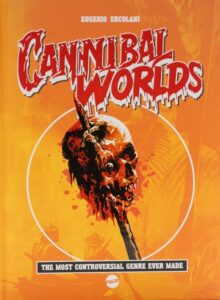
By EUGENIO ERCOLANI (Pulse Video/CREE; 2026)
Books about the Italian cannibal film cycle of 1972-88 have been shockingly sparse, with CANNIBAL: THE MOST SICKENING CONSUMER GUIDE EVER! by John Martin and WE ARE GOING TO EAT YOU by Stephen Bissette being the only pre-2026 examples I know of. Now we have CANNIBAL WORLDS, a knowledgeable, wide ranging and heavily illustrated (with many graphic adults-only stills) tome that has some shortcomings, but more than delivers on its promise of being “the most comprehensive and in-depth book devoted to an inherently scandalous genre.”
Particularly edifying is the fact that the primary authors Eugenio Ercolani and Andrea Meroni are Italian, and offer highly authoritative recountings of their country’s history. An early Meroni authored chapter provides a learned overview of the socioeconomic strife that occurred in 1970s Italy, the so-called “Years of Lead” in which crime, inflation and political upheaval gave rise to a uniquely violent and cynical brand of cinema, represented by films ranging from THE VIOLENT PROFESSIONALS (Milano trema: la polizia vuole giustizia; 1973) to AN AVERAGE LITTLE MAN (Un Borghese piccolo piccolo; 1977) and IL…BELPAESE (1977). Also appearing in the Years of Lead was director Umberto Lenzi’s THE MAN FROM DEEP RIVER (Il pease del sesso Salvaggio; 1972), which established the cannibal movie framework.
Lenzi’s film was followed by Ruggero Deodato’s JUNGLE HOLOCAUST (Ultimo mondo cannibale; 1977), Joe D’Amato’s EMMAUELLE AND THE LAST CANNIBALS (Emanuelle e gli ultimi cannibali; 1977), Sergio Martino’s MOUNTAIN OF THE CANNIBAL GOD (La montagna del dio cannibal; 1978), Deodato’s CANNIBAL HOLOCAUST (1980), Lenzi’s EATEN ALIVE (Mangiati vivi!; 1980) and CANNIBAL FEROX (1981), Mario Gariazzo’s WHITE SLAVE (Schiave bianche – Violenza in Amazzonia; 1985), Michel Massimo Tarantini’s MASSACRE IN DINOSAUR VALLEY (Nudo e selvaggio; 1985) and Antonio Climati’s THE GREEN INFERNO (Paradiso infernale; 1988). All are exhaustively covered in these pages, along with “anomalies” like ZOMBIE HOLOCAUST and ANTHROPHAGUS (both 1980), and Eli Roth’s American made tribute THE GREEN INFERNO (2013), about which Deodato stated that “I was embarrassed when I watched his film. The only positive thing about it, is that it makes mine look even better.”
Included are voluminous interviews with many of the stars, directors (including Lenzi and Deodato) and technicians behind these films, and summaries by Alessio de Rocco on the censorship to which they were subjected. Unsurprisingly, it’s CANNIBAL HOLOCAUST, the most famous (and widely reviled) film of the lot, which gets the lengthiest write-up, with a full 5 pages of Rocco’s “Censorship” coverage (around 3-4 pages more than any of Rocco’s other such entries).
Several chapters are taken up with self-contained essays by authors like Merlyn Roberts, Troy Howarth, Giacomo Calzoni and Rachel Nisbit. The latter’s painfully academic contribution, “Ravaged and Devoured: Sexual violence in the Italian Cannibal Film,” is focused on rape, which “appears throughout the Italian cannibal cycle as a recurring motif” (silly me: I thought the cycle’s major motif was cannibalism). I wasn’t too enamored with Nisbit’s essay, which goes against Ercolani’s introductory assertion that he and his colleagues “made a conscious choice not to sermonize or to impose our personal code of ethics,” and I also say a bit too much coverage is lavished on Climati’s GREEN INFERNO, which Andrea Meroni dismisses with the wholly accurate claim that “The cannibal movie, in its final chapter, drags itself in the wrong direction and dies with a feeble sigh like (a) poor turtle succumbing to exhaustion.”