
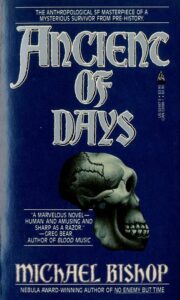
By MICHAEL BISHOP (Tor; 1985/86)
The idea of a protohuman stuck in the present day isn’t new, and nor was it in 1985, when ANCIENT OF DAYS was published. It partakes of the contemporary caveman trope, which has been utilized in SF media ranging from ICEMAN (1984) to ENCINO MAN (1992). ANCIENT OF DAYS tends to be proclaimed a masterpiece of SF, a designation that strikes me as inaccurate, as does the SF categorization. This is more an example of anthropological fantasy, with a hint of horror in the final third; nor is it a masterpiece in my view, although it is a pretty damn good book.
As we’ve come to expect from the late Michael Bishop (1945-2023), ANCIENT OF DAYS is a consistently likeable and absorbing read. Its 400-plus pages are related in easygoing prose, with a first-person protagonist who’s sympathetic but also quite prickly and complex. The Georgia based restaurateur Paul is the protagonist in question, with the story centered on his ex-wife RuthClaire, an artist who’s fallen for a protohuman she finds cowering in her pecan grove, a fellow she names Adam.
Adam is an example of Homo habilis, an African-based species believed to have gone extinct 2 million years ago. He was transported to America in the 1980 Cuban Freedom Flotilla (as seen in the beginning of SCARFACE), having grown up on a Haitian island and been enslaved. Adam turns out to be quite an intelligent fellow, learning sign language and, following a facial operation, speech. He becomes quite the scholar, being especially interested in religion, a development that proves extremely vexing to his atheist-minded companions.
Adam also impregnates RuthClaire, which leads to all manner of trouble when the newborn child, one “Tiny Paul,” is kidnapped by white supremacists offended by the thought of Adam cohabitating with a white woman. Paul finds himself drawn into the resulting drama despite harboring a highly ambivalent attitude toward Adam; Paul is, frankly, jealous, as he still has feelings for his ex, feelings that not even a new wife, the sweet and perceptive Caroline, can dim.
The novel’s final third provides the story with an altogether unexpected psychedelic climax. In this portion of ANCIENT OF DAYS, Paul travels to Adam’s Haitian hometown and among other things is made the subject of a voodoo ceremony, in which state he enters into a hallucinatory reality and literally converses with God. It’s here that Adam’s religious overtures are paid off in mystically oriented passages that clash with the humanistic tone of most of the rest of the book. That tone reasserts itself in the final pages, which forsake mysticism and psychedelia in favor of a warm and unremarkable conclusion that like so much else about ANCIENT OF DAYS feels very true to life.