
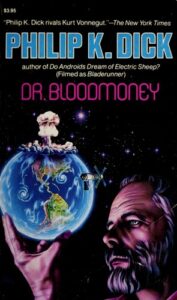
By PHILIP K. DICK (Carrol & Graf; 1965/1988)
Quite simply, one of the late Philip K. Dick’s greatest novels. DR. BLOODMONEY was published around the same time as the mid-period PKD masterworks MARTIAN TIME-SLIP (1964) and THE THREE STIGMATA OF PALMER ELDRICH (1965), and shares many of their attributes, including a consistently gripping and unpredictable narrative, a gallery of well fleshed-out, multi-dimensional characters, and an air of mind-rattling weirdness that’s unique to the author.
What DR. BLOODMONEY also has in its favor is a stream of constant invention. It’s among the most feverishly imaginative of PKD’s narratives, exploring a post nuclear Marin County in the far-off year 1988. This environ is lorded over by Hoppy Harrington, a psychically endowed fellow lacking arms and legs whose powers, and evil nature, increase exponentially after the bombs fall. There’s also Walt Dangerfield, an astronaut-disc jockey who’s shot into space in the beginning of the book, and so finds himself endlessly orbiting the Earth after it’s nuked, helping the survivors cope by broadcasting classical music. It seems that Hoppy’s talents include the ability to perfectly mimic people’s voices, and he seeks to use this talent to take over Mr. Dangerfield’s position.
There are many more interesting characters on hand, including Dr. Bruno Bluthgeld, a.k.a. Dr. Bloodmoney, a schizophrenic physicist who’s convinced his delusions started the war (which may indeed be the case), as well as the modest TV salesman Stuart McConchie and Edie Keller, a little girl with Bill, a half-formed twin stuck in her stomach who has psychic powers that rival those of Hoppy. It’s Bill who, in a typically Dickian refutation of conventional heroism, ultimately rises to the occasion and takes on Hoppy, something none of the non-mutant humans are able to accomplish.
There’s much more, of course, in one of Dick’s most densely packed, wide-ranging narratives, yet the book (in contrast to less successful Dick fare like THE SIMULACRA or COUNTER CLOCK WORLD) never feels cluttered or confused. Rather, it’s a confident, streamlined affair that blends the epic and the intimate (with several teasing hints that the whole thing might be a schizophrenic delusion).
The Carroll & Graf edition of this novel contains a most illuminating 1980 afterword by Dick himself. He muses at length on what he got wrong in the novel, mainly his predictions of how and when the world would end (“I was expecting it any time; I kept checking my watch”), and details the many autobiographical tidbits he included (“This is a work of fiction. And yet at a certain level it is not”). Dick also makes sure to underline the book’s celebration of “genuine humans doing genuinely human things” because “There are no supermen in this novel. There are no heroic deeds. There are some very poor predictions on my part…but about the people themselves and their strength and tenacity and vitality…there I think I foresaw accurately.”