
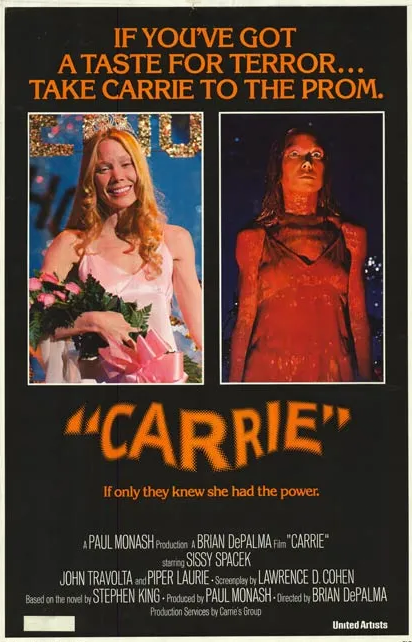
 The first, and best, adaptation of Stephen King’s debut novel. Published in 1974, the CARRIE novel had a concentrated simplicity (an attribute that appears to have deserted King) and a story, about a telepathic teenager burdened with an uber-religious mother and bullying schoolmates, which continues to resonate. The director of this 1976 film adaptation was Brian De Palma, who in a very rare instance actually outdid the source text, something King himself has admitted, claiming his novel “seems clear enough and truthful enough in terms of the characters and their actions, but it lacks the style of De Palma’s film,” which is apparently “more cutting” in its critique of high school culture.
The subject is a severely maladjusted girl named Carrie White (Sissy Spacek). She’s first seen in her high school gym, in a lyrical shower scene whose slow motion sensuality is abruptly shattered when blood is seen running down her legs. She’s having her first period, and her gym-mates react by pelting Carrie with tampons and sanitary pads and chanting “Plug it up!” This event has a most unexpected result, as Carrie finds she’s developed telekinetic powers, indicated by blowing up a lightbulb and, a bit later, causing a bratty kid (Cameron De Palma) to crash his bike.
Carrie’s troubles are aggravated by her outrageously pious mother Margaret (Piper Laurie), who’s transferred all her fears and ignorance to her daughter. As if this weren’t enough, Carrie and Margaret live in a seriously creepy house whose interior is filled with distinctly church-like architecture (courtesy of strikingly oft-kilter art direction, accomplished in part by Jack Fisk, a longtime David Lynch friend and crewmember, and also Sissy Spacek’s husband).
Back in school, Sue (Amy Irving) becomes suffused with guilt over her role in the shower incident and convinces her boyfriend Tommy (William Katt) to ask Carrie to the prom. Carrie is initially reticent but accepts, not realizing that the school’s foremost mean girl Chris (Nancy Allen), who blames Carrie for their gym teacher (Betty Buckley) expelling Chris, is cooking up a macabre gambit involving Carrie being crowned prom queen and having pig blood dumped on her. Chris is unaware of Carrie’s powers, which run riot at the prom and later at home, where a miniature statue of the martyred St. Sebastian proves quite prophetic in how Carrie deals with her mom.
Brian De Palma’s direction may be too formalistic and self-conscious for its own good, with a retinue of attention-getting techniques—slow motion, a twirling camera, split diopter lenses, etc.—reminding us that the man began his career as an experimental filmmaker, and a few minor but annoying miscalculations—namely a lame attempt at comedy in a tuxedo store and a number of laughably dated phrases/fashions/etc.—further weaken the film. Yet the thematic content, encompassing weighty topics like ostracization, revenge and feminine power (all the film’s major power wielders are female), far outshines the surface bravura, and the justifiably famous prom blow out, a horrific yet undeniably satisfying melee where Carrie gets her just revenge, remains one of De Palma’s greatest-ever set-pieces (although, as De Palma himself as admitted, the use of split screen is distracting).
The screenplay by Lawrence D. Cohen (who went on to script the Stephen King adapted miniseries IT in 1990 and THE TOMMYKNOCKERS in 1993) artfully simplifies and streamlines the epistolary formatted King novel. Yet it’s the uniformly excellent performances, many of them by up-and-coming cast members like Nancy Allen, John Travolta and Amy Irving, that really make the film, which ultimately functions as a two-hander between Sissy Spacek as Carrie and Piper Laurie (returning from a 15 year screen absence) as Margaret. Spacek projects a near-otherworldly aura, while the ferocious and disarmingly charismatic performance of Laurie rendered her an instant genre icon, and very nearly made CARRIE an all-time classic, which it may just be anyway.
Vital Statistics
CARRIE
United Artists
Director: Brian De Palma
Producer: Paul Monash
Screenplay: Lawrence D. Cohen
(Based on a novel by Stephen King)
Cinematography: Mario Tosi
Editing: Paul Hirsch
Cast: Sissy Spacek, Piper Laurie, Amy Irving, William Katt, Nancy Allen, John Travolta, Betty Buckley, P.J. Soles, Sydney Lassick, Stefan Gierasch, Priscilla Pointer, Michael Talbott, Doug Cox, Harry Gold, Noelle North, Cindy Daly, Deirdre Berthrong, Anson Downes, Rory Stevens, Edie McClurg, Cameron De Palma