
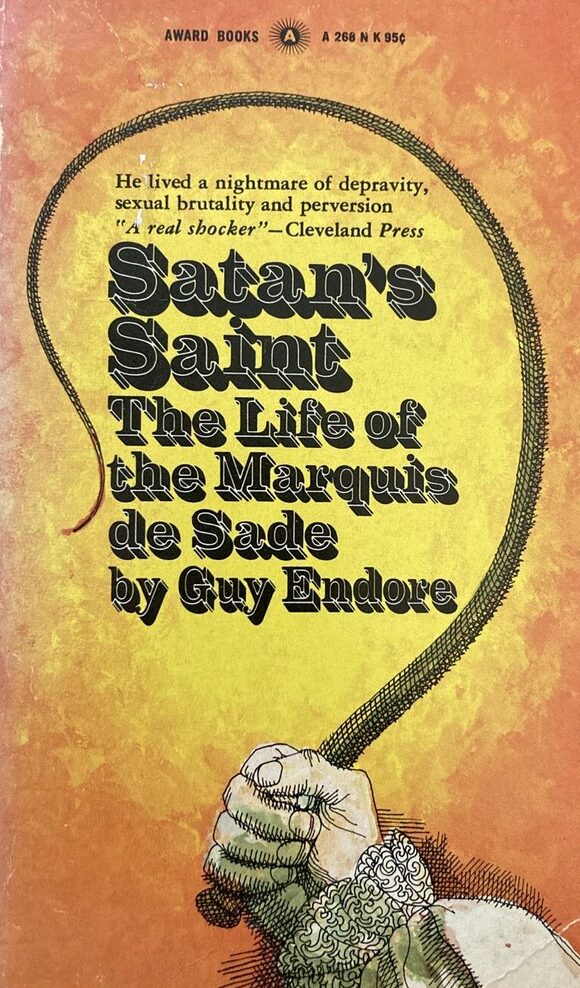
 By GUY ENDORE (Award Books; 1965/67)
This novelized biography of the Marquis de Sade has been widely neglected, but I say SATAN’S SAINT demands a rediscovery. It was written by the American novelist/screenwriter Guy Endore (1900-1970), whose other books include the gory, sexy horror classic THE WEREWOLF OF PARIS (1933) and the premiere English translation of Hanns Heinz Ewers’ decadent classic ALRAUNE (1911), which prove that Endore was the ideal choice to write about the subject of this book, a nobleman, libertine and author of some of the most scandalous writings of all time.
SATAN’S SAINT is an eccentric yet deeply compelling document that memorably captures Sade and the time in which he lived: France in the so-called “era of enlightenment.” It’s related largely in Sade’s own voice, taken from journals, letters and fictionalized recollections. This mixture of fact and invention works better than you might expect (with Endore arguing in an opening harangue that “Although many of the documents in SATAN’S SAINT have been invented by the author, it is his contention that a rich context of fact supports their validity”), with the “Divine Marquis” emerging as a multi-faceted personage who inspires horror and admiration in equal measure.
Born into the “lap of luxury,” the youthful Sade “took it for granted that everything had been created by nature and by society for only one purpose: to minister to my enjoyment.” His world, however, was shattered when his mother elected to send him away to live with his grandmother, a woman whose child-rearing instincts were overly tender, with she “blind to all my faults, so that instead of arming me to fight my vices, she delivered me up to them as a slave for the rest of my life.” That life came to encompass revolutionary fervor, with Sade whipping up a crowd while imprisoned in the Bastille (a mere two weeks before it was stormed); personal derring-do, as when he broke out of a mountaintop prison in Sardinia; and tragedy, with the Château de Lacoste, Sade’s ancestral castle home, getting destroyed in the French Revolution.
Endore includes excerpts from Sade’s fiction to help advance the narrative, as well as oft-fictionalized diary entries from others, most notably Anne-Prospere, Sade’s stepsister with whom he briefly eloped. Endore makes that episode the centerpiece of his book, with Anne-Prospere’s diary entries revealing a deep-seated revulsion for Sade that gradually turns to fascination, and then affection.
My only real complaint is with the final section, detailing Sade’s incarceration and death in the Charenton insane asylum (the setting of Peter Brook’s MARAT/SADE) following multiple scandals and arrests. In this portion the author abandons the straightforward narrative of the rest of the book in favor of an extended psychological dissertation. Included is a 21 page transcript of 1962 UCLA speech given by Endore that encompasses war, sexuality and Oscar Wilde, and ultimately accomplishes nothing other than distraction.
At least Endore concludes his study on an appropriate note. Specifically, SATAN’S SAINT ends with the musings of a doctor studying the skull of the Marquis de Sade, and concluding that it belonged to “a saintly man, that’s certain.”