
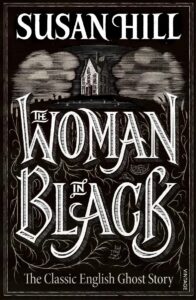
By SUSAN HILL (Vintage; 1983/2016)
A quintessential example of Quiet Horror: elegant, old-fashioned, and subdued, not to mention very English in its setting and outlook (note the tagline promising a “Classic English Ghost Story”). The subject of numerous stage and screen adaptations, and a mainstay in English school curriculums, THE WOMAN IN BLACK is the most famous novel by Susan Hill, who offers up a concentrated no-frills ghost story that deliberately harkens back to classics of the form (as is made explicit by a chapter heading called “Whistle and I’ll Come to You,” a title that will resonate with old school horror buffs), and comes very close to matching them in shivery excellence.
It begins in deceptively cozy fashion, with the widowed solicitor Arthur Kipps having a Christmas Eve celebration in which, per English tradition, ghost stories are told. Kipps, who assures us that “I did not believe in ghosts” (a claim that by the end of the book no longer holds true) is taken aback by the request that he tell a ghost story of his own, but is inspired to write about an incident from his earlier years that happens to involve ghosts.
Involved is the summoning of Kipps to the rural town Crythin Gifford, to settle the affairs of the recently deceased Alice Drablow. At her funeral Kipps sees a mysterious woman dressed all in black, prior to being taken to the Eel Marsh House where Mrs. Drablow resided, a forbidding structure bordered by untamed swampland. This leads to all manner of uncanny incidents suggesting the house and surrounding area are haunted: rhythmic bumps, childish screams and further sightings of the woman in black, who is evidently a ghost.
Kipps grows obsessed with learning the story of Eel Marsh and Mrs. Drablow, and uncovers a most horrific history involving a child born out of wedlock, a shocking death and an undying revenge. That latter aspect eventually comes to disrupt Kipps’ own life in a powerfully wrought, and very dark, ending.
The elegant and refined air of Susan Hill’s prose (also on display in the stunning I’M THE KING OF THE CASTLE) directly recalls the old school gothic fiction referenced by THE WOMAN IN BLACK, and makes for a strong and atmospheric reading experience. The protagonist, an impossibly sensitive fellow who tends to be overcome by horror, is a bit too fragile for my tastes, but the mere fact that he registers as a three dimensional personage (as rendered by an author of a different gender) is a definite plus.