
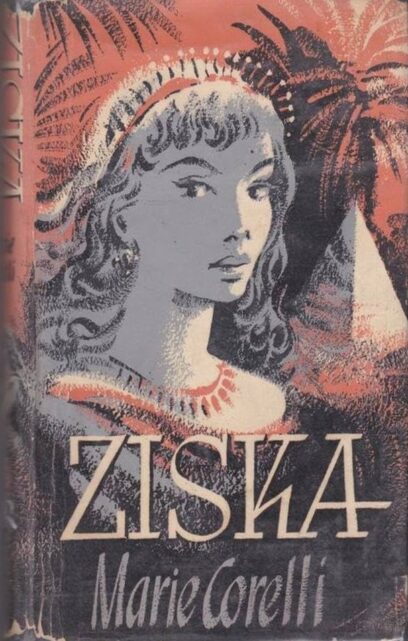
 By MARIE CORELLI (Bristol Arrowsmith; 1897)
If the English novelist Marie Corelli (1855-1924) gets mentioned at all these days, it’s usually in a disparaging or even mocking manner. Her 1895 supernatural tinged bestseller THE SORROWS OF SATAN was the number one entry on R.S. Hadji’s “Worst Stinkers of the Weird” ranking in the TWILIGHT ZONE MAGAZINE’s seminal “Fantasy Five-Foot Bookshelf” feature; ZISKA: THE PROBLEM OF A WICKED SOUL, another Corelli bestseller with supernatural overtones, appears to have escaped such vitriol, although it isn’t especially well known.
If anything, ZISKA harkens back to Corelli’s debut novel A ROMANCE OF TWO WORLDS (1886), a pantheism-infused mystical reverie that posited nothing less than a new, electric based model of Christianity. The reincarnation centered ZISKA is similarly oriented but far less radical in its approach.
The setting is late 1800s Cairo, which Corelli, a dedicated society-basher, characterizes thusly: “The ubiquitous Britisher and the no less ubiquitous American…were busily engaged in the work of reducing the city, formerly called Al Kahira or The Victorious, to a more deplorable condition of subjection and slavery than any old-world conqueror could ever have done.” It’s there that, in the confines of a luxury hotel, we’re introduced to one Denzil Murray, a handsome Scotsman, and his best friend, the renowned French painter Armand Gervase.
Also introduced is the impossibly alluring Princess Ziska, who enraptures both men but only has eyes for Gervase, who she claims to have known for a long time “in spirit.” He for his part can’t shake the feeling that he’s seen the princess before, and finds himself completely consumed with her, yet when he paints her picture what results is a “strange and awful face…a thing of distorted passion and pain!” Ziska, I should add, is obsessed with a little-known Egyptian warrior named Araxes, who she claims is interred in the Pyramids, and a dancer named Ziska-Charmazel, who died by Araxes’ hand.
The hidden narrative powering all this is hinted at by an early passage positing that “many a criminal undiscovered by the police is haunted by a seeming Person—a man or a woman—who is on terms of intimacy with him…yet is truly nothing but the ghost of his victim in human disguise, sent to drag him gradually to his well-deserved, miserable end.” This (to spell things out) is precisely what is occurring with Ziska and Gervase, with he being the reincarnation of Araxes and she Ziska-Charmazel, who’s looking to avenge her murder.
It’s all frankly a mite dull. The narrative is intellectually grounded (not a wise move when telling a spiritually oriented story), with lengthy digressions about love, male fallibility (a favorite Corelli subject) and ghosts, and related largely in the form of overheard conversations. It takes until chapter XVI (until near the end of the novel) for things to really get going in a hallucinatory encounter inside the Great Pyramid, which contains all the sensational and horrific aspects I was anticipating in the rest of the novel.
A recent republication of ZISKA contains a 2009 introduction by Curt Herr, who compares the novel to the two major horror texts of the Victorian era—DRACULA by Bram Stoker and THE BEETLE by Richard Marsh—and calls for “a reconsideration of Corelli as a major figure in Victorian popular culture.” About the DRACULA-BEETLE comparison I strongly disagree, as ZISKA really can’t hold a candle to either, but a reconsideration of Corelli’s none-too-exalted literary status is something I’m all for.