
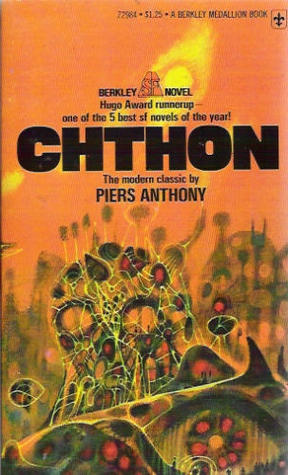
 By PIERS ANTHONY (Berkley Medallion; 1967/75)
One of the foremost “dangerous visions” of the late 1960s was this once-shocking interplanetary reverie, the first novel by the prolific fantasist Piers Anthony. As with other SF envelope pushers of the time like THORNS and BUG JACK BARRON, it’s difficult nowadays to figure out what upset 1967 readers so much about CHTHON; the most likely culprits are the sexual content, which is frank (albeit nonexplicit), and a last act twist that adds an entirely new, perverse dimension to a work that even without it isn’t lacking in multi-dimensionality.
If anything, CHTHON is a bit overstuffed, which was apparently a major reason for its unenthusiastic reception. Regarding that reception, Anthony’s major takeaway was that “a novel needs to appeal to the readers rather than to the author” (hence the more commercially oriented fantasies Anthony has since turned out).
The first in the two-book Aton saga (which concluded with 1975’s PHTHOR), CHTHON takes the form (Anthony claims) of a doubled hexagon. The protagonist Aton Five’s existence in the eponymous “prison of the damned” is the major structural component, interspaced by flashbacks and flashforwards whose events parallel one another in an apparently hexagonal manner.
The Chthon prison, inspired by Anthony’s late 1950s military service, consists of maze-like subterranean tunnels where garnet is mined by inmates who get rewarded for their efforts by having food lowered down from above, but have to brave all manner of inhuman creatures. Aton becomes interested in staging an elaborate escape and corrals several fellow prisoners to assist in the attempt.
There follows the first of many flashbacks, to the seven-year-old Aton meeting an alluring minionette, or soul-devouring siren, named Malice on the planet Hvee, where the young Aton was raised by his widowed father. Aton grows up obsessed with Malice (unaware of her true identity, whose third act reveal is a stunner), with she being the major reason for his imprisonment in Chthon. That imprisonment turns out to be a blessing in disguise, as for despite all the hardship Aton faces, including near-starvation and zombified companions, he emerges from the ordeal in a much better position than before to ferret out the nature of minionette’s hold on him.
There’s much more to this insanely wide-ranging account, including a contagion known as The Chill that’s sweeping through the galaxy, the fact that Aton has abilities far beyond those of his fellow humans, and a psychedelic air appropriate to 1967 that becomes especially pronounced in the overtly hallucinatory final third. Does it all mesh? Nope, but it does make for a memorably oft-kilter concoction that’s almost worth the effort it takes one to read it.