
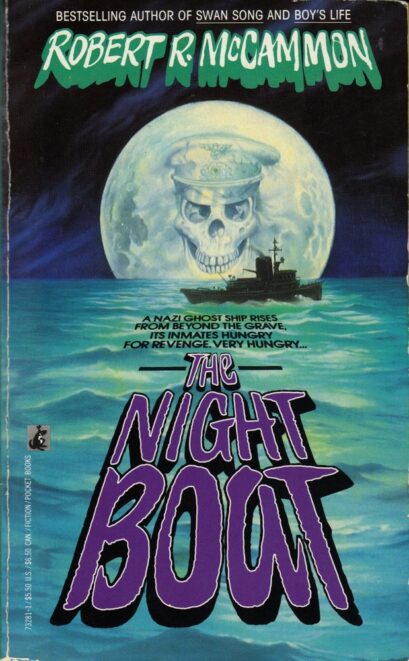
 By ROBERT R. McCAMMON (Pocket; 1980/88)
It’s far from the best of Robert R. McCammon’s early horror novels, but THE NIGHT BOAT has, at the very least, an irresistible premise involving a sunken Nazi submarine rising to the surface of a Caribbean island community, where the sub’s zombified inhabitants wreak gory havoc. Nautical horror, I should add, was quite popular at the time of this book’s initial 1980 publication, which was preceded by GHOST BOAT (1978) and followed by THE JONAH WATCH (1981), in whose company THE NIGHT BOAT fits reasonably well.
Characterization isn’t the reason one reads novels like this one, but THE NIGHT BOAT’s characters are reasonably well delineated. There’s David Moore, a hotelier in the tiny island community of Coquina who while diving in an ocean abyss sets off an unexploded depth charge, which unearths a sunken German U-boat that promptly rises to the surface. Enter Steven Kip, Coquina’s constable of police, who after the submarine is safely(?) moored in a boatyard, and a couple mysterious deaths occur, decides to explore the U-boat’s interior. He does so together with Moore, who once again proves quite troublesome, unleashing the sub’s undead inhabitants, an angry bunch harboring an insatiable hunger for bleeding flesh, preferably of the human variety.
Among the other characters (who are so numerous McCammon is still introducing them well into the second and third acts) are Boniface, a voodoo priest with a strong connection to the submarine’s initial sinking; Jana Thornton, a fetching British historian who fills in the details of the submarine and its forbidding commander while providing Moore with a most agreeable romantic partner; and the ageing ex-Nazi Frederick Schiller, the only non-zombified survivor of the U-boat crew, who makes sure to involve himself in the drama surrounding his former wartime station.
These people’s exploits are frankly pretty predictable, down to the final explosive laden assault on the U-boat and its inhabitants, albeit with some superbly drafted horror set-pieces of the type in which McCammon specialized in his early days (with perhaps a few too many mentions of skin-tightening and spine-afflicting shivers). It lacks the brilliance of McCammon’s later novels, which at their best can stand alongside most modern fiction, horror or otherwise. THE NIGHT BOAT (McCammon’s second novel to be written, but his third to be published) isn’t that strong, but for such an early effort it’s pretty damn good.