
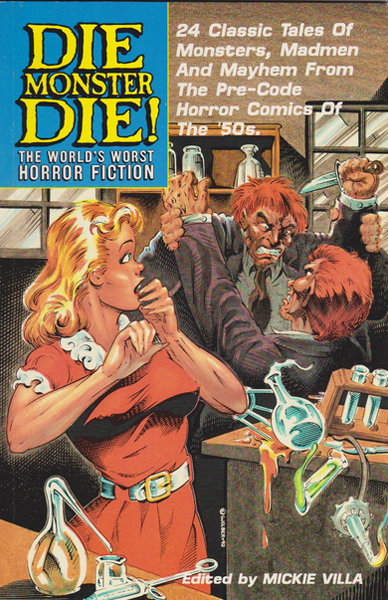
 Edited By MICKIE VILLA (Malibu Graphics; 1991)
The “World’s Worst Horror Fiction”…? That may well be true of the 24 stories collected in DIE MONSTER DIE!, whose editor Mickie Villa took as his source the textual filler of 1950s horror comics like CHAMBER OF CHILLS, WITCHES TALES and TOMB OF TERROR. As explained in an introductory essay by Jim Korkis, 20th Century comic books had to be designated as magazines in order to attain second class mailing privileges in the US, resulting in the inclusion of text-only stories like the ones collected here. The uncredited authors of these tales included big names like Mickey Spillaine and Harry Harrison, as well as, in Korkis’s words, “whoever was willing to write one, including relatives of staff.”
The level of literary agility on display is indicated by the opening sentence—“He was locked in the tomb with It!”—of a story titled, appropriately, “It!” Other standout lines found in DIE MONSTER DIE! include “The madman looked down into the pit of death,” “he had left with a wife and returned with a ghost” and “only the cold, winking stars about him were mute witnesses to the terrible blackness that now closed about him—forever!” The absolute worst is saved for last, specifically the final line of the final story “Weather Forecast,” about a weather forecaster whose dreams determine the following day’s weather becoming flummoxed when he has no dream—because “You see, that was the day the world came to an end!”
There are attempts at quality writing. “Bury Me Deep,” about a grieving widow whose supposedly dead wife continually turns back up, isn’t what I’d call “good,” but is at least competent (which places it several leagues above most of its fellows). “Unposted” evidences some ingenuity in its account of interstellar prospectors encountering an extraterrestrial critter they christen Angel, with the story related in the form of a letter whose contents grow increasingly hysterical as its author realizes Angel isn’t as angelic as it initially seems. “The Cursed Diamonds” has little to recommend outside a truly nasty, morbid narrative involving the leader of a trio of thieves looking to ward off a deadly ant swarm by killing his companions, thus providing the ants with two distractions.
Ultimately, any criticisms one might have about these stories are moot because, quite simply, their authors evidently didn’t try very hard. Indeed, based on what’s contained here I’d say the time spent writing the stories was about equal to how long it takes to read them.