
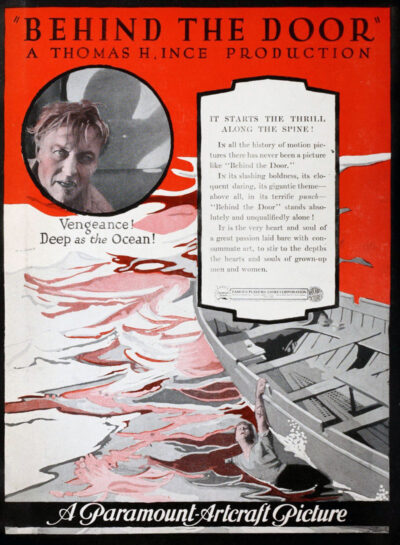
 A hard-hitting example of silent horror, hailing from 1919, that was “lost” for nearly a century. Directed by the prolific silent-era helmer Irvin Willat (1890-1976), BEHIND THE DOOR was inspired by a 1918 McCLURE’S published story by Gouverneur Morris, starred the popular early 20th Century leading man Hobart Bosworth (1867-1943) and was extremely controversial in its day. Restored by the San Francisco Silent Film Festival in 2016, the film contains quite a few elements that haven’t survived, leaving us with a 70 minute abbreviation with (as is often the case with silent movie restorations) several crucial plot points conveyed by still photos.
On “the Wind-Swept coast of Maine” in the future year 1925, the broken-down Captain Oscar Krug (Hobart Bosworth) returns to visit a long-deserted taxidermy shop he once owned. Upon finding a handkerchief that belonged to his deceased spouse Alice Morse (Jane Novak), Krug flashes back to the year 1917.
It was then, we learn, that Krug asked for Alice’s hand in marriage, against the wishes of her banker father (J.P. Lockney). Also arrayed against Krug are his fellow townspeople, who disapprove of his Germanic last name because America has just entered WWI. Krug proves his mettle by fighting off his attackers and joining the military, marrying Alice on that very day.
Krug leaves Maine aboard the Perth steamer, upon which Alice insists on stowing away. She and Krug nearly lose their lives when a German U-boat torpedoes the Perth, getting trapped on the open sea and rescued, it would appear, by the crew of the very U-boat that sunk their ship; however, only Alice is saved, with Krug left to fend for himself.
A few months later, Krug, having resumed his post as ship captain, spots the offending submarine and has his men fire upon it. He makes sure to personally rescue the U-boat’s commander (Wallace Beery), who reveals that Alice was raped and killed by him and his crew. This news enrages Krug, who utilizes his taxidermy skills in a truly horrific act of revenge.
The grisly details of that revenge are kept discreetly offscreen (the Gouverneur Morris story is a bit more forthcoming in describing Krug’s handiwork, which leaves his victim resembling “an anatomical model for a medical museum—a model to show the muscular system of the human body—executed in a clear and glistening pink enamel”), but register quite strongly nonetheless. The overpowering grief and disquiet felt by Krug are extremely vividly portrayed, bequeathed by romantic scenes that border on excessively melodramatic—or, if you prefer, sappy—but which adequately convey the intensity of an affection that lasts beyond death (as indicated by the final scenes, in which ghosts come into play).
Contained are some well-delineated action sequences and a strong lead performance by Hobart Bosworth, but psychological upset is the film’s true driving force, and it’s conveyed with a harshness and brutality that brought an entirely new, none-too-pleasant dimension to early 20th Century cinema.
Vital Statistics
BEHIND THE DOOR
Paramount Pictures
Director: Irvin V. Willat
Producer: Theo H. Ince
Screenplay: Luther Reed
Cinematography: J.O. Taylor
Cast: Hobart Bosworth, Jane Novak, James Gordon, J.P. Lockney, Otto Hoffman, Wallace Beery