
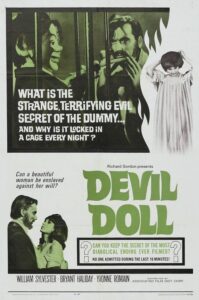
This, I say, is the finest evil ventriloquist doll movie on the market. A modestly mounted 1964 British American co-production that cribbed from George du Maurier’s immortal 1894 novel TRILBY (containing the character Svengali) and the DEAD OF NIGHT (1946) episode “The Ventriloquist’s Dummy,” DEVIL DOLL was inspired by a 1951 story by Frederick E. Smith. Its director was Canada’s late Lindsay Shonteff (1935-2006), a protégée of Sidney J. Furie (who reportedly advised Shonteff throughout the production of DEVIL DOLL), and the executive producer was Richard Gordon (1925-2011), a legendary figure in the exploitation film world whose credits include FIEND WITHOUT A FACE (1958), FIRST MEN INTO SPACE (1959) and BIZARRE (1970).
DEVIL DOLL (1964) Trailer
In DEVIL DOLL the Great Vorelli (Bryant Haliday) headlines a popular London based stage show involving a dummy named Hugo (the same name, FYI, of the dummy in DEAD OF NIGHT), which Vorelli keeps locked in a cage when they’re not performing. Mark English (William Sylvester), an American reporter, is assigned to write a newspaper article on Vorelli, and attends the show with his wealthy GF Marianne (Yvonne Romain), who ends up getting hypnotized onstage by Vorelli. Even more strikingly, Vorelli has Hugo get up and walk around the stage.
Desperate to find a rational explanation for Hugo’s behavior, Mark gets Marianne to invite Vorelli and Hugo to a party her relatives are throwing. At the party Hugo once again moves of his own volition, and threatens his master with a knife. More trouble occurs when Vorelli seduces Marianne and leaves her in a semi-coma, and Mark is paid a nocturnal visit by Hugo, who implores “Help me…1948…Berlin.”
An investigation of Vorelli’s past reveals that he’s a disgraced medical doctor who had an assistant named Hugo. After stabbing Hugo onstage, Vorelli transferred his soul into the dummy, which is now under Vorelli’s absolute control. This is proven when Vorelli induces Hugo to murder his suspicious assistant Magda (Sandra Dorne). Vorelli is planning on transferring Marianne’s soul into a female doll, but Hugo is growing increasingly restless, and about to push back against his master.
The film is noteworthy for its highly noirish black and white illumination that despite pedestrian camerawork imparts an authentic sense of nightmarish frisson. The film has been criticized for over-relying on close-ups, but those close-ups are undeniably affecting, with Hugo the dummy’s beaked nose and prominent cheeks allowing cinematographer Gerald Gibbs to cast some very expressive shadows. The best scenes are those between Hugo and Bryant Haliday, visualized via odd angles and a haunting percussive undertone (courtesy of public domain library tracks).
Also deserving of a singling-out is Bryant Halliday (1928-1996), a producer, businessman (he was the co-founder of Janus Films, now known as the Criterion Collection) and sometime actor. The Great Vorelli was almost certainly Halliday’s standout role, accomplished with great creepiness and charisma. It’s too bad, then, that the bland William Sylvester played Mark is given so much screen time.
Vital Statistics
DEVIL DOLL
Associated Film Dist. Corp.
Director/Producer: Lindsay Shonteff
Screenplay: George Barclay, Lance C. Hargreaves
(Based on a story by Frederick Escreet Smith)
Cinematography: Gerald Gibbs
Editing: Ernest Bullingham
Cast: Bryant Haliday, William Sylvester, Yvonne Romain, Sandra Dorne, Nora Nicholson, Alan Gifford, Karel Stepanek, Francis de Wolff