
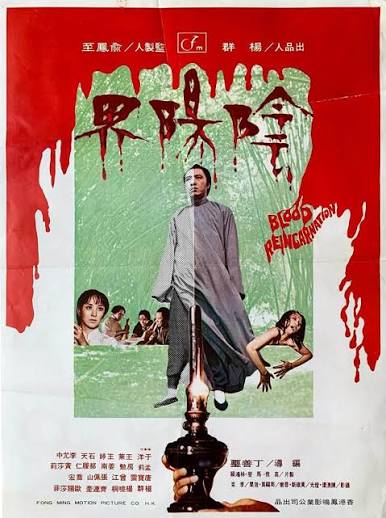
 An example of Hong Kong anthology cinema, consisting of thematically linked shorts contained in a 98 minute whole. Those short films were usually features that, in a not-at-all-uncommon occurrence in 1970s Hong Kong cinema, were never completed. BLOOD REINCARNATION (Yinyang jie; 1974), a three-parter “based on the Cantonese legend and asks people to do good deeds,” hailed from the late H.K. Fong Ming Motion Picture Company, and was directed by the Shaw Brothers veteran “Shanxi Ding,” a.k.a. Shan-Hsi Ting (1936-2009).
The first segment is “The Treasure,” in which Ah Heung (Shirley Huang) is giving birth, with her recently deceased godmother Gan Niang (Mama Hung) present in a bed below her. A flashback reveals that some time earlier Gan Niang, Ah Heung and her husband Ah Tak (Dean Shek Tin) dug up a barrel supposed to contain untold wealth, only to find not treasure but a deceased person’s remains, with Gan Niang killed in the melee. Back in the here-and-now blood drips onto the old woman’s corpse and Heung’s baby, a boy, is born; everything seems to be all right until the infant, bearing the face of Gan Niang, avenges the old woman’s murder.
In “The Wanton,” a murderous couple are once again at the forefront. Liu Zi (Henry Yu Yang) and Er Niang (Mang Li) are spotted in an adulterous coupling by Er’s husband (Chiang Han), resulting in them locking him in a case they throw into the sea. Following this, strange things begin to occur: Liu finds he can’t quench his thirst or cease peeing, while his none-too-better half nearly drowns in a bathtub and has horrific nightmares involving bloody wounds and spinning beds. It concludes with Liu somehow becoming possessed by a nearby dog(!), which entails panting, crawling on all fours and biting his beloved.
In “Lau Tin Sok,” the third and longest segment, the kindly doctor Lau (Peter Yang Kwan), who after attending to the son of the mercenary Chiu (Ting-Ken Shih) and concluding that “Your son is suffering from sickness” is sentenced to be beheaded for a murder he didn’t commit. Chiu, it turns out, is to be Lau’s executioner, but before carrying out the decapitation he instructs Lau on how to achieve “Blood Reincarnation.”
The instructions are followed, and a ghostly Lau returns to his wife (Tang Pao-Yun) and young child, but he avoids sunlight, doesn’t cast a shadow and can’t gaze upon Buddha statues (because “ghost can’t meet the Buddha. People should worship Buddha so they can avoid ghost!”). Furthermore, he only has seven days before his body decays.
In true Hong Kong movie fashion, a frenzied and hysterical tone, bolstered by ultra-kinetic action movie pacing, unhinged emoting and much assorted mayhem (including a live chicken getting decapitated), is established early on and maintained throughout. This helps to paper over the crumminess of the special effects and overall lack of anything resembling character development (with the people in this film displaying very little in the way of motivation or behavioral consistency).
In fact, all the noise and sensation, which is continuous in the first two segments and toned down only somewhat in the third, serves the same function as that of Hollywood blockbusters: to keep the viewer in a state of constant distraction so s/he won’t notice the script deficiencies, of which BLOOD REINCARNATION contains more than its share.
Vital Statistics
BLOOD REINCARNATION (Yinyang jie; 1974)
H.K. Fong Ming Motion Picture Company
Director: “Shanxi Ding” (Shan-Hsi Ting)
Producer: Fung-chi Yue
Screenplay: Yan-tse Chou, Shan-Hsi Ting
Cinematography: Chris Chen Ching-Chu
Editing: Cheung Kwok-kuen
Cast: Shirley Huang, Mama Hung, Dean Shek Tin, Henry Yu Yang, Mang Li, Chiang Han, Peter Yang Kwan, Au-Yang Sha Fei, Tang Pao-Yun, Wang Lai, Ting-Ken Shih, Chang Pei-Shan, Roy Chiao, Kenneth Tsang, Henry Yui Yang