
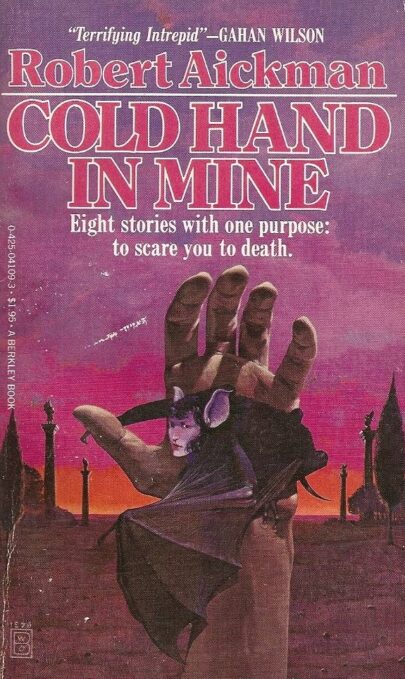
 By ROBERT AICKMAN (Berkley; 1975/79)
England’s late Robert Aickman (1914-1981) was one of the 20th Century’s greatest, most individual writers of horror fiction, yet he was (and remains) little known on this side of the pond. His 1975 collection COLD HAND IN MIND represented one of the brief periods in which American publishers were willing to take a chance on Aickman’s work (the posthumously published WINE-DARK SEA, which appeared in 1988, was another). Not that the New York based Berkley Books seemed to fully comprehend what they were putting out, as evidenced by the classification of the book as “Science Fiction” and the wholly misleading tagline “Eight stories with one purpose: to scare you to death.”
In actuality, Aickman’s aims were far more subtle and elusive. His elegantly drafted stories—mini-novellas, actually—generally took the form of extended character studies that opened with a lengthy background sketch of an extremely introverted individual, leading up to a series of bizarre and irrational events that can be intended as an externalization of the protagonist’s subconscious anxieties. As the narrator of “Meeting Mr. Millar” proclaims, “I believe mine to be the narrative of a haunted man rather than of a haunted house,” which could refer to the title character, a creepy fellow disrupting a London based rooming house, or the narrator himself.
The haunted man designation also applies to the virginal narrator of “The Swords,” who becomes involved with an alluring young magician’s assistant/prostitute named Madonna, the object of a stage show in which audience members are invited to stick swords in her. Rosa, the island dwelling protagonist of “The Real Road to the Church,” is more sexually experienced but just as introverted as the previous guy, and is done in by, among other things, extreme isolation.
Aickman rarely ever bothered explaining his enigmas, as is elucidated by the Sacheverell Sitwell quote that begins this book: “In the end it is the mystery that lasts and not the explanation.” He also refrained from standard horror tropes, although there is one on display in “Niemandswasser,” about a lake whose properties go far beyond the natural—this being an Aickman story, you can be sure that the effects of the lake on a naive German prince are primarily psychological—and another in “Pages from A Young Girls’ Journal,” which takes the form of a diary by a 19th Century British lass becoming a vampire during a sojourn in Italy, with a supporting cast that includes Lord Byron and Percy Shelley.
More typical of Altman’s sensibilities is “The Hospice,” a vaguely Kafkaesque reverie about a recluse named Maybury stuck in a secluded hospice whose proprietors and guests do some mighty strange things. “The Same Dog” features a guy named Hilary who’s haunted by a young girl who made a huge impression on his childhood, and concludes with what might be taken as a throwaway joke.
The final story, “The Clock Watcher,” is COLD HAND IN MINE’s most fanciful entry. It’s set in the years following WWII, with yet another severely introverted narrator, this one a war veteran who marries a mysterious German woman named Ursula. The daughter of a clock maker, Ursula has an unhealthy obsession with clocks, even though she apparently “never had the least idea of time.” She collects clocks of every conceivable stripe, which are meticulously maintained by a mysterious someone of whom the narrator never manages to catch a glimpse. His ultimate conclusion: “Everything to do with time is hideous” in a powerfully oft-kilter depiction of time, and consciousness, turned wildly out of joint.