
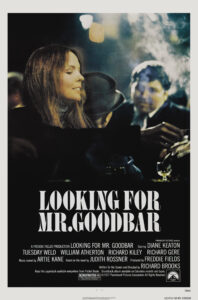
This isn’t a horror film per se, but it did rank number 5 in a 1981 “Scariest Films Ever Made” listing by Stephen King, who described LOOKING FOR MR. GOODBAR (1977) in mock fairy tale terms: “Once upon a time there was a sad girl who picked up men in bars, because when the men came home with her, she didn’t feel so sad. Except one night she picked up a man who was wearing a mask. Underneath the mask he was the boogeyman.”
LOOKING FOR MR. GOODBAR (1977) Trailer
LOOKING FOR MR. GOODBAR’s source was a 1975 bestseller by Judith Rossner (1935-2005), which was based on an actual 1973 case involving Roseanne Quinn, a young schoolteacher murdered by a guy she picked up in a bar. Writer-director Richard Brooks, who was 64 when he made the film version of Rossner’s tale, cast the late Diane Keaton (1946-2025) in the lead (an unknown at the time, but a big star when the film was released due to the fact that ANNIE HALL had played a few months earlier), along with soon-to-be famous supporting players like Richard Gere, Tom Berenger and Brian Dennehy. The film was a sizeable hit (Brooks’ last, as it turned out), and one of the more famous “lost” films, vanishing from circulation for decades due to lapsed music rights; it took until 2024 to get a digital release, courtesy of Vinegar Syndrome.
The novel opened with a newspaper recounting of the murder of one Theresa Dunn by a sex partner, who got upset when she demanded he leave her apartment; the remainder of the book takes the form of an extended recounting of Theresa’s life prior to that fateful night. Brooks does away with that structure, but does include plenty of foreshadowing in the form of flickering illumination and knife play, both of which reach their apex in the horrific finale (during which Stephen King claimed his wife “ran for the women’s room, believing she was going to toss her cookies”).
Theresa is played by Keaton, starting in her college years, when she loses her virginity to Professor Martin Engle (Alan Feinstein). She commences an affair with the married Engle even though he’s a pretentious asshole who “can’t stand a woman’s company right after I’ve fucked her.” This experience, combined with her upbringing—dominated by an ultra-stern father (Richard Kiley), a promiscuous sister (Tuesday Weld) and a childhood bout with polio that’s left Theresa with an ugly scar on her back—has made her a cynical loner who prizes casual sex over real intimacy.
She becomes a teacher of deaf children while stringing along James (William Atherton), an ultra-square slumlord, and Tony (Gere), a sexually overt bad boy. When these two get to be too much she heads out on New Year’s Eve, 1976, and picks up Gary (Berenger), a repressed gay man who (as Stephen King claimed) is initially seen wearing a mask…and events take their inevitable course.
On the whole, this is a strong film, even though Richard Brooks insisted on mixing the type of gritty naturalism that typified 1970s cinema with the 1950s-era melodrama of his earlier films. The documentary naturalism of the bar scenes and eye-opening sexual frankness clashes with the highly stylized fantasy sequences illuminating Theresa’s mental state and oft-histrionic performances (with Richard Kiley as Theresa’s father delivering an especially unhinged climactic soliloquy).
Gere is a standout, acting-wise, in a dangerous and unpredictable turn that remains one of his most memorable performances. Tom Berenger is also quite strong as the Gary the killer, while Diane Keaton can be said to have made the best of a wildly miscast role, although the prospect of this famously sweet and perky performer playing a voracious sex addict was doubtless a major factor in the film’s success.
Vital Statistics
LOOKING FOR MR. GOODBAR
Paramount Pictures
Director/Screenplay: Richard Brooks
(Based on a novel by Judith Rossner)
Producer: Freddie Fields
Cinematography: William A. Fraker
Editing: George Grenville
Cast: Diane Keaton, Tuesday Weld, William Atherton, Richard Kiley, Richard Gere, Alan Feinstein, Tom Berenger, Priscilla Pointer, Laurie Prange, Joel Fabiani, Julius Harris, Richard Bright, Carole Mallory, Robert Burke, Robert Fields, LeVar Burton