
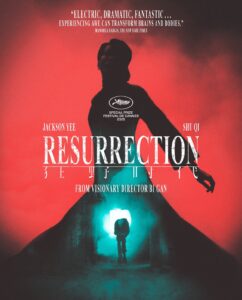
If any film deserves to be graded on a curve it’s the Chinese RESURRECTION (Kuang ye shi dai; 2025), a staggeringly ambitious throwback to Japanese made dream epics like DAY-DREAM (Hakujitsumu; 1964) and TEN NIGHTS OF DREAMS (Yume jû-ya; 2006). I don’t believe RESURRECTION is quite as successful as those films, but it is impressively crafted and original.
RESURRECTION (2025) Trailer
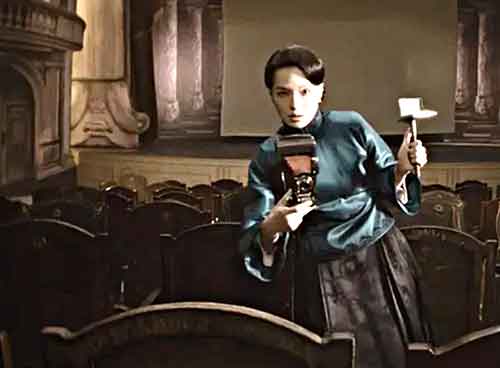
The setting is a future world in which humanity has discovered the secret of eternal life: they’ve stopped dreaming. Some “deliriants,” however, continue to dream clandestinely. One such individual (Jackson Yee) appears in early scenes done up in silent movie style, in a dungeon-like sanitorium wherein a woman (Shu Qi) is confronted with an increasingly hallucinatory reality in which skeletons lounge amid sculptures that include a smiling half moon and a large semi-circle.
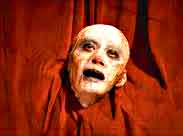
The deliriant is a creepy bald fellow the woman both runs from and assists, until he eventually subsides in a field. Before he can do so she gives him a movie projector that replays his dream life, which takes the form of four dreams in a six-part whole, supposedly organized around the six senses of Buddhist thought (although I’ll confess I had trouble making them out). Each is set in a post-apocalyptic landscape where the deliriant takes on a different guise.
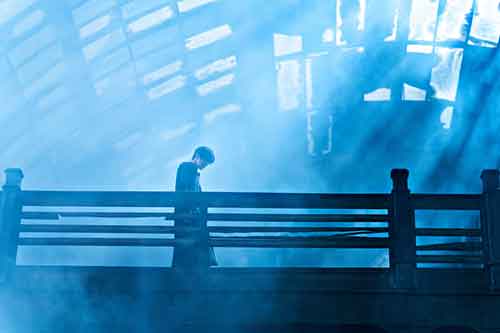
In dream one he’s Qiu, a young singer who’s interrogated by authorities seeking to uncover the clandestine secrets of a musician (Nan Yan) Qiu murdered. The dream comes to involve a suitcase whose contents are apparently capable of driving people mad, a shootout in a hall of mirrors and Qiu ending up a bloody mess.
Dream two sees the deliriant assuming the form of a corrupt ex-monk, residing in a deserted snowbound monastery. Advised by a Buddha statue on how to extract an aching tooth, the ex-monk find himself confronted by the “Spirit of Bitterness,” who takes the form of the ex-monk’s father (Chen Yongzhong). The latter, it seems, met his end at the hands of his son, thus initiating an epic yet disarmingly intimate drama of faith, guilt and forgiveness.
The deliriant becomes a chain-smoking con artist in dream three, seeking to win a contest by convincing people he’s supernaturally endowed. In a brightly lit, bustling metropolis he convinces a young orphan girl (Mucheng Guo) to assist in the scheme by posing as his daughter, a choice that turns out to be far more resonant than it initially seems, as the elderly initiator of the contest (Zhijian Zhang) abandoned his own daughter long ago, and longs for a reconciliation.
The final dream is set on the last day of 1999, in a rainy nocturnal landscape of dingy alleys, dark corners and forbidding stairways. Here several people are celebrating the turn of the millennium, among them the deliriant’s latest incarnation: Apollo, a punk who falls for a young woman named Tai (Gengxi Li). They bond over the shared belief that the apocalypse is at hand, and the increasingly violent celebrations around them would appear to confirm that sentiment. Eventually they escape the mainland on a boat, and as the sun rises Tai reveals that she’s a vampire. Apollo doesn’t care.
(Spoiler Alert!) Eventually the woman from the opening scenes enters into the deliriant’s final dream and sees him off. The film concludes, appropriately, in a spectral movie theater.
Movie-mad inserts are quite common in RESURRECTION, whose major influences were THE CABINET OF DR. CALIGARI (Das Cabinet des Dr. Caligari; 1920) and NOSFERATU (1922). That’s evidenced by the early 20th Century period detail and utilization of old-timey effects like fast motion, time-lapse, stop and reverse motion, etc. This results in a flashy and eye-catching aesthetic (as in the single take Steadicam work and red tinged color scheme of the final segment), and proffers many striking images (such as the writing of Chinese symbols on the surface of a mossy lake with a finger). There are some negatives, however.
The early scenes have problems with focal length and pacing, in a wide shot of a bustling lobby that fails to impart the necessary information (the actors are too far in the distance for their actions to properly register) and is held far too long. Those last two words aptly describe the film itself, whose 160 minute runtime feels vastly inflated, while the studied and stylized visuals have an emotionally distancing effect.
Mirrors, unsurprisingly, are a repeated motif in a film whose major themes are insanity and hallucination, presented through an explicitly Buddhist, and authentically dreamlike, lens. RESURRECTION may have problems but, ultimately, it works.
Vital Statistics
RESURRECTION (Kuang ye shi dai)
Dagmai Films
Director: Bi Gan
Producers: Shan Zuolong, Charles Gillibert, Yang Lele
Screenplay: Bi Gan, Zhai Xiaohui
Cinematography: Dong Jinsong
Editing: Bi Gan, Pai Pai
Cast: Jackson Yee, Shu Qi, Mark Chao, Li Gengxi, Huang Jue, Chen Yongzhong, Guo Mucheng, Zhang Zhijian, Chloe Maayan, Yan Nan