
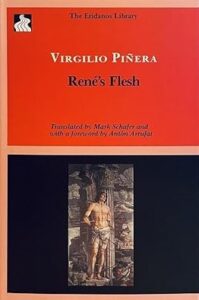
By VIRGILIO PIÑERA (Eridanos Press; 1952/88)
This novel is a definite head-scratcher, a Kafka-esque parable of a young man’s adverse relationship to his own flesh. The author was Cuba’s late Virgilio Piñera (1912-1979), best known in the English speaking world for the collection COLD TALES (1956/88), whose inside jacket flap described as “shocking and often absurd; his lyrical and bloody metaphors take the reader through most of our contemporary infernos; his prose is ironic and incisive, at once tropical and cold, somewhere between tragedy and farce.” Those words likewise sum up the Mark Shafer translated RENE’S FLESH, Piñera’s first novel.
The 20-year-old Rene is a bit of a wimp, something his father, who occupies a high position in the “cult of flesh,” isn’t too happy about. He enrolls Rene in a school whose motto is “Suffer in Silence.” Its pupils are forced to undergo torture of the flesh via electrocution, branding and other means, but those things do little to soften up Rene’s skin, which comes to mirror his unyielding attitude toward the school and its faculty. In fact, Rene’s flesh eventually hardens to the point of petrification, inspiring the faculty and student body to engage in a desperate lick-a-thon that inevitably devolves into a mass orgy.
There’s also a doubling motif: Rene’s father owns a painting of St. Anthony piercing himself with arrows with Rene’s face in place of that of the subject, while a crucifixion statue in Rene’s room likewise has his face on it, while his girlfriend’s bathtub contains a mannequin made in Rene’s likeness. Eventually Rene’s father is killed, but it takes a while for Rene to catch onto that fact, as his dad is replaced with a double who has trouble convincing Rene that he’s not in fact his father.
As stated above, RENE’S FLESH is a head-scratcher, an oft indecipherable yet bleakly humorous surreal fest that essentially defines the term dreamlike. That there’s a strong political dimension to the narrative is without question, as Piñera was an outspoken and controversial political figure in his native land.
Also without question is the fact that despite Mark Shafer’s best efforts, a fully accurate English rendering of this novel is very likely impossible. Piñera’s use of the Spanish language is eccentric, and favors words with multiple meanings; the Spanish word for flesh, for instance, is carne, which also means meat, a pairing that’s appropriate to the story, but which doesn’t entirely register in English.