
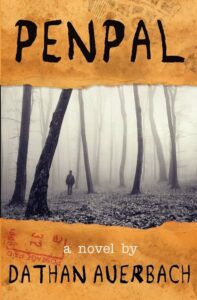
Years ago, I wrote about THE INTERFACE SERIES, a 2016 science fiction novel by _9MOTHER9HORSE9EYES9 that was comprised entirely of Reddit posts. Here I’ll turn my attention to a horror-oriented narrative that likewise began as a series of postings on Reddit.com. It’s proven to have had enormous staying power, as while THE INTERFACE SERIES is now largely forgotten, PENPAL by Dathan Auerbach remains in heavy rotation on the horror circuit.
PENPAL’s initial appearance was in late 2011, as “Footsteps,” a short(ish) story on the subreddit “No Sleep.” Credited to 100Vultures, “Footsteps” was popular enough that Auerbach added several interrelated stories, complete with in-character intros (in which the narrator invariably apologizes for the following story being so long). This led to a 2011 adaptation for the NOSLEEP podcast and a self-published 2012 novel that expanded on and altered many details, but the initial Reddit stories (currently streaming in audiobook form on several YouTube channels) remain the optimum, and certainly most concise, recounting of this material.
My feelings about online fiction are admittedly pretty negative. I liked THE INTERFACE SERIES well enough, but it’s an outlier in my view—and nor do I believe that popularity is synonymous with quality. The ludicrous mess of cliches that is “The Russian Sleep Experiment” has become inexplicably famous ever since its 2010 debut on Creepypasta, for reasons I can’t fathom. Thankfully, I found PENPAL to be a far more resonant work. It’s a deeply felt, boldly rendered account, related in simple and unaffected prose that’s quite complimentary to the subject matter: childhood memories, courtesy of an unnamed narrator who had a uniquely horrific upbringing.
The recollections begin with the aforementioned “Footsteps,” in which we’re introduced to the narrator’s six-year-old self, who foregrounds the book. We’re also made privy to his harried single mother, their modest home in a small town bordering a vast forest, and his best friend Josh, who plays an outsized role in the subsequent chapters. In “Footsteps,” though, the narrator finds himself very much alone on an odyssey that involves a possible kidnapping and the finding of a strange note.
The second and most potent story is “Balloons,” from which the title PENPAL is taken. It once again mines the narrator’s youthful memories and involves a mass release of balloons with notes attached to them, in the hope that the recipients will become penpals with the senders. What the narrator gets instead is a series of Polaroids that initially seem incongruous but, upon closer examination, prove quite significant.
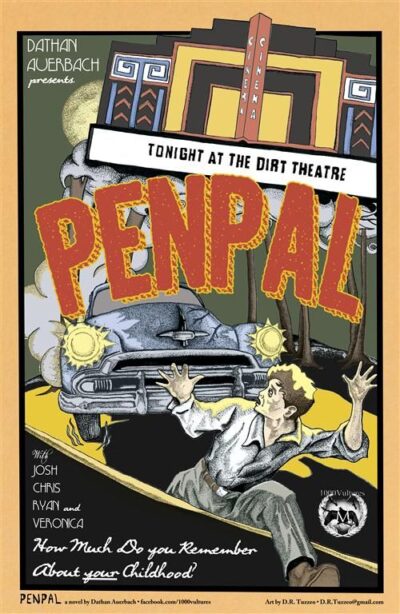
“Balloons” adds a great deal of incidental detail that wasn’t present in “Footsteps.” Much is made of a snow cone business the narrator and Josh run in their spare time, as well as a game played in “The Ditch,” which tie into the main narrative but serve primarily as character shading—and are far more concretely fleshed out in the PENPAL novel than they are in the Reddit version.
“Boxes” refers to a cat the narrator had as a kid that, following a move, precipitates a most unpleasant encounter in his now-deserted former residence, while “Maps” is focused primarily on Mrs. Maggie, an old lady neighbor harboring disquieting secrets. “Maps” is notable for the divergences between the novel and Reddit versions, with at least one entire subplot missing from the latter; for optimum appreciation and comprehension I’d recommend reading both.
“Screens” is unique in this line-up due to the fact that it’s concerned more with young adulthood than kindergarten. It begins, expectedly, with the narrator describing his six-year-old exploits, involving Josh and his sister Veronica, only to jump forward fifteen-or-so years to describe the narrator’s attempts at courting the much older Veronica at a midnight movie screening that turns horrific. The scares here exist on a far more realistic plain than those of the preceding entries, exploring the “horror” of a loved one’s unexpected demise.
The final story is “Friends,” which likewise confronts the realities of death while simultaneously offering explanations for the seemingly unexplainable occurrences of the preceding text. We’re also made privy to how it is that the narrator’s friendship with Josh first came about, and why he seems so regretful about it, with it all concluding on a powerful note of unresolved anguish.
Relatability is PENPAL’s major asset. Its stories tend to be structured around things that resonated with my childhood self: getting lost in a forest, moving out of one’s first home and the balloon gambit (something that was actually done in my first-grade class). It’s an account that initially reads like the literary equivalent of films like PARENTS and SKINAMARINK in its evocation of childhood angst, but it moves into territory that’s quite grown-up—and, I’d argue, even more relatable, with regret and misplaced nostalgia gradually overtaking the scares.
On the downside, the interrelated stories gambit doesn’t quite function as it should. The overall structure is very PULP FICTION-ish, but doesn’t work nearly as well in PENPAL, as we get a lot of repeated plot points and withheld information that showcase the fact that the book wasn’t conceived as a continuous narrative. Yet Dathan Auerbach’s heartfelt evocation of primal fear and retrospective regret is impacting; taken as either a novel or an anthology, PENPAL is strong stuff.