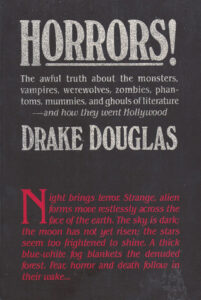
By DRAKE DOUGLAS (Overlook Press; 1966/89)
Nonfiction genre studies by horror novelists can always be counted on to contain quirky content, and HORRORS! is no exception. Originally published by the MacMillan Company in 1966 as HORROR! (and apparently written 20 years earlier), it joins LIVING IN FEAR by Les Daniels, DANSE MACABRE by Stephen King and THE HORROR SHOW by David J. Skal as a supremely quirky overview, with the mysterious “Drake Douglas” (a pen name for Werner Zimmerman, about whom little is known), of the pulp horror novels UNDERTOW (1984), CREATURE (1985) and DEATH SONG (1987), proving a knowledgeable and maddeningly idiosyncratic guide. I recommend the book, but with strong reservations.
Those reservations start with the fact that neither Douglas nor the Overview Press, which reprinted the book in 1989, bothered to update the text. That’s a problem, as Douglas’ younger self admits to never having seen the 1925 PHANTOM OF THE OPERA, viewing copies of which may have been difficult to come by in 1966, but not in ‘89. Also passable in 1966 was the claim “There are no famous zombie monsters in literature, and he has not made on screen the tremendous impact of the vampire and werewolf,” a quote with zero relevance in the post-NIGHT OF THE LIVING DEAD era. Most damaging of all, the many mistakes that littered the original publication have not been corrected; Douglas can be forgiven for getting things like the location of THE WOLF MAN (whose title character does not live in a “Transylvanian home”) wrong in 1966, when information on horror media was hard to come by, but in 1989 there was simply no excuse for such ignorance.
The book is essentially an anthology, with each chapter centered on a classic monster. There’s “The Vampire,” about DRACULA and its progeny; “The Werewolf,” about THE WOLF MAN; “The Monster,” about Frankenstein and his creation; “The Mummy”; “The Walking Dead”; “The Schizophrenic,” about DR. JEKYLL AND MR. HYDE (and also THE PICTURE OF DORIAN GRAY); and “The Phantom,” about the Phantom of the You-Know-What. Each chapter is marked by an extended plot summary rendered in seriously overripe gothic prose (“It is almost as though Nature, when painting the world, here found her palette dry of the bright hues of life, and so daubed this landscape with the drab and cheerless shadings of death”) and freely intermixing elements from the source texts and the films adapted from them.
Also included are brief profiles of “The Alcoholic” (Edgar Allan Poe), “The Rhode Island Recluse” (H.P. Lovecraft) and “The Mystic of Wales” (Arthur Machen), and introductions and epilogues from 1966 and ‘89. In the ’89 introduction/epilogue the author gives his thoughts on modern-day horror cinema, which as you might guess aren’t too sanguine: “The films have lost the dark creeping spirit of true horror, dealing as they do with shock and sensationalism rather than the more cerebral and human aspects of the classics,” while “Literature in the field of horror also seems to have deteriorated. There is no Poe or Lovecraft today…”
The book certainly has its upside. The author’s passion and enthusiasm for his chosen subject are palpable, and his critiques are insightful, intelligent and elegantly rendered. The quirkiness of the enterprise, though, is a constant distraction.