
There’s never been a writer like the late Terry Michael Wright (1947-2015), and A MANHATTAN GHOST STORY was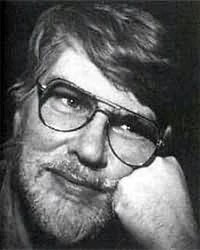 among T.M. Wright’s standout books. Appearing as a paperback original in 1984, it was the closest Wright ever came to bestsellerdom (having gone through multiple editions), and remains his most popular work. It’s also the only one of his novels to be adapted for film, although that mid-1990s production never came to fruition. What precisely happened? Let’s talk about it.
A MANHATTAN GHOST STORY represents vintage Wright. Eerie, understated and surreal, it’s quite an absorbing read, provided one is willing to surrender oneself to Wright’s quirky and unpredictable rhythms. As with other Wright novels like THE ISLAND (1988) and COLD HOUSE (2003), its major attribute is a powerfully evoked sense of place, in this case the urban sprawl of 1980s Manhattan.
Big city horror, to be sure, is an ill-advised trope given that there simply aren’t too many supernatural manifestations (especially of the low key variety favored by Wright) capable of competing with reality. That’s especially true of 1980’s NYC, which was undergoing what is often called its most violent period. Wright’s triumph in A MANHATTAN GHOST STORY is that he came very close to pulling off a subtle and affecting scare-fest in such an unsubtle setting.
The first-person protagonist is the Maine-based photographer Abner W. Cray, who, distraught by the back-to-back deaths of his parents, has relocated to Manhattan. From the start of his stay, however, Abner finds himself stuck in “that other Manhattan,” an environ plagued with ghosts that aren’t terribly easy to discern, because apparently “the living are not very different from the dead. And I have learned that you often have to have a very good eye indeed to tell the difference.”
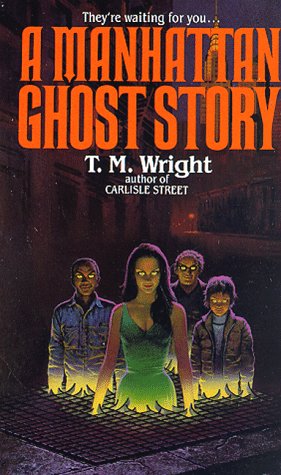 Included in the ghost category is Phyllis Pellaprat, an attractive Black woman who happens to be living in the apartment bequeathed Abner by an old friend named Art, who’s currently on vacation (or so he says). Phyllis claims to be Art’s girlfriend, which doesn’t stop Abner from initiating a carnal relationship with her, and nor is he terribly phased by the fact that she’s not actually alive, having been killed by Art a month earlier.
Wright’s scares are affecting largely because they’re grounded in reality. Included in that category are descriptions of holding an elevator door for an unseen person who never shows up, getting lost in a labyrinthine apartment stairwell and attempting to get buzzed into an apartment building, only to be stymied by the fact that the buzzer isn’t held long enough for the front door to open. The many weird characters Abner meets, including a little boy selling puppies who keeps repeating the same line over and over, a freaked-out hippie and reckless cab driver, likewise feel very true to life in the big city, which as described here is extremely accommodating to ghosts.
Wright redrafted this novel fairly significantly in the mid-1990s, which is the version currently being offered in print and audiobook format by Valancourt Books. The redraft is in many respects an improvement over the original 1984 text, being tighter and more cohesive (with several childhood flashbacks, on hand to show that Abner has a predilection for ghosts that goes back a long way, jettisoned), but ultimately I prefer the earlier version, as sprawling and undisciplined are things that better suit the methodology of an author who once advised beginning novelists to “Keep basic guidelines, but allow yourself to follow your muse! Creative writing is just that.”
It was around the time Wright was redrafting his novel that a screenplay adaptation was penned by Ronald Bass. The Oscar winning screenwriter of RAIN MAN (1988), SLEEPING WITH THE ENEMY (1991) and THE JOY LUCK CLUB (1993), to name but a few, the incredibly prolific Bass was one of Hollywood’s top scripters when he penned MANHATTAN GHOST STORY (the “A” having been dropped). The backer of this high profile project was Carolco Pictures, who paid Bass a hefty $2 million for his services, with another $5 million going to the film’s prospective star, the (then) red hot Sharon Stone. Carolco’s 1995 collapse put an end to the project, with Disney, which purchased the script in Carolco’s 1996 bankruptcy sale, attempting to remount the film (as evidenced by the 1996 copyright date on the draft under review), only to have it quickly fizzle out.
The surprising thing about this script is how well its first two thirds capture the strangeness and unpredictability of Wright’s text. Unusually for a Hollywood screenwriter, Bass clearly understood the novel, and transposed it not exactly intact, but with enormous thematic fidelity (which may not have been entirely due to Bass, who’s been known to utilize a team of uncredited writing assistants known in the industry as “The Ronettes”)—at least until act three, when Bass inserts his (and/or the Ronettes’) own additions.
Abner is renamed Aaron, Art is now Paul, and Phyllis is given the name Julianne (and also, in a move that would get Bass in major trouble nowadays, race-swapped from the Black woman described in the novel to White). The novel’s major supporting players—the dog-selling boy, the hippie and the crazy cabbie—are all carried over, as is the overarching narrative involving Aaron trying to deal with the fact that his beloved is a ghost. Understatement and refinement are the script’s major attributes, along with an ominous prose style that’s heavy on ellipses, which often obliquely blend the dialogue and screen directions (as in dialogue reading “There’s paradise in the…,” followed by the description “DARKNESS.”).
But about that third act. Contained are explosions, a sinking ship and a shootout (reminding us that the script was commissioned by the company behind TOTAL RECALL and TERMINATOR 2: JUDGMENT DAY), as well as a climactic twist that directly anticipated that of THE SIXTH SENSE (1999). It’s been claimed by more than one person that the latter film plagiarized Bass’s script, and I don’t find that claim at all farfetched; MANHATTAN GHOST STORY also put me in mind of GHOST (1990), which with its depiction of unquiet spirits afoot in NYC definitely harkened back to A MANHATTAN GHOST STORY (the novel), and if it’s plausible that M. Night Shyamalan got a look at Bass’s script before writing THE SIXTH SENSE than it’s equally probable that GHOST’s screenwriter Bruce Joel Rubin was acquainted with Wright’s novel.
Whoever may have ripped off who, the ending of MANHATTAN GHOST STORY is a problem. The novel concludes with its protagonist accepting the fact that he and his beloved occupy separate spheres and resolving to face down the “other Manhattan” with curiosity and acceptance rather than fear, whereas the script goes in a far different, more Hollywood direction. It ends, in fact, in the most cloying imaginable manner, as “the peace, the rightness, the eternal nature of it all settles on us” in a blissful afterworld far removed from the concrete jungle that provides the story’s reason for being. So, while the MANHATTAN GHOST STORY script definitely has its virtues, ultimately you’re better off reading the novel.