
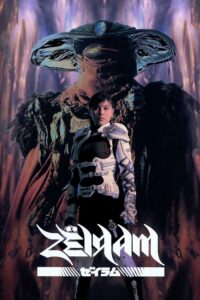
An example of Japanese Tokusatsu (live action special effects based cinema) that I say is mid. ZEIRAM (Zeiramu; 1991), however, has proven quite popular in the western world, where it was a film festival Midnight Madness fixture and received an English dubbed theatrical release through Orion Pictures, and also a Fox Lorber VHS (the back cover of which proclaimed it “A breakthrough in futuristic space adventure”), things superior examples of Tokusatsu from 1991—like BATTLE GIRL: THE LIVING DEAD IN TOKYO BAY (Batoru gâru: Tokyo crisis wars), PINOCCHIO 964 and MIKADROID (Mikadoroido)—didn’t receive. So well liked was ZEIRAM that many of its principals, including director Keita Amemiya, co-writer Hajime Matsumoto and actress Yûko Moriyama, turned out a more-of-the-same sequel in 1994, in addition to an Amemiya created anime adaptation that same year.
ZEIRAM (1991) Trailer
The title refers to a Mizuho Yoshida played bio-engineered alien entity, characterized by a massive cloak, a low-hanging hat and a kabuki face that’s actually the head of a lengthy snake-like entity. Zeiram is currently in route to Earth, with the bounty hunters Iria (Yûko Moriyama), a body armor outfitted babe, and Bob, who exists as a computerized voice (provided by Masakazu Handa), turning up in Tokyo to take down Zeiram. To contain their prey, Iria and Bob create an alternate universe “Zone” that closely resembles this one but for the fact that no people are present; Zeiram is transported into the Zone, together with the goofball electricians Kamiya (Yukijirô Hotaru) and Teppei (Kunihiro Ida), by the Bob controlled “Zone Positioning Transformer.”
Iria keeps Kamiya quiet by entrapping him in what looks like a giant diamond. Teppei, meanwhile, is pursued by an E.T. like alien critter conjured by Zeiram, who’s enclosed in an Iria created obelisk. Iria, unfortunately, is accidentally transported back to the here-and-now, where the Zone Positioning Transformer malfunctions just as Zeiram bursts his confinement. Teppai and the freed Kamiya are nearly killed by Zeiram, but Iria eventually finds her way back into the Zone, where she deals with her foe in time-honored action movie fashion: by firing gunshots at it.
There’s enough morphing, explosions and gravity-defying fight scenes here to make for a memorable watch by Asian Cult Cinema fans, but ZEIRAM could be much better overall (with most of the abovementioned elements contained in the last 20 minutes). It suffers from silly monsters, cheap-looking armor sported by the female lead and slack direction by TV veteran Keita Amemiya (who went on to helm MECHANICAL VIOLATOR HAKAIDER/Jinzô ningen Hakaidâ, 1995, and several big and small screen entries in the KAMEN RIDER and GARO franchises).
The film is most interesting for unprecedented-in-1991 elements like the tough female protagonist (a fixture of Japanese horror/SF cinema, though not of early 90s Hollywood) and a depiction of computer-controlled interdimensional warfare that prefigured THE MATRIX (1999). The use of old school monster effects, of both the guy-in-suit and stop motion variety, is also quite endearing, although there exist many more J-cult films (such as the early features of Shinya Tsukamoto) that did it better.
Vital Statistics
ZEIRAM (Zeiramu)
Gaga Communications
Director: Keita Amemiya
Producers: Hiroshi Ichida, Shigeki Takeuchi
Screenplay: Keita Amemiya, Hajime Matsumoto
Cinematography: Hiroshi Kidokoro
Cast: Yûko Moriyama, Kunihiro Ida, Yukijirô Hotaru, Masakazu Handa, Mizuho Yoshida, Yukitomo Tochino, Riko Kurenai, Naomi Enami, Mayumi Aguni, Masakazu Katsura