
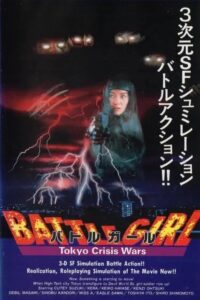
Another dispatch from the 1990s VHS bootleg scene, in which BATTLE GIRL: THE LIVING DEAD IN TOKYO BAY (Batoru gâru: Tokyo crisis wars; 1991), a low budget film made for the Japanese video market by director Kazuo “Gaia” Komizu (and a cast comprised largely of professional wrestlers), was a popular title. Now available on DVD from Synapse Films, it can take its rightful place as a solid example of Asian Trash Cinema that’s unusually heavy on the trash.
BATTLE GIRL: THE LIVING DEAD IN TOKYO BAY (1991) Film
The film begins with a literal bang: a meteor hits Tokyo Bay, resulting in marital law being declared and a “chemical reaction between a heavy metal and nitrogen in the air” creating a “cosmo-amphetamene” that has “insinuated itself into human DNA”—and so causes dead folks to become zombies that leak green blood. The surviving populace increasingly gives itself over to looting and wholesale brutality, which only serves to create more zombies.
Enter K-Ko (Japanese wrestling superstar Cutey Suzuki), a government employed super-fighter who happens to be the daughter of one Colonel Kirihara. She springs into action, her father having provided her with a state-of-the-art (but very silly looking) battle suit, which comes complete with a visor that (as in THE TERMINATOR and ROBOCOP) has an infra-red digital readout capable of identifying zombies.
Opposing K-ko is the evil General Hugioka (Keiko Hayase), who’s conducting inhumane experiments. He’s already created an elite “Human Hunter Unit” whose members bear Wolverine-like razored knuckles and razor-sharp teeth, who K-ko nonetheless takes down with ease. She eventually joins up with the Battle Kids, a band of punks who ride around in a tour bus and shoot zombies.
Director Kazuo “Gaia” Komizu can’t help but get tripped up by his low budget, especially in light of screenwriter Daisuke Serizawa’s absurdly ambitious conception (it’s no accident that the film takes place at night, with darkness and/or mist conveniently obscuring much of the action). Gaia’s resourcefulness, however, ultimately wins out; the use of roving spotlights in Hugioka’s office is especially inspired, as is the presentation of portions of the film in the form of TV broadcasts, filmed with handheld video cameras.
What can’t be forgiven are the fight scenes. Surprisingly enough (given that the lead actress was a pro wrestler), the scuffles are halting and slow. Japan cottoned to the idea of woman superheroes long before Hollywood did, and here we’re given the type of ultra-stoic, personality-free strong female lead that has become de rigeur in present-day Tinseltown—and, as in most female-led Hollywood actioners, the conceit fails the believability test.
On the plus side, the presence of a female protagonist has the effect of tempering the near-psychotic misogyny of previous Gaia efforts like ENTRAILS OF THE VIRGIN (Shojo no harawata; 1986) and GUZOO (Guzoo: Kami ni misuterareshi mono – Part I; 1986), so BATTLE GIRL isn’t entirely without real worth.
Vital Statistics
BATTLE GIRL: THE LIVING DEAD IN TOKYO BAY
Daiei Co. Ltd.
Director: Kazuo “Gaia” Komizu
Screenplay: Daisuke Serizawa
Cinematography: Kazuo “Gaia” Komizu
Cast: Cutey Suzuki, Kera, Keiko Hahase, Kenji Otsuki, Devil Masami, Shinobu Kandori, Miss A, Eagle Sawai, Toshiya Ito, Shiro Shimomoto