
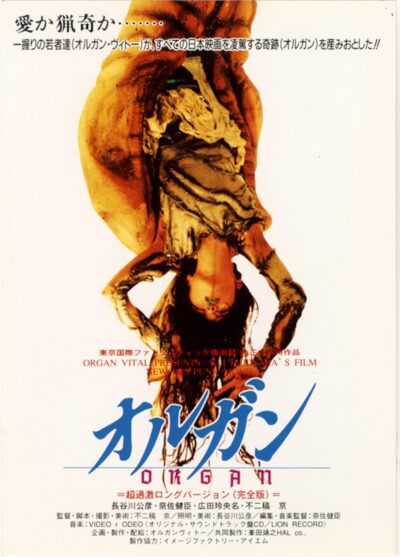
For a brief period in the late 1990s, this was the hottest Asian cult film on the market. The directorial debut of actress Kei Fujiwara (best known for playing the female lead in Shinya Tsukamoto’s TETSUO), ORGAN (1996) was so sought-after that in 1998 the late ASIAN CULT CINEMA magazine offered a limited edition VHS of the film as an enticement to get people to purchase a subscription.
ORGAN (1996) Trailer
The title refers to human organs, sold by traffickers on the black market. This concept had by 1996 been widely utilized—see COMA (1978), SPARE PARTS (FLEISCH; 1979), THE AMBULANCE (1990) and THE HARVEST (1993)—but never with more gruesome flair than in ORGAN. What the film lacks is coherent storytelling; in an interview with the aforementioned ASIAN CULT CINEMA, Fujiwara complained about a reviewer misunderstanding the plot, so ambiguity was clearly not her intent.
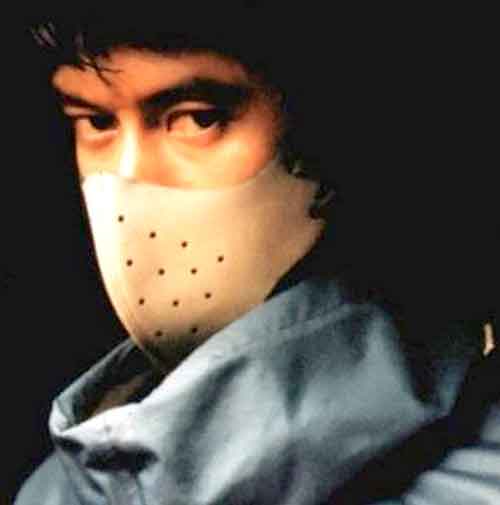
As best I can make out, the narrative pivots on a band of criminals led by the eyepatch wearing seductress Yoko (Fujiwara). The drama begins one night in Tokyo, where “the odor of death…attracts the sellers of human organs.” Among the latter are Yasuda, who while collecting a corpse outside a hospital is followed by Numata (Kenji Nasa) and Tosaka, cops who stage a clumsy raid on Yoko’s clandestine facility that results in mass mayhem.
Numata escapes the melee, only to be dropped from the police force and deluged with horrific memories and hallucinations. Tosaka, meanwhile, remains in the clutches of the organ sellers, where he’s subjected to inhumane experiments by Yoko’s high school science teacher brother Saeki (Kimihiko Hasegawa); utilized in the experiments is a drug whose side effects include the transformation of Tosaka into something resembling “that guy from THE FLY.” Saeki is also taking the drug, which causes massive pus-spurting lesions to appear on his torso.
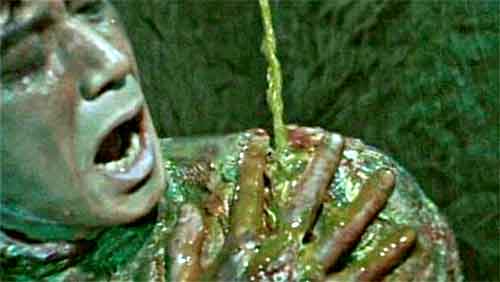
Further complicating matters are elaborate childhood flashbacks by Saeki of his (literally) castrating mother, a most unfortunate girl student (Natsuyo Kanahama) used by Saeki as an experimental subject to dissect, and a loony female teacher (Reona Hirota) who’s none-too-secretly turned on by Saeki’s psychotic side. We also have the increasingly unhinged Numata, who’s grown increasingly determined to enact revenge on Yoko’s gang.
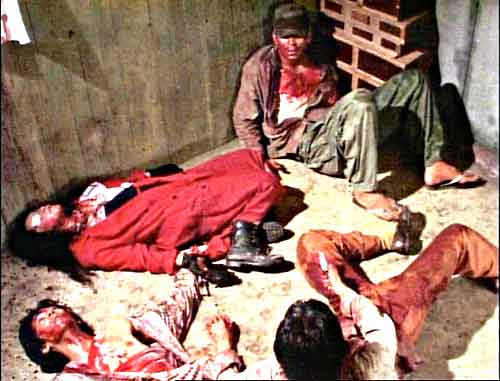
As with her mentor Shinya Tsukamoto, Kei Fujiwara did quadruple duty, acting as the director, screenwriter, cinematographer and lead actress. She shares with Tsukamoto a fascination with gore and mutation, and a disdain for traditional narrative. What’s missing is the kineticism of Tsukamoto’s work, which was replaced by a dreary and surreal slog through a dimly lit urban psychoscape with an abundance of bodily fluids (of every conceivable variety).
So in terms of linear storytelling and conventional entertainment, ORGAN is a fail. Yet taken purely as a poetic, image-based evocation of death, decay and psychosis the film very nearly outdoes Tsukamoto, and its other major antecedent David Cronenberg, at their own game.
Vital Statistics
ORGAN
Organ Vital
Director/Screenwriter/Cinematography: Kei Fujiwara
Producers: Binbun Furusawa, Kôichi Tôda
Editing: Kenji Nasa
Cast: Kei Fujiwara, Kimihiko Hasegawa, Natsuyo Kanahama, Kenji Nasa, Ryu Okubo, Tojima Shozo, Shun Sugata