
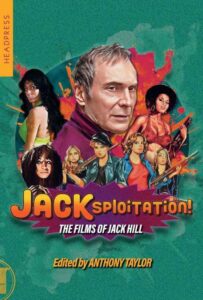
Edited by ANTHONY TAYLOR (Headpress; 2026)
A great idea, if you ask me: an attractively designed, profusely illustrated (with poster art and stills) anthology devoted to the films of Jack Hill, one of the foremost cinematic exploiteurs of the 1960s and 70s. Prior to 2026, only one major book was devoted to Hill’s work, the 2009 publication JACK HILL: THE EXPLOITATION AND BLAXPLOITATION MASTER, FILM BY FILM by Calum Waddell, so JACKSPLOITATION! was long overdue. It deserves points for its erudition, thoroughness and understanding portrayal of Hill’s films and the time of their making (which wasn’t exactly progressive-minded), steering clear of the moralistic scolding that marred Waddell’s tome.
The book opens with an admiring reminisce by two-time Hill cast member Beverly Washburn and a forward by Hill himself, in which he recalls his work in the blaxploitation genre with justifiable pride. From there we get essays on (nearly) all of Hill’s features, with ISLE OF THE SNAKE PEOPLE, THE INCREDIBLE INVASION (both 1971), FEAR CHAMBER and HOUSE OF EVIL (both 1968) all compressed into a single Mark Clark authored chapter, and SORCERESS (1982), from which Hill had his name removed, left out entirely.
Standout contributions include “A Film of Many Authors: Jack Hill and THE TERROR” by Troy Howarth, who offers an authoritative history of the infamously chaotic Roger Corman production THE TERROR (1963), which counted Hill among its half-dozen uncredited directors. Author/filmmaker C. Courtney Joyner provides an interesting dissertation on BLOOD BATH (1966), a “shattered mirror” comprised of “jagged bits and pieces of several films that struggle to fit smoothly together to reflect Hill’s original vision,” while Stephen R. Bissette explores SPIDER BABY (1967) in his inimitable style, blending autobiography, scholarly analysis and a quirky history lesson in a manner that will resonate with anyone who’s read Bissette’s indispensable 2020 publication THE BROOD.
Lucas Hardwick incorporates literal dolls into his analysis of THE BIG DOLL HOUSE (1971), as well as Greta Gerwig’s BARBIE (2023); I’m not entirely sure I buy the connection, but Hardwick deserves credit for audacity. “Don’t Mess Around with FOXY BROWN!” by Chris Alexander argues quite persuasively that Hill’s blaxploitation classic FOXY BROWN (1974), a sort-of sequel to his earlier, better received blaxploiter COFFY (1973), actually outdoes its predecessor, and in “Unknown Pleasures: Colleen Camp and THE SWINGING CHEERLEADERS,” this book’s editor Anthony Taylor covers Hill’s SWINGING CHEERLEADERS (1974) entirely through the memories of its co-star Colleen Camp.
The final essay is Pheof Sutton’s “I Am Not What I Am—SWITCHBLADE SISTERS,” which explores Hill’s wildest film in a manner that’s every bit as nutty and unpredictable as SWITCHBLADE SISTERS (1975) itself, with claims that it’s “a radical, genre-defying work that masks serious political and social ideas beneath its sensationalist surface,” which is “too sincere to be parody, too chaotic to be mainstream, and too politically subversive to be safely dismissed.” I say that’s an entirely accurate description, and a major reason SWITCHBLADE SISTERS has never received the acclaim it deserves—for that matter, those words also stand as a good summation of Jack Hill’s oeuvre, which has likewise been quite underrated. That’s an issue I fully believe this book will help remedy.