
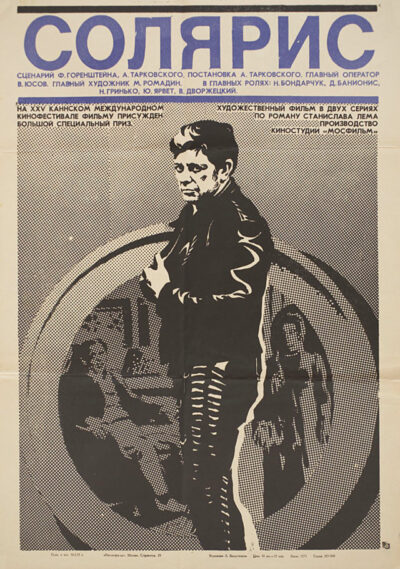
The third feature by Andrei Tarkovsky and his first foray into science fiction, SOLARIS (Solyaris; 1972) is the most famous such film to emerge from Russia. A nation whose SF output is rich and varied, Russia turned out two subsequent SF themed films—Tarkovsky’s own STALKER (1979) and Tarkovsky acolyte Konstatin Lopushanskiy’s DEAD MAN’S LETTERS (Pisma myortvogo cheloveka; 1986)—that I say outdo SOLARIS, but its status remains inviolate.
SOLARIS (1972) Trailer
Tarkovsky’s film was the second to be adapted from Stanislaw Lem’s 1961 Polish language SF classic (with a 1968 Soviet TV movie being the first and a 2002 Steven Soderbergh production the third). Lem famously hated the film, and Tarkovsky himself wasn’t too high on SOLARIS, proclaiming it his worst-ever effort. It is indeed somewhat problematic, as is evident in the clumsy opening section.
Depicted in that roughly 40 minute section are a few days in the life of Chris Kelvin (Donatas Banionis), a psychologist who spends his off hours wandering the grounds of his pastoral home. We learn that he’s preparing to blast off to a space station orbiting the distant planet Solaris, his job being to perform a psychological evaluation of the station’s crew members, who it seems are losing their minds. This would appear to be confirmed by the pilot Berton (Vladislav Dvorzhetskiy), who was recalled from an earlier Solaris expedition after experiencing an apparent hallucination; his present activities include an extended POV drive through the Tokyo freeway system (a sequence that lasts an interminable five minutes), with a child in the back seat who may not be real.

Upon arriving at the space station, Kelvin finds that his colleagues are indeed more than a little nutty, and with good reason: the ever-churning oceans of Solaris work as a giant psychic conductor, creating flesh and blood personages conjured from people’s memories. Kelvin finds himself haunted by a replica of his late wife Khari (Natalya Bondarchuk), who committed suicide a decade earlier by injecting herself with poison (with the Khari replica sporting a telltale needle mark on her left arm).
Kelvin tries to get rid of the Khari clone by blasting it off in a rocket, but another incarnation immediately appears. With this new Khari, Kelvin finds himself falling into the same destructive lifestyle that drove the real Khari to self-deletion, with Kelvin ignoring her and she attempting suicide—only to resurrect yet again in a dynamic that’s deeply (and appropriately) hallucinatory, intercut with glimpses of Solaris’ churning sea.
The final twenty minutes devolve into a brooding philosophical yak fest (an arc that was repeated in STALKER), with Khari exiting the film and Kelvin agonizing about whether he has the “right” to leave Solaris. I’ll also complain about the imaginative possibilities that are brought up but never explored, such as the conjuring by the ocean of Solaris of unearthly creatures from Kelvin’s imagination, something I’d have really liked to see Tarkovsky visualize.
What’s here, however, is more than enough to please the discerning film buff, with standout elements that include gorgeously rendered underwater reeds and roiling ocean surfaces (which take the place of standard SF movie hardware), Kelvin and Khari’s poetic levitation sequence set to Bach’s “Ich Ruf Zu Dir, Herr Jesu Christ” (which this film appropriates in the same way 2001: A SPACE ODYSSEY did Richard Strauss’ “Also Sprach Zarathustra”), and a climax that sees several future Tarkovsky trademarks—including indoor rain and a spectral dog—make their debut appearances.
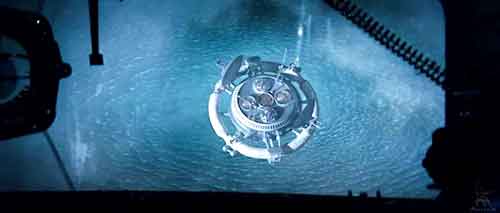
SOLARIS can also be identified as the premiere instance in which Tarkovsky really leaned into the characterization of him by Ingmar Bergman as “the one who invented a new language, true to the nature of film, as it captures life as a reflection, life as a dream.” Dreamlike is indeed the word for SOLARIS, from the ultra-languid pacing to the alterations made to the Stanislaw Lem source novel, a highly learned scientifically-oriented narrative that Tarkovsky boiled down to its psychologically based core.
Those things don’t bely the relentlessly self-conscious, stylistically overt filmmaking that positions Tarkovsky as the true star. It must be said, however, that Natalya Bondarchuk (daughter of the acclaimed Ukrainian filmmaker Sergey Bondarchuk, who Tarkovsky considered his “great enemy”) makes a rather sizeable impression as Khari, creating an enchanting and mysterious character who comes close to being the film’s major gotta-see-it factor—which, I’m guessing, is the primary reason she gets so little screen time.
Vital Statistics
SOLARIS (Solyaris; 1972)
Mosfilm
Director: Andrei Tarkvosky
Producer: Viacheslav Tarasov
Screenplay: Fridrikh Gorenshteyn, Andrei Tarkovsky
(Based on a novel by Stanislaw Lem)
Cinematography: Vadim Yusov
Editing: Lyudmila Feyginova
Cast: Natalya Bondarchuk, Donatas Banionis, Yuri Yarvet, Vladislav Dvorzhetskiy, Nikolay Grinko, Anatoliy Solonitsyn, Olga Barnet, Vitalik Kerdimun, Olga Kizilova, Tatyana Malykh, Aleksandr Misharin, Bagrat Oganesyan, Tamara Ogorodnikova, Sos Sargsyan, Yulian Semyonov, Vitaliy Statsinskiy, Vera Sumenova, Georgiy Teykh