
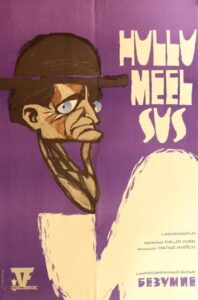
The concept of an insane asylum as a metaphor for modern civilization didn’t originate with the Estonian MADNESS (Hullumeelsus; 1969), but the film did provide this particular movie model with a quintessentially Eastern European highlight. If nothing else, it stands as an interesting forerunner to subsequent insane asylum dramas like THE MANSION OF MADNESS (La mansión de la locura; 1973), ONE FLEW OVER THE CUCKOO’S NEST (1975) and THE NINTH CONFIGURATION (1980).
HULLUMEELSUS (MADNESS, 1969) Clip
MADNESS is set in an unidentified WWII-era village where, an unseen narrator informs us, “the invaders had already succeeded in executing all jews, Marxists, gypsies, guerillas.” All that remains, it seems, are the insane, housed in a vast asylum run by a seemingly kind and caring doctor (Voldemar Panso).
A Nazi commando unit marches onto the asylum grounds to exterminate its patients, but the operation is halted by Windisch (Jüri Järvet), a gestapo officer in search of an English spy. Passing himself off as a doctor, Windisch studies the asylum’s inmates, who represent a cross-section of Soviet society, and singles out five persons of interest: “Person No. 1” (Vaclovas Blėdis), an intelligent man who believes he’s a Roman emperor; Yuri (Viktor Plyut), a paranoid schizophrenic; Willy (Bronius Babkausas), a decorated serviceman who’s lost his mind; Eduard (Valeri Nosik), a writer/editor who was incarcerated after publishing an article he claims was co-drafted by the Devil; and Sophie (Mare Garsnek), a malcontent who annoyed Soviet officials with her constant complaints.
Windisch initially tries a straight interrogation of his charges, but this gets him nowhere. On the advice of the asylum head, he decides to live with his subjects as an inmate, which proves dangerous, as he comes to identify a bit too closely with his loony fellows. He’s also unaware of the asylum head’s true motives, in which Windisch serves as an unwitting pawn.
Director Kaljo Kiisk’s plans for MADNESS were apparently far grander than what ended up onscreen. Soviet censorship forced the scaling down of many of Kiisk’s initial conceptions (and also the film’s release, which was severely limited), resulting in an overly contained account whose social satire is quite muted. Also lacking are the type of showstopping set pieces that elevated the abovementioned insane asylum dramas (namely the mock trial of THE MANSION OF MADNESS, the strangling of Nurse Ratched in ONE FLEW OVER THE CUCKOO’S NEST and the bar fight climax of THE NINTH CONFIGURATION).
Yet many interesting elements did manage to slip by the censors. Those elements include a subtly unnerving white-on-white color scheme and set design that cunningly evokes mental disquiet, as in a corner-less room with skewed walls where more than one pivotal scene is set, and what must be counted as the most haunting harmonica dirge outside that of ONCE UPON A TIME IN THE WEST (1968).
Vital Statistics
MADNESS (Hullumeelsus)
Tallinnfilm
Director: Kaljo Kiisk
Screenplay: Viktors Lorencs
Cinematography: Anatoli Zabolotski, Andrei Dobrovolski
Editing: Eugen Rozental
Cast: Jüri Järvet, Voldemar Panso, Vaclovas Blėdis, Valeri Nosik, Bronius Babkausas, Viktor Plyut, Hugo Havel, Mare Garsnek, Lembit Anton