
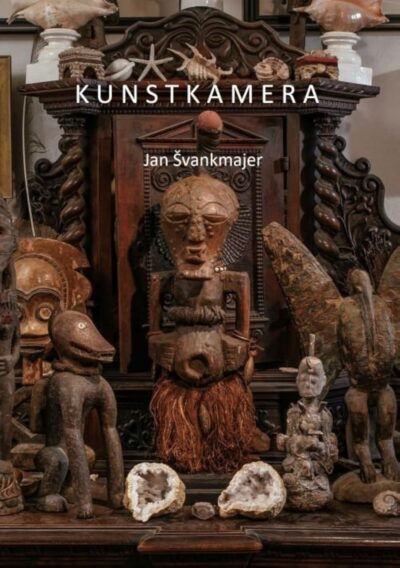
 The final feature directed by Jan Svankmajer, who provides a documentary tour of the Czech Republic based Horni Stankov Castle, a 17th Century structure that since 1981 has served as Svankmajer’s home. The follow-up to the disappointing INSECT (2018), KUNSTKAMERA (2022) has been called a “cinematic conservation” by Svankmajer’s longtime producer Jaromír Kallista. As such, it doesn’t match the high standards set by Svankmajer’s previous features (which include surreal classics like 1988’s ALICE, 1994’s FAUST and 2000’s LITTLE OTIK), but serves nonetheless as a fitting final statement by an artist and filmmaker whose personal obsessions have always taken center stage.
KUNSTKAMERA (Svankmajer’s name for his workshop) is set to Vivaldi’s “Four Seasons,” which underscores digitally shot imagery of what could pass for a museum, and an especially jam-packed one. It’s no exaggeration to state that nearly every inch of this multi-room structure is filled with works of art, a great deal of which was created by Svankmajer himself and his late wife Eva Švankmajerová (1940-2005).
On display are etchings, paintings (on canvas and on walls), woodcarvings, sculptures, found object collages (in which bones, seashells and knotted tree trunks are especially prevalent), taxidermized animals, masks, puppets, dolls and figurines. A huge variety of cultures and traditions are represented, including African tribal art, Japanese Ukiyo-e prints and Czech surrealist paintings, yet Svankmajer’s peculiar brand of macabre absurdism is ever-present, with death, decay and eroticism being major touchstones.
Many of the objects on display will be recognizable to Svankmajer fans as props from his films, as will the poster art from said films. No demarcation is made between them and the other artwork, nor between the creations of Svankmajer himself and those of others (who include names like Bruegel, Dali and Piranesi), a preference that extends to close-ups of an opened beer bottle, a bowl of dog food and a pair of worn slippers that are made to become part of the tapestry.
It’s all done up in a highly baroque, narration-free style that isn’t too far removed from Svankmajer’s surreal and fantastic films, with doors that open by themselves and sound effects accompanying certain edits. Adding to the effect is highly expressive handheld camerawork that all but caresses the art on display, and dynamic montage editing that reveals the director’s personal preferences by lingering on certain pieces and immediately cutting away from others.
Those wanting a more conventional biographical portrait of Jan Svankmajer are advised to seek out the 2020 documentary ATHANOR: THE ALCHEMICAL FURNACE (co-directed by Adam Olha, a cinematographer on KUNSTKAMERA), which offered an admirably immersive depiction of its subject’s life and career. KUNSTKAMERA, obviously, is something entirely different: an unabashedly idiosyncratic tour of one man’s private universe. It exists in a 55 minute version that screened at a Czech film school in July 2022, in addition to the more common 114 minute director’s cut, which is frankly a bit much.
Vital Statistics
KUNSTKAMERA
Athanor
Director: Jan Svankmajer
Producer: Jaromír Kallista
Cinematography: Adam Olha, Jan Ruzicka