
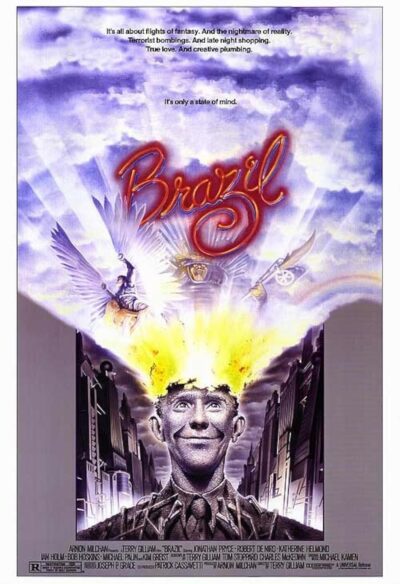
Reactions to this 1985 film tend to be split between those who call it a timeless masterpiece and those who find it intolerably dated. I lean toward the former opinion, BRAZIL being an unmatched (even by its own director) display of unruly genius, although I will admit that the latter one isn’t entirely off base.
BRAZIL (1985) Trailer
BRAZIL was the third solo feature directed by the American born, UK based Terry Gilliam (following JABBERWOCKY and TIME BANDITS). Initially titled 1984½, it offered a satiric take on George Orwell’s classic, with the target of that satire being not Brazil but the stifling bureaucracy and consumerism of 1980s England (it’s not insignificant that this British peopled film’s only truly virtuous characters are American), which explains why BRAZIL doesn’t feel as potent as it once did. There’s also the fact that many of the film’s previously far-fetched conceptions, such as cosmetic surgery that stretches peoples’ faces into inhuman formations and random carnage becoming a mundane reality, have since come to pass.
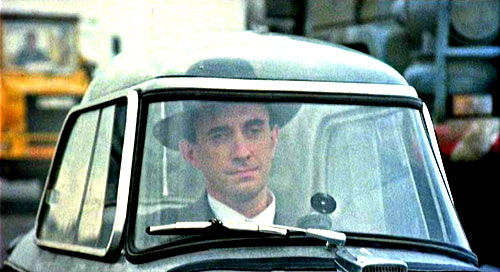
Beyond that, BRAZIL is famous for the battle that occurred between Gilliam and Universal president Sid Sheinberg over its final form. A preview of Gilliam’s subsequent tanglings over THE ADVENTURES OF BARON MAUNCHAUSEN (1988) and FEAR AND LOATHING IN LAS VEGAS (1998), the “Battle of BRAZIL” (as the 1987 book was titled) saw Gilliam take out a full page ad in VARIETY that read “Dear Sid Sheinberg, When are you going to release my film, BRAZIL?” and an approximation of Gilliam’s director’s cut (which didn’t see distribution in the US until early 1991) released in place of a “Love Conquers All” version prepared by Universal. The release was not a success, although BRAZIL gained enough cult attention that Criterion’s deluxe 1996 laserdisc release and 1999 DVD version were both sell-outs.

Assuming the Winston Smith role is Sam Lowry (Jonathan Pryce), a meek Briton whose rich mother (Katherine Helmond) has gotten him a job as a government employee. Sam loathes his work and the horrific dystopia, marked by government overreach and terrorist bombings, in which he finds himself trapped. He spends his downtime daydreaming about flying through the air and rescuing a beautiful woman (Kim Griest) from threats that include massive buildings bursting up from the ground and a fire-breathing samurai warrior.

While investigating the case of Mr. Buttle, a family man who due to a bug falling into a printer is wrongfully arrested in place of the renegade American technician Harry Tuttle (Robert De Niro), Sam comes into contact with Buttle’s upstairs neighbor Jill Layton (Kim Griest), an American truck driver who closely resembles the girl of his dreams. He also meets Tuttle, who intercepts Sam’s call for a plumber and becomes a confidante in Sam’s intensifying struggle against the world he hates.
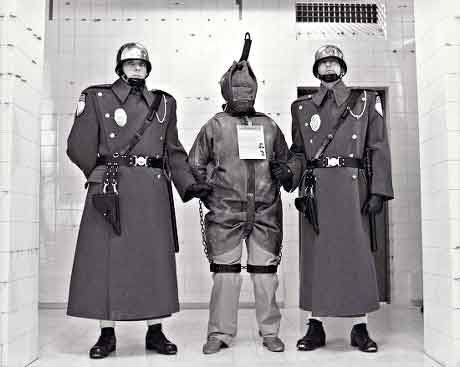
Inevitably, fantasy and reality intersect, with Sam becoming caught up in an increasingly surreal universe. Here the phantoms of his imaginings intermingle with the events of his day-to-day life, leading to an ending that, depending on one’s point of view, can be viewed as happy or (very) unhappy.
This is the film that introduced what was to become Terry Gilliam’s signature style: hapless characters stumbling through artfully cluttered landscapes, rendered in painterly fisheye lensed compositions and structureless storytelling; complaining about the lack of conventional structure in BRAZIL (or any Gilliam film) is pointless, as chaos is crucial to the Gilliam aesthetic. BRAZIL also has in its favor superbly blanched cinematography by Roger Pratt and imaginative scenery by production designer Norman Garwood and art directors John Beard and Keith Pain, which is so rich and unique in its presentation of mock-1940s architecture and technology that the plainly inadequate budget registers as a minor annoyance. I’ll also applaud the use of the 1970 Geoff Muldaur recording of the 1930s Samba song “Aquarela do Brasil” (and Michael Kamen’s instrumental riffs on it), which makes for a spot-on tonal accompaniment to the imagery.
AQUARELA DO BRASIL (1970 Geoff Muldaur recording)
That being said, the fantasy sequences could be better, with Gilliam having had to pare down the extravagant descriptions of his screenplay, resulting in uninspiring depictions of Sam wearing metallic strap-on wings, people in baby masks and a samurai warrior (a very 1980s representation of modern technology). Much of the humor feels forced, and a silly bit where Sam climbs around the outside of Jill’s truck trying to get her attention, which she continually rebuffs, doesn’t work at all (it being, according to author Jack Matthews, “an attempt to give younger audiences some thrills”).
One last thing: the 142 minute European cut, which has replaced the 132 minute American cut (and the 94 minute “Love Conquers All” recut) as the most readily available version of BRAZIL, is actually a downgrade. If features scenes that actually undercut the film—such as a climactic bit in which a fellow dressed as Santa Claus reveals to Sam that Jill has died, thus rendering the final scenes moot—and an industrial end credits setting that pales in light of the blue sky and clouds that replace it in the American cut, which work better in every respect.
Vital Statistics
BRAZIL
Universal Pictures
Director: Terry Gilliam
Producers: Arnon Milchan
Screenplay: Terry Gilliam, Tom Stoppard, Charles McKeown
Cinematography: Roger Pratt
Editing: Julian Doyle
Cast: Jonathan Pryce, Robert De Niro, Katherine Helmond, Ian Holm, Bob Hoskins, Michael Palin, Ian Richardson, Peter Vaughan, Kim Greist, Jim Broadbent, Brian Miller, Sheila Reid, Simon Nash, Barbara Hicks, Kathryn Pogson, Bryan Pringle, Derrick O’Connor, Elizabeth Spender, Charles McKeown