
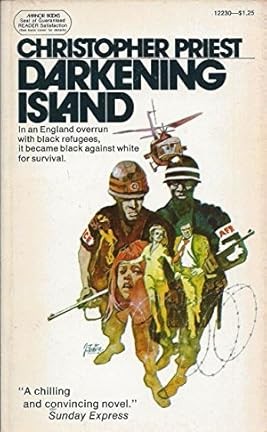
By CHRISTOPHER PRIEST (Harper; 1972)
A long out-of-print SF novel that’s attained newfound popularity in the 2020s. Why? Its premise, involving a future England overtaken by foreign refugees, now has a resonance it didn’t possess back in 1972.
This doesn’t change the fact that DARKENING ISLAND (initially titled FUGUE FOR A DARKENING ISLAND) was very much a product of its time. Back in the late 1960s-early 1970s the SF field was packed with apocalyptic race war narratives, contained in novels like THE COMING SELF-DESTRUCTION OF THE U.S.A. and MEETING THE BEAR, that followed the racial tensions of the late 1960s to their most nihilistic extremes.
In DARKENING ISLAND the catalyst for all the strife is a contingent of African refugees fleeing nuclear devastation. Several boatloads’ worth of refuges end up dead, their boats crashed on shore, but enough “Afrims” manage to make their way onto England’s shores that they pose a serious challenge to the white ruling class.
This book’s author, the late Christopher Priest (1943-2024), always struck me as politically left-leaning. Comparisons have been made to THE CAMP OF THE SAINTS, but Priest’s concerns were far different from those of that book, with DARKENING ISLAND’s major conflict brought about, as Priest makes sure to assert, by racism and xenophobia on the part of England’s populace (a revised edition was published in 2011 that apparently toned down the more controversial elements, but I haven’t read it).
The novel is related in the first person by Alan Whitman, who begins his recounting with the proclamation “I have white skin.” In studiedly emotionless prose, Alan reports on the Afrim boat landings and the rapid breakdown of society that followed, with this ‘Darkening Island” overtaken by civil war and Alan, together with his wife Isobel and young daughter Sally, forced out of his home. Things only get steadily worse from there, as mother and daughter are kidnapped by the Afrim and forced into sexual slavery, which provides Alan with an entirely new, and entirely hopeless, focus.
This all results in a supremely bleak, and quite rushed, conclusion. Compounding the negatives is the achronological storytelling, which has an annoying tendency to jump back and forth to various points in time, often leaving pertinent events undescribed until later in the text (we’re not made privy, for instance, to the circumstances of Isobel and Sally’s kidnapping until near the end of the book). It’s these issues that lessen an otherwise admirably uncompromising, cannily imagined scenario, and spotlight the fact that DARKENING ISLAND’s gifted author was at an early stage of his career. Obviously, he had yet to attain his full writing power.