
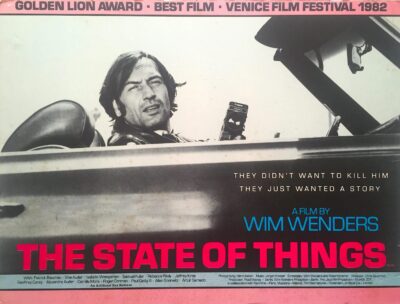
What do Wim Wenders, Jim Jarmusch, Roger Corman, Raul Ruiz, Jon Jost, the district of Sintra and the city of Lisbon have in common? I’ll begin my multi-pronged answer to that query with THE STATE OF THINGS (Der Stand der Dinge; 1982).
THE STATE OF THINGS (1982) Trailer
Made by the sometimes-great Wim Wenders, the German made STATE OF THINGS was a no-budget arthouse quickie (the very definition of what the late Robert Altman called a “Flick-of-The-Wrist Movie”) that has largely faded from view. It was, however, a pivotal influence on the American independent film revolution of the late 1980s and 90s. Without THE STATE OF THINGS there would be no STRANGER THAN PARADISE (1984), whose director Jim Jarmusch lensed a large portion of that film on Wenders-donated short-ends (unused film stock)—and by extension no SEX, LIES AND VIDEOTAPE (1989), SLACKER (1990) or CLERKS (1994), all of which took inspiration from STRANGER THAN PARADISE.
The State of Things
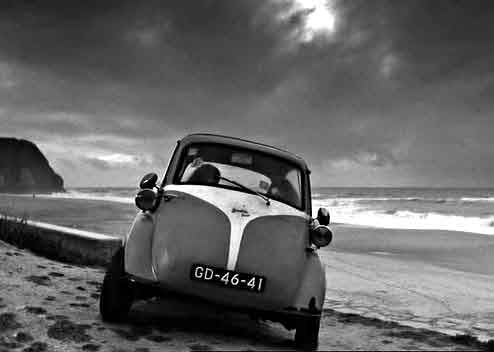
Of course, it wasn’t just short ends that made THE STATE OF THINGS such a pivotal work. Shot piecemeal during a period of downtime on the Wenders directed HAMMETT (1982), THE STATE OF THINGS was clearly made up on the spot, with a loose and improvisational air that recalled the glory days of John Cassavettes.
The lead actor Patrick Bauchau, playing a film director traveling to LA to see what has become of the funding for a sci fi epic he’s shooting in Greece, is a problem: his charisma is zero and his line readings couldn’t be more stilted. Wenders’s filmmaking also has its annoyances, over-relying on improvised dialogue and film nerd in-jokes (Corman and Sam Fuller both have lengthy cameos). That said, the pic contains a number of pleasingly imaginative elements, such as a movie mogul (Allen Garfield) who spends his days cruising around LA in an RV, and luminous black and white photography by the great Henri Alekan (of Cocteau’s BEAUTY AND THE BEAST and Wenders’ own WINGS OF DESIRE).
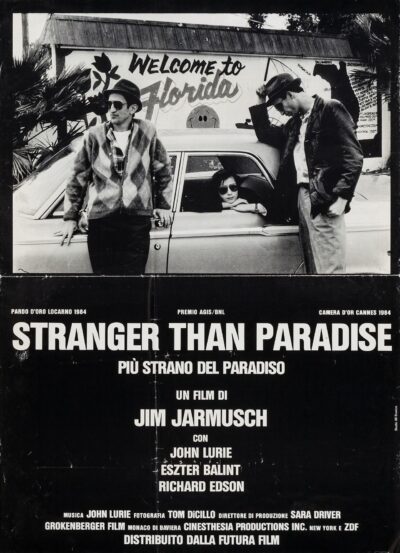
STRANGER THAN PARADISE, also lensed in black and white, wasn’t too far removed from THE STATE OF THINGS thematically. It’s about two aimless losers (John Lurie and Richard Edson) on a trip to Florida with a cute Hungarian immigrant (Eszter Balint), a trio of losers who never learn from their adventures or do much of anything other than sit around and bitch. As with Wenders, it’s the way Jarmusch textured the film that has rendered it so iconic: via lengthy fixed camera shots broken up by fades to black.
STRANGER THAN PARADISE (1984) Trailer
This brings us to a film that preceded THE STATE OF THINGS and STRANGER THAN PARADISE, and is in many respects the most important of the lot: THE TERRITORY from 1981. It’s radically different from its antecedents, a would-be cannibal horror fest made by the brilliant but erratic Raul Ruiz (1941-2011), whose first-ever English language film it was.
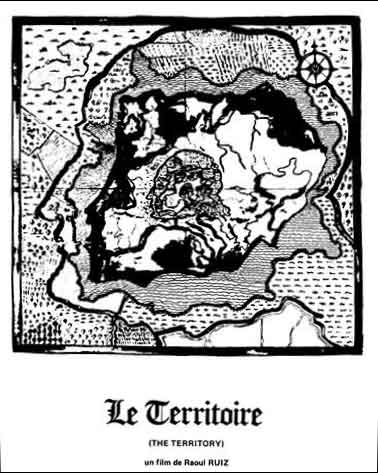
One critic famously dismissed Ruiz as “a surrealist without a subject,” but in THE TERRITORY he had a very strong subject: an actual incident in which a group of French hikers got lost in a forest and fell prey to starvation and cannibalism. Ruiz was also blessed with an appropriately scenic setting in the form of the rural Portuguese district of Sintra, and the backing of none other than Roger Corman.
THE TERRITORY (1981) Trailer
The idea of a Ruiz-Corman collaboration sounds promising, but Corman was involved only in the early stages of the production. His input was reportedly limited to a telegram bearing the following guideline: “This movie must be very, very disgusting.” After Corman withdrew his participation the financing collapsed, forcing Ruiz and his crew to complete the film guerilla-style (further complicating matters was the presence of the American underground filmmaker Jon Jost, on hand to make a never-completed documentary called IN CORMAN’S TERRITORY?).
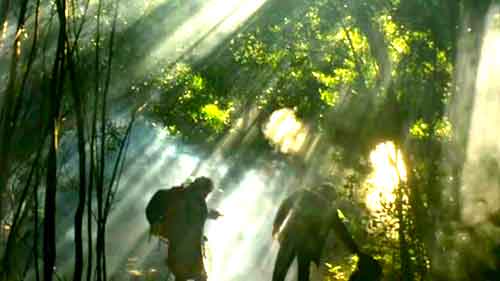
The Territory
Enter Mr. Wenders, who during a lull in the HAMMETT shoot was summoned to the TERRITORY set by his then-girlfriend Isabelle Weingarten, one of the film’s stars. Sintra’s “dream décor” and the “serene manner” of Ruiz’s crew inspired Wenders to immediately put into production a Sintra set feature of his own. That feature, of course, was THE STATE OF THINGS, which was partially filmed in Sintra and utilized THE TERRITORY’S entire cast and crew—after which Wenders returned to the production of HAMMETT.
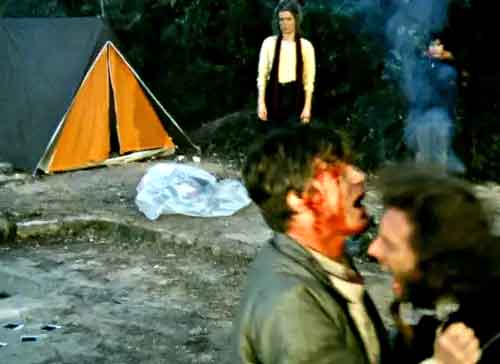
The Territory
Regarding THE TERRITORY’s finished form, I’d say its behind-the-scenes travails are the most interesting aspects by far. It resembles many early 1980s forest-set slashers (including JUST BEFORE DAWN and THE FINAL TERROR) in the burnished cinematography of the aforementioned Mr. Alekan, but otherwise it’s a bloodless (in every sense of the word) outdoor reverie marked by stilted acting, a formless narrative and enough half-baked conceits to shame Ed Wood. Examples of the latter include the outrageous Last Supper-esque religious ceremonies the protagonists hold before devouring portions of their friends (apparently something that occurred in reality), a delirious woman imagining her son’s head turning into a diamond-encrusted skull, two kids fighting over a severed arm and dialogue like “to get out of the park we have to get out of Europe, and to get out of Europe we have to get out of the park”—an utterance that’s apparently so profound a character is moved to reply “That’s amazing!”
Unsurprisingly, the film was barely released (it didn’t reach the US until August 1990) and is now quite obscure. That’s as it should be, given that from a historical standpoint THE TERRITORY is an important film, but a complete disaster otherwise.
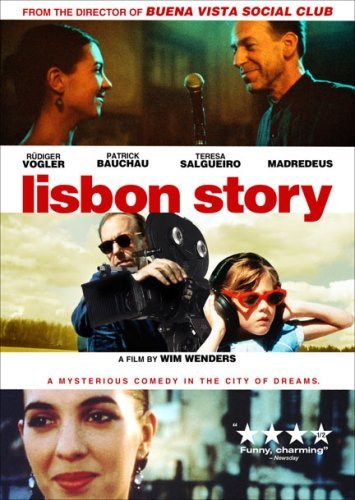
There’s one more film that needs to be taken into account. LISBON STORY (1994) was a Wim Wenders helmed sequel (of sorts) to THE STATE OF THINGS, with Patrick Bauchau reprising his character in a film that apparently began as a promotional documentary commissioned by the city of Lisbon, only to be twisted by Wenders to his own very eccentric ends.
THE LISBON STORY (1994) Trailer
Unfortunately, as anyone who’s sat through UNTIL THE END OF THE WORLD (1991), FARAWAY, SO CLOSE! (1993) and THE END OF VIOLENCE (1997) well knows, Wenders’ nineties films simply didn’t match his output of the previous two decades. LISBON STORY was very much in keeping with that situation, replacing the intrigue and interest of THE STATE OF THINGS with puddle deep pretention. The film is at least colorful and eye-pleasing, meaning that as the travelogue it was initially supposed to be, LISBON STORY satisfies.