
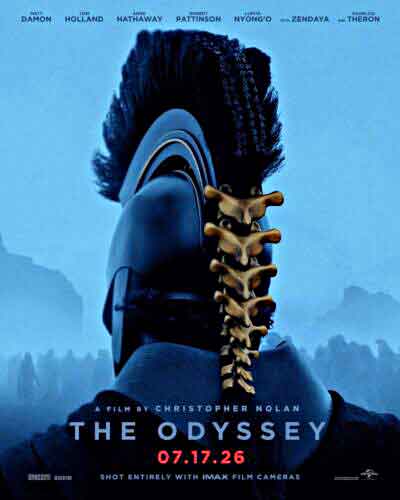
My feelings about Christopher Nolan’s widely contested 2026 filming of Homer’s ancient Greek epic THE ODYSSEY? I say it’s a blast.
THE ODYSSEY (2026) Trailer
The many issues brought up by Nolan’s detractors (which I’ll get to) aren’t entirely without justification, but the film works, especially when viewed in its intended IMAX presentation. The imagery of cinematographer Hoyte van Hoytema is crisp and magisterial, while the narrative arc, involving the decade-long return home of Odysseus in the wake of the Trojan War (fleshed out in THE ILIAD), is suitably epic, and the sound design thunderous and enveloping (this may well be the loudest movie I’ve ever seen). The epic runtime isn’t even the drawback I feared it might be, as the pacing is so kinetic and the action so furious that the 173 minutes passed quickly and painlessly. THE ODYSSEY is, in the words of the late Melvin Van Peebles, “Entertainment-Wise, A Motherfucker.”
All that surface bravura, however, didn’t blind me to the film’s many problems. Those problems start with an issue that stretches back to pioneering epics like INTOLERANCE (1916) and NAPOLEON (1927): the prizing of spectacle over humanity. As with those films, the characterizations of THE ODYSSEY might charitably be called one-dimensional. The Samantha-Morton played Goddess Circe evinces some complexity, but Tom Holland as Odysseus’ son Telemachus is a bland cypher who’s given far too much screen time, Robert Pattinson as Antinous the suitor is so cartoonishly villainous he might as well be twirling a mustache, and Anne Hathaway as Penelope, Odysseus’s wife and the object of Antinous’s affections, is given to impassioned soliloquies about her innate dissatisfaction, a word that says all that need be said about the character.
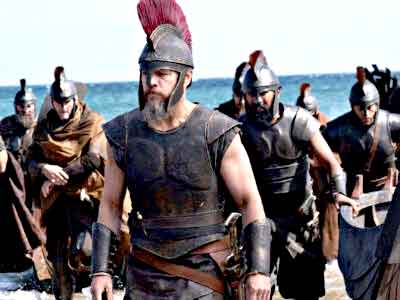
Matt Damon
Then we have Matt Damon’s Odysseus, whose demeanor accords with the demands of the narrative. He’s strong and decisive one minute and weak and indecisive the next, with Damon ultimately assuming the brooding demeanor of previous Christopher Nolan antiheroes, as seen in THE DARK KNIGHT (2008), DUNKIRK (2017) and OPPENHEIMER (2023). The gambit of remolding Odysseus according to one’s own obsessions certainly isn’t new; the late Greek writer and philosopher Nikos Kazantzakis did just that in THE ODYSSEY: A MODERN SEQUEL (1938), in which Homer’s hero was made to embody Kazantzakis’ concerns about consciousness and spirituality in a near-900 page epic poem that grows quite hallucinatory.
Nolan likewise adds a wrinkle of his own to Homer’s text, fashioning a climax that sees Odysseus, disguised as a beggar in Penelope’s quarters, reveal that he’s wracked with guilt over the Trojan Horse gambit (detailed in the form of extended flashbacks) and subsequent violence perpetrated by Odysseus and his men. This doesn’t stop him from killing off nearly all Penelope’s suitors in a sequence that recalls the notorious slaughterific finale of Kihachi Okamoto’s SWORD OF DOOM (Dai-bosatsu tôge; 1966).
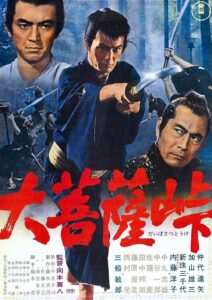
The Sword Of Doom
Okamoto’s film was a period drama depicting pre-industrial Japan. As such it couldn’t hope to compete with the work of Okamoto’s fellow countrymen Akira Kurosawa and Kenji Mizoguchi, and he wisely didn’t try to do so, with his focus on the troubled mental state of the psychotic protagonist (Tatsuya Nakadai). Nolan’s focus in THE ODYSSEY, conversely, is on period detail, which yields some impressive imagery, yes, but invites unwanted scrutiny.
Here we arrive at one of the major points of controversy surrounding THE ODYSSEY: its historical anachronisms. Nolan was reportedly quite obsessive about historical accuracy—note the mood-based score by Ludwig Göransson, which at Nolan’s insistence omits orchestral arrangements because orchestras didn’t exist in ancient Greece—yet he was also extremely bearish about appealing to a modern audience.
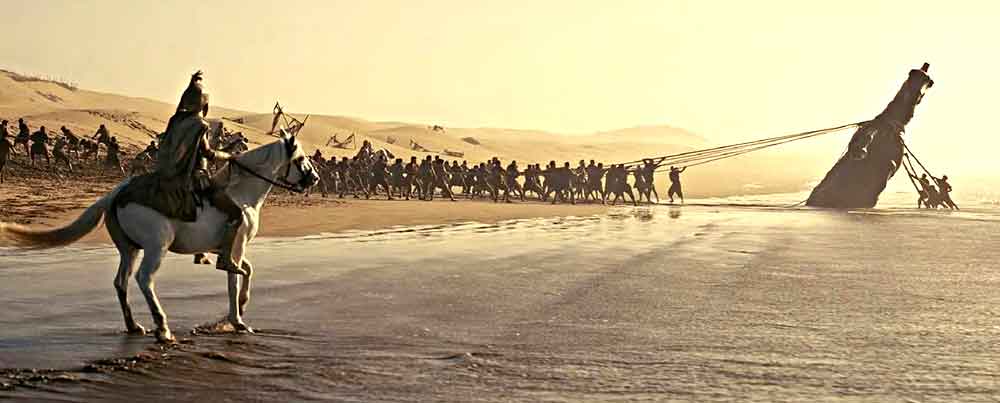
An especially contentious element is the modern-day lingo (i.e. Odysseus being told to “Fuck off”), which didn’t bother me overmuch, as I’m not sure authentic “Olde Worlde” movie dialogue is entirely feasible. As screenwriter Paul Schrader, speaking about adapting Nikos Katzanzakis’ LAST TEMPTATION OF CHRIST for director Martin Scorsese, stated, “You have to assume that (the characters) are conversing in a normal fashion and in order to make it sound as if you’re hearing these conversations for the first time you have to use a fresh, idiomatic dialogue.”
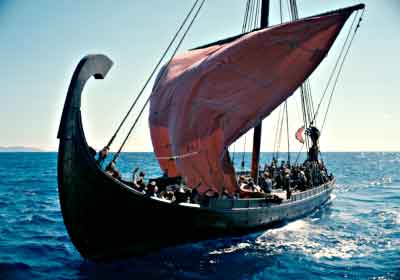
The complaints about THE ODYSSEY’s anachronistic scenery, which include a Viking boat and non-period specific armor, are in my view a bit more consequential. Period specificity certainly isn’t a requirement for historical cinema, but Nolan’s naturalistic treatment would appear to call for it. I say he’d have been better off going the surreal/postmodern route of underground films like the No wave classic ROME ‘78 (1978), a NYC filmed depiction of the Roman court that flaunted its tackiness, and the German made JESUS—DER FILM (1986), which depicted the life of Jesus Christ amid the unaltered decor of late 1980s Berlin.
One surreal element Nolan did utilize, which appears to have pissed of many people, was the casting of non-white actors. My issue with the gambit is that it feels halfhearted, with all the major characters played by white actors and the Black and Hispanic performers on hand, it would seem, to fill diversity quotas.
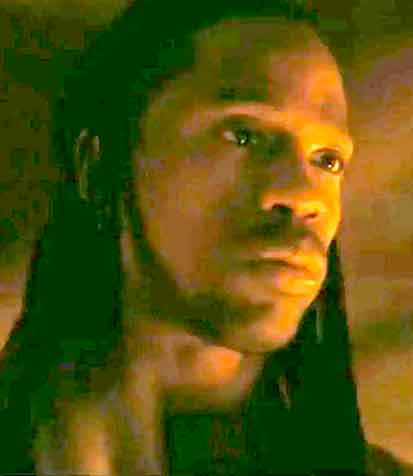
Travis Scott
Of those non-white performers, rapper Travis Scott as the bard, or narrator (Nolan: “I cast him because I wanted to nod towards the idea that this story has been handed down as oral poetry, which is analogous to rap”), has too little screen time to please or offend overmuch, while John Leguizamo passes for a native-born Greek as Odysseus’ pal Eumaeus (not the first time Leguizamo has pulled off such a feat, having convincingly played an Italian hairdresser in SUMMER OF SAM, 1999).
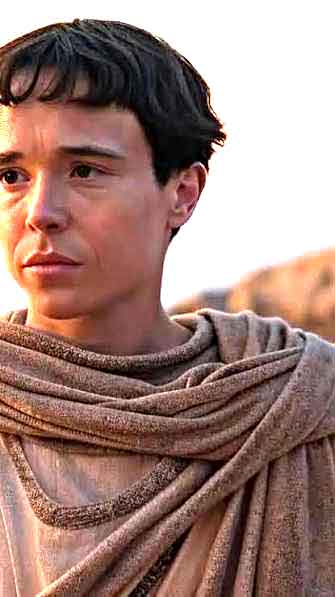
Elliot Page
Also appearing is the transgender Elliot Page as the warrior Sinon, a casting choice that was most likely due to Nolan’s penchant for using actors he’s previously worked with (Page, let’s not forget, co-starred in INCEPTION under a different name and gender). My problem with the role is that the character of Sinon was taken not from THE ODYSSEY but from the Latin epic THE AENEID, written by Homer’s foremost imitator Virgil (which would be akin to including characters from THE BLACK HOLE, 1979, in a remake of STAR WARS). Page, in any event, is a strong actor regardless of his gender preferences, and makes the most of his few minutes of screen time.

Lupita Nyong’o (The ODYSSEY)
What really appears to have gotten people riled up is the inclusion of a black Helen of Troy, a.k.a. The Face That Launched A Thousand Ships. The dark skinned Lupita Nyong’o makes for quite a sight in her brief appearance as HoT, recalling Carl Anderson as the black Judas of JESUS CHRIST, SUPERSTAR (1973) and, more notably, the African American Donyale Luna as the title character of Carmelo Bene’s frenzied and hallucinatory 1972 filming of Oscar Wilde’s notorious SALOME.
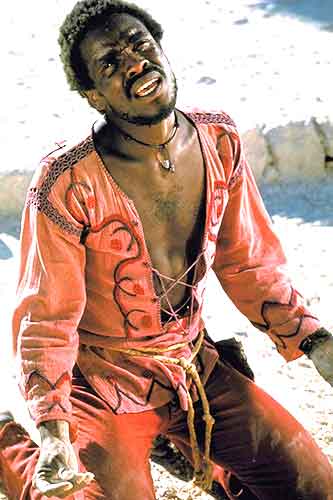
Carl Anderson (JESUS CHRIST SUPERSTAR)
Ms. Luna previously appeared in Federico Fellini’s similarly tripped out take on Petronius’ SATYRICON (1969), in which she played (appropriately or not) a witch. Her ethereal and otherworldly presence elevated both films, if for no other reason than that she stood out amid the otherwise all-white casts, something that can also be said of Lupita Nyong’o in THE ODYSSEY. Whether her visage is capable of launching a thousand ships is another question entirely (one that can also be asked of previous HoT players like Rossana Podestà and Diane Kurger).
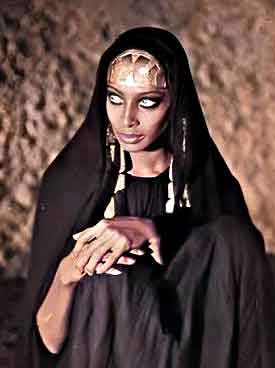
Donyale Luna (SATYRICON)
Mention of Bene’s SALOME and Fellini’s SATYRICON, as well as THE LAST TEMPTATION OF CHRIST, ROME ‘78 and JESUS—DER FILM, brings up a most curious fact: in depictions of ancient Rome filmmakers tend to get creative (due perhaps to the poetic nature of Roman art), whereas depictions of ancient Greece are quite literal—excepting the 1979 BBC production of Aeschylus’ THE SERPENT SON, which utilized a weird science fictionish visual aesthetic, and Lars Von Trier’s 1988 made-for-TV take on Euripides’ MEDEA, which contained a wealth of pre-digital small screen innovations.
The norm in filmic portrayals of ancient Greece occurs in reality-centered films like THE FALL OF TROY (La caduta di Troia; 1911), HELENA (1924), HELEN OF TROY (1956), THE TROJAN HORSE, ANTIGONE (both 1961), ELECTRA (1962) and THE TROJAN WOMEN (1971), the last three starring Greece’s late Irene Papas, and let’s not forget Wolfgang Peterson’s mega-budgeted ILIAD adaptation TROY (2004) and Pier Paolo Pasolini’s filmings of Sophocles’ OEDIPUS REX (1967) and Euripides’ MEDEA (1969). Pasolini, according to the British critic John Berger, “was in love with and at war with history,” and that’s equally true of Christopher Nolan.
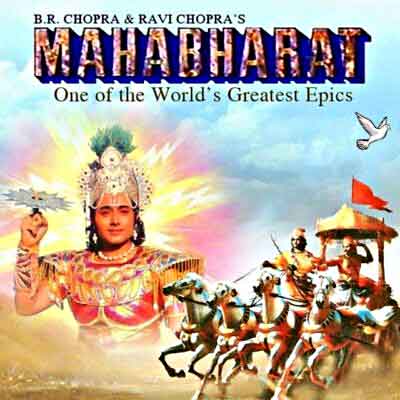
For a successful merging of the historical and ahistorical, and the literal and fantastic, one has to turn to Bollywood, in which humanity and divinity are intermixed, and deliberately overwrought melodrama and music numbers are requisites. That was certainly true of the so-called devotional epics of old, whose ranks include numerous big and small screen filmings of the ancient Indian epic THE MAHABHARATA. The quality of those filmings tends to vary (my preference is for the 1988 TV serial), but all offer full-bodied special effects-packed dramatizations. Opposing them is the Peter Brook helmed 1989-90 English language TV version, which takes place entirely on a stage with burnished lighting and largely imaginary props, and is, frankly, a bore. For a text to find its full expression onscreen, the material’s original heritage is oftentimes a requisite.
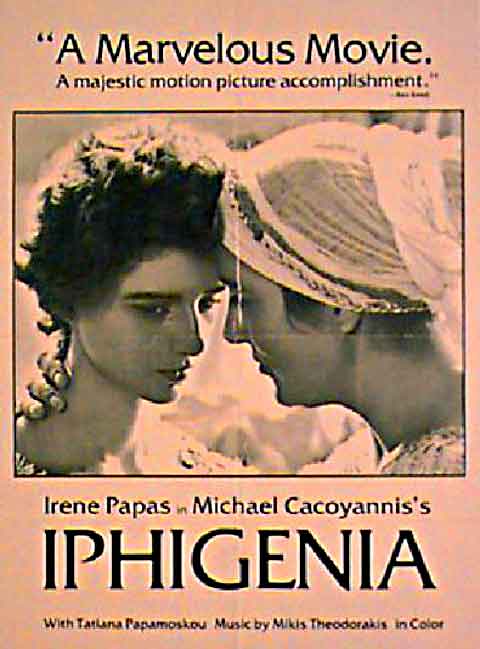
Which brings me to the curious fact that the country which produced THE ODYSSEY back in 8th Century BC has yet to turn out an ODYSSEY movie (with the closest example being Theo Angelopoulos’ 1995 arthouse epic ULYSSES’ GAZE) . Classical Greek culture has generally been well served by Greek cinema, as in Michael Cacoyannis’ IPHEGNIA (1977), an adaptation of Euripides’ “Iphigenia at Aulis” in which the title character (Tatiana Papamoschou) is marked for sacrifice by her father Agammemnon (Kostas Kazakos). This greatly upsets the girl’s mother Klytaimnistra (Irene Papas, again), but, in a twist only a Greek scribe (or filmmaker) could pull off, Iphigenia herself enthusiastically endorses the killing (of a similar hue is Medea’s murder of her two children because she’s annoyed with her husband, which as dramatized by Euripides seems like semi-reasonable conduct).
THE ODYSSEY, by contrast, has no such moral conundrums and so is easily adaptable by non-Greeks. Still, I can’t help but long for an adaptation of Homer’s masterpiece by a top Greek filmmaker (I can only imagine what SINGAPORE SLING’s late Nikos Nikolaidis might have done with it).
It’s a fact that literary transpositions, classical literary transpositions in particular, are often accomplished best in indirect form. In 1980, when mega-producer Dino De Laurentiis attempted to mount a big budget film of the 1934 FLASH GORDON comic strip and 1936 serial film, he was stymied by the fact that the material’s optimal screen transition had already been accomplished in the form of STAR WARS, whose existence forced De Laurentiis and director Mike Hodges to create an overtly campy rock opera in order to differentiate their film.
Regarding THE ODYSSEY, I’d argue that its most memorable filmings did with it what STAR WARS did with FLASH GORDON. See Jean-Luc Godard’s CONTEMPT (Le Mépris; 1963), in which Godard cheekily referenced Homer’s narrative in the form of a fraught love story that matched Godard’s own disintegrating marriage, and as the subject of a movie being scripted by the writer protagonist (Michel Piccoli). Joseph Strick’s 1967 filming of James Joyce’s ULYSSES tones down Joyce’s modernist orientation in favor of a straightforward evocation of two men in early 20th Century Dublin whose wanderings roughly parallel those of Odysseus and co. Ethan and Joel Coen’s O BROTHER, WHERE ART THOU? (2000) transplanted Homer’s core narrative to 1930s Mississippi, and Ulysses into a George Clooney played bank robber on the run.
O BROTHER, WHERE ART THOU? (2000) Trailer
Overshadowing all those films (and Nolan’s as well) is what I believe to be the greatest cinematic transposition of THE ODYSSEY that exists: Stanley Kubrick’s 2001: A SPACE ODYSSEY (1968), which outdid THE SERPENT SON’s SF edge by resetting Homer’s epic in a futuristic milieu involving a computerized minotaur, followed by an extraterrestrial variant on Odysseus’ detainment by the Goddess Calypso and the protagonist’s inevitable return home (which in the Arthur C. Clarke novelization replaced the slaughter of the suitors with the detonation of space-based nuclear missiles, because “he preferred a cleaner sky”).
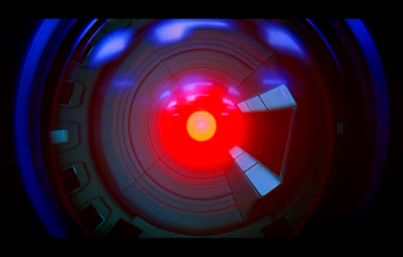
Hal 9000 (2001 A SPACE ODYSSEY)
Offsetting this was ULYSSES (1954), a so-so Italian made peplum (sword and sandal) epic from the aforementioned Dino De Laurentiis that starred Kirk Douglas as Ulysses (the Latinized form of Odysseus).
ULYSSES (1954) Trailer
De Laurentiis (who also adapted the Book of Genesis in THE BIBLE IN THE BEGINNING…, 1966), turned to Homer once again in an 8-part 1968 miniseries version of THE ODYSSEY, which is often touted as the most accurate screen rendition.
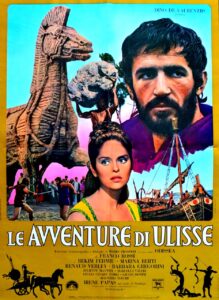
THE ODYSSEY (8-part MINISERIES, 1968)
Directed by Franco Rossi, Mario Bava (who also helmed portions of ULYSSES) and Piero Schivazappa, the 1968 ODYSSEY is certainly the most thorough and knowledgeable screen adaptation, with narration that functions as both scene setting and history lesson. Alas, the program suffers from pedestrian visuals (the striking colors of the Bava directed segments aside) and a lead performance by Bekim Fehmiu that’s lacking in the charisma Matt Damon very much had. The ubiquitous Irene Papas, however, far outdoes Anne Hathaway’s efforts at fleshing out Penelope.
Another miniseries adaptation followed in 1997, a 2-parter that was broadcast on NBC, executive produced by Francis Ford Coppola and directed by Andrei Konchalovsky. Armand Assante plays Odysseus and Greta Scacchi Penelope in a program marked by handheld camerawork and cut-rate CGI that makes the proceedings look mighty cheap. The series is of primary note for once again featuring Irene Papas, as Odysseus’ mother Anticleia, as well as its pre-2026 inclusion of a non-white performer in Homer’s tapestry, in the form of the Vanessa Williams played Calypso, and a mighty striking (if technically shoddy) depiction of Hades involving rains of fire and hordes of tortured souls.
THE ODYSSEY (TV SERIES NBC, 1997)
This brings up an area in which Nolan’s film is most certainly deficient. The underworld presented by Nolan, consisting of a dimly lit plain from which dead folk rise, is frankly pretty sorry. Nor was I too enamored with the Bill Irwin played Polyphemus the Cyclops, who takes the form of a fellow with a single sideways eye who moves in slow motion and is largely nonverbal (thus omitting the immortal Odysseus-Polyphemus dialogue exchange that concludes with the refrain “My name is nobody”). Furthermore, the monster Scylla, traditionally depicted as a beautiful woman with the body of a serpent, is reduced to a mass of tentacles that pluck Odysseus’ men into the air; I say Nolan would have been well advised to take a cue from the Charles H. Schneer/Ray Harryhausen classics JASON AND THE ARGONAUTS (1963) and CLASH OF THE TITANS (1981), which played fast and loose with their mythologically-infused narratives but had a plethora of great Harryhausen created monsters (and which, ironically enough, Nolan has cited as major inspirations).
While on the subject of monstrousness, let’s turn our attention to the Song of the Sirens sequence. On display is Odysseus’ crew stopping up their ears with wax as he, tied to the mast of his ship, is driven to near madness by the alluring songs of dimly glimpsed women on a rocky island. I’ve never seen a fully satisfying depiction of this passage in any of the ODYSSEY filmings, and so can’t complain overmuch about Nolan’s depiction of the sirens’ handiwork, consisting of dimly heard singing on the soundtrack while voice-over dialogue describes the torment Odysseus is feeling.
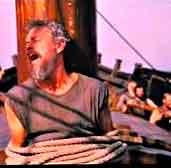
The Odyssey
I find I’m flashing back to Jerzy Skolimowski’s THE SHOUT (1978), about a man (Alan Bates) bearing the power to kill with a shout. As crafted by Skolimowski and sound designer Mike Basset, that shout, when it occurs, is a multi-channeled thing of ear-splitting beauty that won’t kill any of the film’s viewers, but will leave them satisfied (and wanting more).

The Shout
Another method of cinematically depicting the unspeakable is on display in THE NEVERENDING STORY (1984). Dramatizing a pair of giant statues—the “Sphinx Gate”— that in the Michael Ende source novel cause people to stop and die by telepathically assaulting them with endless questions, director Wolfgang Peterson simplified things considerably by having the statues shoot synchronized laser beams out of their eyes that passerby have to dodge around.
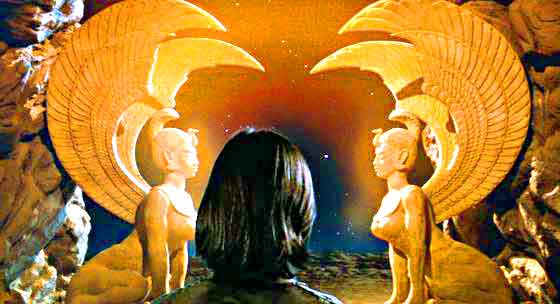
The Sphinx Gate
Then there was STALKER (1979), in which Russia’s Andrei Tarkovsky depicted the ravages of the “Meat Grinder,” a corridor in an alien-infected “zone” that assaults the minds of anyone walking through it, by doing nothing at all. This is to say that the sequence in which the protagonists traverse the Meat Grinder contains no filmic trickery of any sort (outside footsteps that are made to sound like pieces of rock being scraped together).
With all this in mind, I’ll have to conclude that Nolan made a conditional success of the sirens sequence. I feel much the same way about THE ODYSSEY overall, whose attributes are things that taken at face value aren’t terribly noteworthy, such as the fact that it was shot and edited on film and that the ocean-set scenes forsook the CGI waves that have become so prevalent in modern cinema (which to my mind aren’t much more convincing than the patently phony plastic sheeting that comprised the “water” seen in the Fellini films CASANOVA, 1976, and THE SHIP SALES ON, 1983,) in favor of actual water. I like the film, in short, but I’m admittedly grading on a curve.