
 Q: What’s better than Hollywood success? A: International film success. It’s something that’s extremely difficult to achieve, given that outside the Hollywood system there’s simply not a lot of money to go around.
This was proven by Germany’s late Bernd Eichinger (1949-2011), a mega-producer who thrived for a brief period with challenging and idiosyncratic fare like HITLER: A FILM FROM GERMANY (1977), CHRISTIANE F. (1981) and THE NAME OF THE ROSE (1986), but by the time of his 2011 demise was devoting the majority of his attention to RESIDENT EVIL sequels. There’s also Canada’s Robert Lantos, whose formerly prolific producing career included classics like LEOLO (1992), EXOTICA (1994) and THE SWEET HEREAFTER (1997), but who has a mere four post-2010 film credits (the last of them in 2022).
Producers who managed to thrive in the off-Hollywood sphere included the late Saul Zaentz (1921-2014), who was famous for his uncompromising pursuit of quality cinema, and the recently deceased Jeremy Thomas, who managed to maintain an anti-Hollywood prestige film model for five decades. Zaentz was described by the NEW YORK TIMES as “the last of the great independent producers,” but I say that designation better fits Thomas.
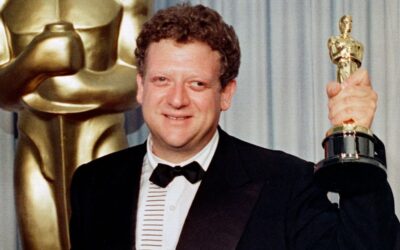 A Londoner born and bred, Thomas produced over 80 films in his time and was never slowed down by the unfortunate (and little-remarked-upon) fact that few of those films made any money. In fact, Thomas actually succeeded in turning that lack of financial success to his advantage, fostering the idea that he was above materialistic concerns in his pursuit of Art—and make no mistake: Art was what Jeremy Thomas provided, with no comic book adaptations, rotgut actioners, splatter films or shallow romcoms to be found in his filmography, which included authentically great, precedent-shattering masterworks like THE SHOUT (1978), BAD TIMING (1980), INSIGNIFICANCE (1985) and CRASH (1996).
Jeremy Thomas’ course was set with the release of his first credit as producer: MAD DOG MORGAN (1976), a highly quirky and eccentric biopic of the 19th Century Irish bushranger Daniel “Mad Dog” Morgan, filmed on location in the Land Down Under by the French born, Australia based Phillipe Mora. Subsequent Thomas projects spanned a host of exotic settings and subject matter, and directors that included Nicolas Roeg, David Cronenberg, Bernardo Bertolucci, Takashi Miike, Win Wenders, Jim Jarmusch, Terry Gilliam, Jerzy Skolimowski and Richard Linklatter. All had to pass a very strict likeability test, as Thomas staunchly maintained that he only worked with “directors he liked.”
Thomas provided those directors with generous budgets on less-than-commercial projects despite the fact that, as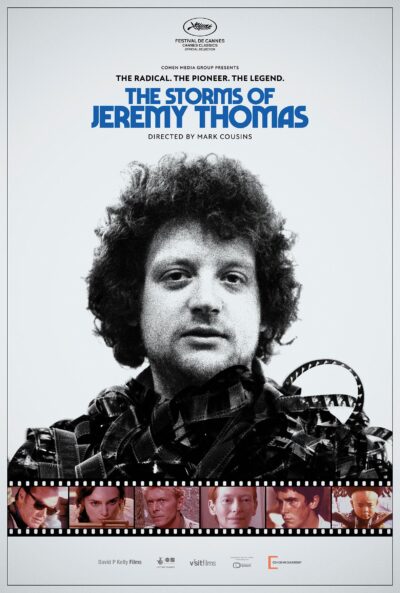 stated above, Thomas’ box office track record was none-too-impressive. Sure, THE LAST EMPEROR (1987) was a notable success that was well represented at the 1988 Academy Awards ceremony (netting Thomas his one and only Oscar), but more typical of Thomas’ output were GOOD TO GO (1986), ALL THE LITTLE ANIMALS (1998), DREAMING LHASA (2005), EMPIRE OF SILVER (2009) and HEMA HEMA (2016). No, I haven’t heard of any of those films, either.
The 2021 documentary THE STORMS OF JEREMY THOMAS, directed by Mark Cousins, engagingly documented the quixotic nature of a man who loved good films, fast cars and opulent living, and freely admitted to being a delayed adolescent. What Cousins didn’t provide was info on Thomas’s dealmaking prowess and the piecing together of financing for his films, for which he had a facility that bordered on genius. Another issue THE STORMS OF JEREMY THOMAS failed to mention was that, as was inevitable given all the off-Hollywood success he amassed, Thomas rubbed many people the wrong way.
The late British director Alan Parker called Thomas out directly in a 1991 PREMIERE magazine interview. Speaking of the Cannes Film Festival, at which Thomas was a longtime fixture, Parker claimed that “There’s a whole group here—Bernardo Bertolucci, Jeremy Thomas—and when I walk up to say hello at their table, I feel like they look at me like I’m a taxi driver, you know? And that really pisses me off. I hate that pretention.” I’ve long believed that Parker inserted himself into the leadership of the British Film Institute in 1998, and chaired the UK Film Council in ‘99, largely to stymie Thomas.
If that latter fact is true then it obviously didn’t work. Pretentious or not, Thomas continued to make films, and make them his way, well into the aughts and beyond (outlasting Parker and most everyone else in his sphere). There was nobody else quite like Jeremy Thomas, and there will assuredly never be another.