

By HARRY HARRISON (Grosset & Dunlap; 1977)
Another case of a severely misleading title. This profusely illustrated book is supposedly a history of sex in science fiction, but it’s actually a history of sex in science fiction art.

The late Harry Harrison (1925-2012) was a prolific science fiction writer (with credits that included the DEATHWORLD and STAINLESS STEEL RAT series and MAKE ROOM! MAKE ROOM!) who got his start as a graphic artist. That explains his interest in the illustrative side of SF publishing, in which field Harrison does indeed prove quite knowledgeable. His attempts at covering the literary side of the Sexy Sci-Fi subgenre, alas, aren’t too impressive.
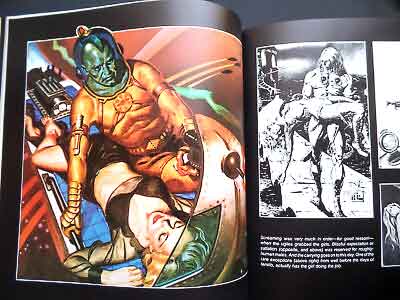
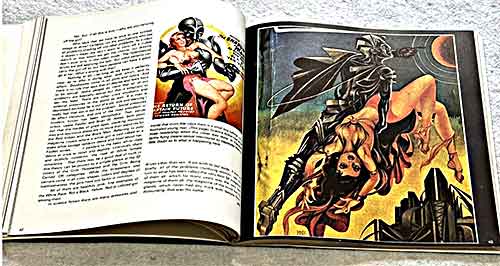
Harrison expends a lot of verbiage on the scantily-clad-women-menaced-by-inhuman-monsters illustrations that graced science fiction book covers and magazines of old (many of them accomplished by Harrison himself). That imagery wasn’t replicated anywhere in the texts of those books and mags, which tended to be quite chaste. It wasn’t until August of 1952, and the publication of the Philip Jose Farmer novella “The Lovers,” that SF writing began to approach the carnality of those illustrations—or so Harrison claims (he was evidently ignorant of stories like “Test-Tube Frankenstein” by W. Wayne Robbins and “The World Without Sex” by Edmond Hamilton, both of which hailed from 1940).
Further complaints: Harrison neglects the renowned SF-themed smut novels published by Essex House in 1968-69 (which may be what he refers to in a throwaway mention of “Some sexy SF novels” that are “collectors items now”) and is drawn into at least one blind alley in a chapter on gayness in SF, which he concludes with the observation “There is plenty of sex of all other kinds in our imaginative dreamland but, at the moment, I see no particularly strong evidence of the presence of this particular sort.”
On the plus side, Harrison proves an extremely witty guide, and offers up many quotable lines like “How Freud would have loved science fiction! What could he not have done with these wombsuitspacesuits which not only supplied all needs but took away all waste with the orifices plugged into tubes and pipes?” A great deal, I’d guess.