

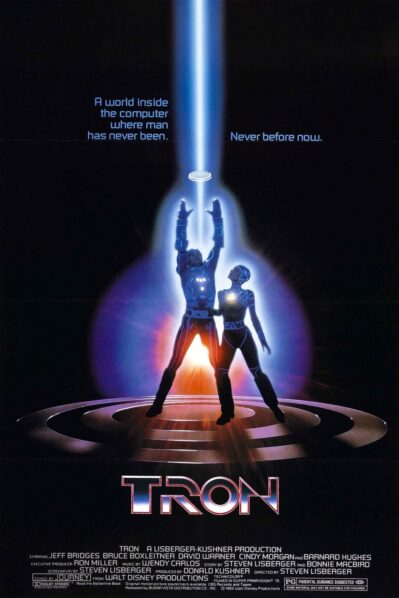
In the wake of TRON: ARES (2025), whose failure appears to have put a permanent end to the TRON franchise, let’s take a look back at the 1982 film that started it all. TRON (1982) was a rare example of Disney, the most risk-averse studio in Hollywood, taking a chance on material that’s defiantly unique (borderline experimental, even) in both conception and execution.
TRON (1982) Trailer
TRON: LEGACY (2010) Trailer
TRON: ARES (2025) Trailer
Steven Lisberger was an animator who knocked around Hollywood for nearly a decade (with credits that included the 1973 short COSMIC CARTOON and the 1980 feature ANIMALYMPICS) before convincing Disney to finance and distribute TRON. Disney’s primary interest appears to have been the merchandising opportunities afforded by Lisberger’s conceptions, which resulted in glow-in-the-dark action figures, circuit board patterned clothing and a Bally Midway video game that in 1982 ranked as one of the coolest arcade items on the market, movie related or otherwise.
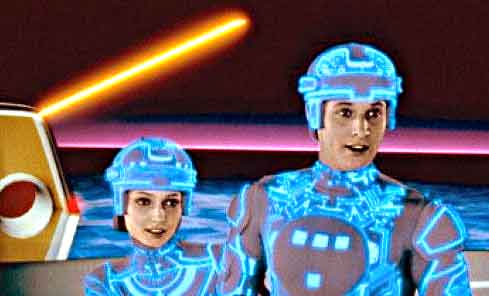
Cindy Morgan, Bruce Boxleitner (1982)
TRON’s universe is sketched in a few deft, matter-of-fact strokes, with the opening textual crawl popular in early eighties SF cinema left unutilized (this, ironically, was a rare case in which an explanatory crawl would have been beneficial). In this realm computer programs, under the tutelage of their real world “users,” move about in a technological never-never land that intermixes live action and animation, rendered in rich hues of blue and red. Back in the here-and-now, the disgraced computer programmer Kevin Flynn (Jeff Bridges) is attempting to get acknowledged for writing SPACE PARANOIDS, a popular video game credited to Ed Dillinger (David Warner), a higher-up in the mega-corporation ENCOM (an ironic plot point coming from Disney, an organization notorious for its intellectual thievery).
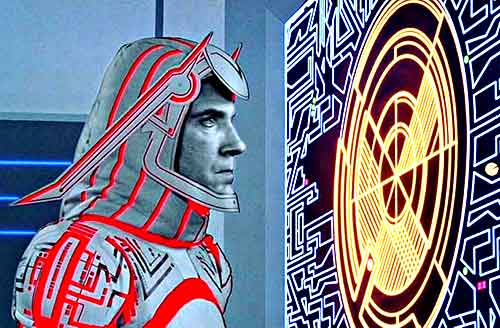
David Warner (1982)
When Flynn tries to find documentation for his claims by breaking into ENCOM’s headquarters, the Dillinger-created Master Control Program (voiced by Warner) zaps him with a laser beam capable of digitizing matter. Flynn is transferred to a “game grid” where programs that closely resemble (WIZARD OF OZ-like) their creators are forced by the MCP and its mouthpiece Sark (Warner) to compete in elaborate games. Having created most of the games himself, Flynn proves an adept player, handily beating a PONG-like ball bouncing tournament and a drive-a-thon with “light cycles.” After besting his opponents in the latter competition, Flynn escapes the MCP’s clutches, together with the programs Tron (Bruce Boxleitner) and Ram (Dan Shor).
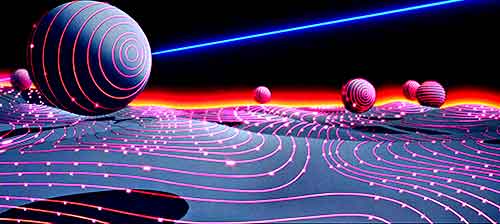
Tron-scape
This trio outwits the MCP’s goons, although Ram doesn’t survive. Enter Yori (Cindy Morgan), a fetching female program who becomes the companion of Flynn and Tron on a “solar sailer” beamrider on its way to the MCP’s core. The vehicle is destroyed by a command ship piloted by Sark, who (seemingly) kills Tron and captures Flynn and Yori, imprisoning them in the control ship—which is promptly “desrezed.” Will Flynn and Yori survive? Is Tron actually dead? Will Flynn ever make it back to reality? Don’t pretend you can’t figure out the answers.
TRON’s technical credits were, and are, impeccable. The innovative synthesizer score by Wendy Carlos fits the action perfectly (and translated quite well to the video game format) and the conceptual design of BLADE RUNNER’S Syd Mead and Jean “Moebius” Giraud imparts an authentically otherworldly technoscape (although much of the film’s imagery directly recalls elements from Disney’s earlier SF effort THE BLACK HOLE, particularly that film’s evil robot Maximilian, whose particulars are replicated in several of TRON’s animated creations).
We shouldn’t be surprised that such a design-conscious film has enormous issues in nearly every other department. The real world set opening half hour is, frankly, lousy, weighed down by indifferent pacing and bad acting (even the seasoned Jeff Bridges fails to make much of an impression), and the game grid set scenes have their own problems.
The physical properties of this universe are never concretely established (how is it that Flynn possesses incredible powers in some parts and not others, and how does he make it back into the real world after being uploaded to the digital realm?) and the action scenes are notably lackluster. The score, impressive though it is, is a major source of the problem, being too even-toned and cerebral to work in an adventure-oriented drama.
Yet taken purely as a science fiction spectacle, TRON has a magic that remains sui generis (not even the sequels TRON: LEGACY and TRON: ARES were able to recapture that magic). It may well be the only movie ever made that fully succeeds in fully conveying the scope and texture of what we now call virtual reality. The film predated William Gibson’s seminal SF novel NEUROMANCER by two years, and was evidently an influence; if the virtual reality universe detailed in Gibson’s fiction ever becomes a reality, it will probably look a lot like TRON’s technological dreamscape.
Vital Statistics
TRON
Walt Disney Productions
Director: Steven Lisberger
Producer: Donald Kushner
Screenplay: Steven Lisberger
Cinematography: Bruce Logan
Editing: Jeff Gourson
Cast: Jeff Bridges, Bruce Boxleitner, David Warner, Cindy Morgan, Barnard Hughes, Dan Shor, Peter Jurasik, Tony Stephano, Stuart Thomas, Craig Chudy, Vince Deadrick, Sam Schatz, Jackson Bostwick, Dave Cass, Gerald Berns, Bob Neill, Ted White, Mark Stewart, Michael Sax, Tony Brubaker