

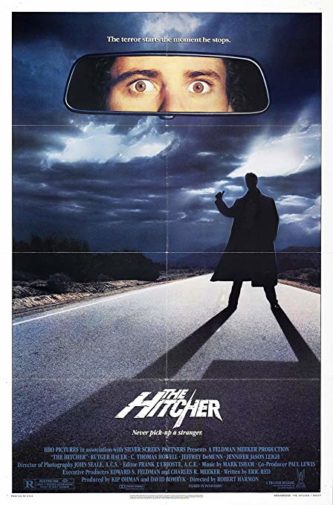
Every now and again movie magic is conjured from wildly disparate elements. Such a case occurred with THE HITCHER (1986), a slasher pic made by a first-time director and some highly overqualified crew members, working from a derivative and illogical script. Somehow the finished product was an impressive accomplishment, with a resonance that was evident early on.
THE HITCHER (1986) Trailer
On February 23, 1986 the LOS ANGELES TIMES devoted the cover of its Calendar section to the just-released HITCHER, with the headline “How does a film like this get made?” and two articles taking potshots (following a withering opening day review that had appeared two days earlier). Critic Michael Wilmington proclaimed it “a shallow, laughable (if strikingly staged and photographed) mess” and “also a deeply offensive one” that “makes something boring and ridiculous out of a portrayal of human fear, suffering and pain.”
The film had to have some standout attributes to inspire such ire, yet it wasn’t a hit. If co-producer Paul Lewis is to be believed, that failure was due to the fact that the film’s major gross-out set piece occurs offscreen: “You can’t show all the killings we showed and then not show the main one. It’s cheating the audience.” Luckily it was made by HBO Pictures, and so played incessantly on the cable channel of that name, ensuring its cult success.
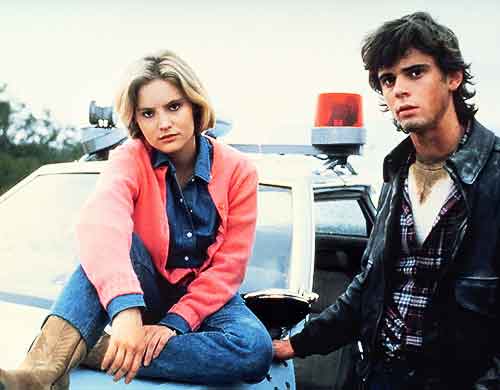
Jennifer Jason Leigh, C. Thomas Howell
Inspired by the Doors tune “Riders on the Storm,” THE HITCHER begins with the young Jim Halsey (C. Thomas Howell) navigating a driveaway car through the Texas (actually Nevada) desert one night, and falling asleep at the wheel. To keep himself awake Jim picks up a hitchhiker, to whom he admits “My mom told me never to do this.” Sound advice, it turns out, as the hitcher is John Ryder (Rutger Hauer), an imposing fellow with an aura that’s deeply psychotic and not a little homoerotic, as in short order he grabs Jim’s knee, sticks a switchblade in his crotch and admits to having just dismembered a motorist. Jim, noticing that the passenger door isn’t fully closed, pushes Ryder out.
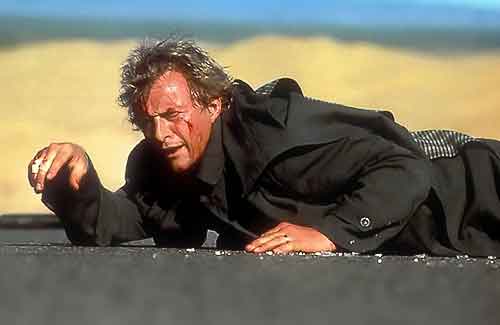
Rutger Hauer
Ryder isn’t done, however, as over the course of the following two days he furthers the weird sadomasochistic bond established in the early scenes by blowing up a gas station in which Jim is fueling his car, placing a severed human finger in a plate of fries, killing numerous cops and ensuring that the blame is placed on Jim, etc. The “best” of Ryder’s outrages (and the one whose apparent restraint was singled out in the abovementioned Paul Lewis quote) is saved for last: tying a young waitress (Jennifer Jason Leigh) Halsey has befriended between two trucks, one of which Ryder drives off. This inspires Jim, whose innocence is entirely lost, to hijack a police cruiser and permanently take the Hitcher out of commission.
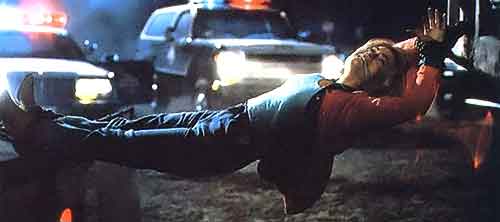
Jennifter Jason Leigh
THE HITCHER’S primary selling point is its sheer relentlessness. The story’s stark simplicity is an asset, with backstories, subplots and subsidiary characters jettisoned, and director Robert Harmon keeping his focus on Jim’s helplessness in the face of Ryder’s onslaught. The pacing is spot-on and the cinematography, achieved by Australia’s great John Seale (who would go on to photograph MAD MAX: FURY ROAD), perfectly captures the arid hopelessness of the desert landscapes. The stunt work also deserves mention, even if it is a bit overwrought (with two police cars flipping end over end down a highway and a crashing helicopter being among the products of a wildly overzealous stunt crew).
Rutger Hauer in The Hitcher
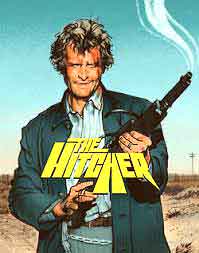
Harmon deserves credit for leaning into rather than resisting the script’s outrageousness. Eric Red’s overheated descriptions—“Soothing country dark thick and tangible as oil flows into the car again,” “John Ryder glares at him, his drippingly disfigured face gruesome in the gangrenous green glow”—were visualized with great fidelity, as was the frankly illogical narrative, which has the feel of an especially pernicious nightmare. Looming over it all is the overpowering performance of the late Rutger Hauer, who created what is almost certainly one of the great movie villains of all time. Hauer’s unsubtle acting style worked best with large-than-life characters, which John Ryder, who may be a supernatural monster from the id or a misunderstood simp (Hauer’s major concern when making this film was that audiences “might think I’m the bad guy”), very much was. As his victim, C. Thomas Howell excels largely because he was reportedly intimidated by Hauer offscreen, and so apparently didn’t need to do much acting.
Vital Statistics
THE HITCHER
HBO Pictures
Director: Robert Harmon
Producers: David Bombyk, Kip Ohman
Screenplay: Eric Red
Cinematography: John Seale
Editing: Frank J. Urioste
Cast: Rutger Hauer, C. Thomas Howell, Jennifer Jason Leigh, Jeffrey DeMunn, Billy Greenbush, Henry Darrow, John Jackson, John Van Ness, Jack Thibeau, Armin Shimmerman, Gene Davis, Henry Darrow, Tony Epper, Tom Spratley, Colin Campbell