
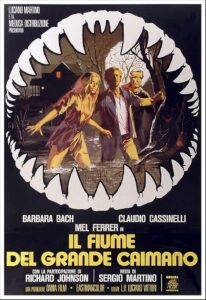
It wasn’t a bad idea: an Italian made JAWS rip-off, crossed with the jungle-set exploitation movie model popular in late 1970s Italy. THE GREAT ALLIGATOR (Il fiume del grande caimano; 1979) was the third entry in a loose-knit trilogy by director Sergio Martino that commenced with MOUNTAIN OF THE CANNIBAL GOD (La montagna del dio cannibal; 1978) and SCREAMERS (L’isola degli uomini pesce; 1979), all examples of what Martino calls “fake spectacular cinema” patterned after American made blockbusters of the era and featuring Hollywood mainstays in key roles, in this case Mel Ferrer, Richard Johnson and the then white-hot Barbara Bach.
THE GREAT ALLIGATOR (1979) Trailer
Filmed on location in the jungles of Sri Lanka, THE GREAT ALLIGATOR is set in and around Paradise House, a vacation resort run by the sleazy businessman Joshua (Ferrer). Enter Daniel Nessel (Claudio Cassinelli), a photographer contracted to help promote the resort, and Joshua’s sexy assistant Alice Brandt (Bach). Surrounding them are members of the native Kuma tribe, who live in fear of the awakening of the god Kruna—which takes the form of a giant alligator.
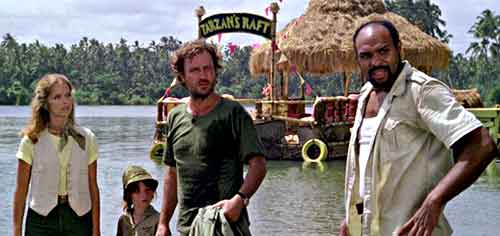
As Daniel and Alice commence their inevitable tryst (with he asking bluntly asking, “Do you fancy coupling with me?”) two resort employees get chomped by Kruna. This leads to a wave of panic among the natives, who believe Kruna is punishing them for befriending the white usurpers—a view shared by Father Jameson (Johnson), a stranded missionary whose companions were all killed by Kruna. As Alice observes, “He came here so these people would believe in his god, but now he believes in one of theirs.”
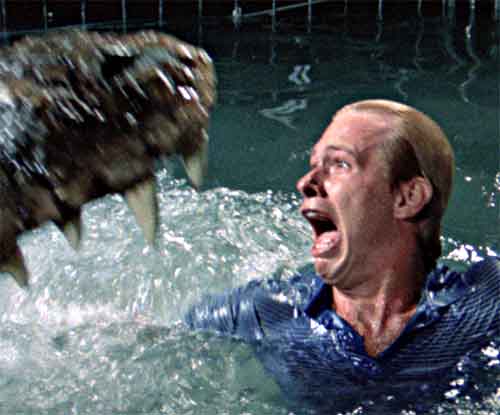
Daniel and Alice try and convince Joshua to close down the resort, but he refuses to let the possibility of death and destruction get in the way of potential profit. Alice is kidnapped by the Kumi, who immobilize her in a water-bound structure as a sacrifice to Kruna. The latter, in turn, attacks a floating barge upon which Joshua and several resort guests are partying, a predicament compounded by a revolt that sees the Kumis attacking the resort guests with sticks and arrows.
THE GREAT ALLIGATOR’s opening third amply demonstrates Sergio Martino’s commercial instincts. Rather inexplicably, it takes 25 minutes for the first alligator attack to occur, but the viewer’s attention is maintained by music video-styled montages and sexually tinged dancing by the natives (in case you were wondering whether the film’s depiction of dark-skinned tribesmen is in any way racist, the answer is a frank Yes).
The shockingly subdued nature of the film is what ultimately does it in. It seems Martino was emulating his American-made forebears in more than just subject matter, as the gore quotient, in common with that of the PG rated JAWS, is quite anemic. That’s a problem, as Martino couldn’t hope to compete with Steven Spielberg in the building of tension or suspense, and turned out a film that’s quite lackluster; only the final scenes, in which the outrageousness I was expecting finally comes to pass, can be said to truly fulfill their promise.
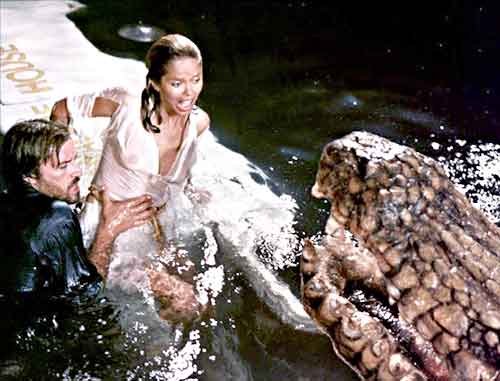
The eponymous critter, I’m sorry to report, is a disappointment. Close-ups of sharp teeth and an unblinking eye are employed to convey the gator’s menace, in conjunction with poor model work that fails to communicate the supposedly gigantic size of the critter. The surprise is that THE GREAT ALLIGATOR was by 1970s Italian cinema standards a fairly big budget production—and, much less surprisingly, one of the last films of its type.
Vital Statistics
THE GREAT ALLIGATOR (IL FIUME DEL GRANDE CAIMANO)
Dania Film
Director: Sergio Martino
Producer: Luciano Martino
Screenplay: Cesare Frugoni, Sergio Martino, Ernesto Gastaldi, Luigi Montefiori, Maria Chianetta
Cinematography: Giancarlo Ferrando
Editing: Eugenio Alabiso
Cast: Barbara Bach, Claudio Cassinelli, Mel Ferrer, Romano Puppo, Fabrizia Castagnoli, Enzo Fisichella, Lory del Santo, Anny Papa, Bobby Rhodes, Clara Colosimo, Peter Boom, Giulia D’Angelo, Marco Mastantuono, Piero Jossa, Marco Giannoni, Geneve Hutton, Silvia Collatina, Richard Johnson