

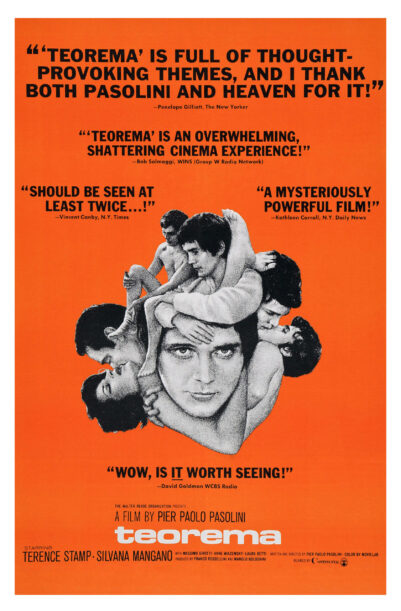
A strange, strange 1968 Marxist parable from Pier Paolo Pasolini. What renders TEOREMA (a.k.a. THEOREM, which, in keeping with most 1960s foreign films released in the US, was and remains known by its original untranslated moniker) an outlier in Pasolini’s filmography is the presence of a prominent English speaking actor: the UK’s late Terence Stamp, who happened to be on the first of several self-imposed exiles from his native land, and who inspired Pasolini to shoot the film in English (although most prints are Italian dubbed).
TEOREMA (1968) Trailer
In TEOREMA the goofy messenger Angelino (Pasolini regular Ninetto Davoli) arrives at a bourgeoise family’s luxurious villa, bearing a telegram that reads “I Arrive Tomorrow.” Its sender is “The Visitor,” a good looking young man (Stamp) who’s first seen working the room at a house party and then reading a book on the patio of the villa. Whether he’s been invited or not is never explained, but he immediately makes himself at home, and the family members are overcome by his apparently irresistible sexual magnetism.
After gazing upon The Visitor Emilia the servant (Laura Betti) tries to asphyxiate herself in the kitchen, but The Visitor saves her and, in what will become a recurring act, she bares herself to him. Lucia the mother (Silvana Mangano) finds the sight of The Visitor cavorting shitless in the backyard so irresistible she invites him into the house and strips down. Pietro the college-age son (Andrés José Cruz Soublette) finds himself drawn to The Visitor but is unable to consummate his desire, while Paolo the father (Massimo Girotti) falls ill and Odetta the daughter (Anne Wiazemsky) drags The Visitor to her bedroom to show him her family photo albums before (you guessed it) eagerly undressing.
But then Angelino the messenger turns up with a second telegram from The Visitor reading, “I Must Leave Tomorrow.” In the wake of The Visitor’s departure Paolo ponders giving the factory he manages over to the workers, but ends up stripping in the middle of a crowded train station and running off to Mt. Etna (the setting of Pasolini’s later film PORCILE). Lucia takes to compulsively picking up roadside hustlers for anonymous trysts (something Pasolini himself did quite regularly) in her bedroom and a roadside ditch. Pietro becomes an abstract painter whose ultimate artistic expression is achieved by pissing onto a canvas, while Odetta slips into a coma and Emilia attracts a crowd by levitating, and later ordering a relative (Susanna Pasolini, a.k.a. Pier Paolo’s mom) to bury her alive on an industrial construction site, where her tears form a mini-reservoir.
The very gay Pasolini was quite enamored with Stamp, who gets the type of fetishistic visual treatment Pasolini often lavished on his young male performers (with the major difference being that unlike most of them, Stamp spends most of his screen time clothed). Stamp has claimed that Pasolini covered much of his performance with hidden cameras recording his actions, which Pasolini evidently found quite arousing. Those of us who don’t share the belief that male pulchritude is capable of reshaping the world—a “theorem” Pasolini found so obvious and absolute he didn’t bother explaining it—will be a might puzzled. Myself, I found the close-ups of the gorgeous Silvana Mangano far more compelling and seductive than anything Stamp had to offer.
Ultimately, THEOREM is fascinating less for its thematic content and political leanings than for the mystical tone that pervades the film, the second half in particular. Aided by a discordant string-based score by Ennio Morricone, the proceedings are quite measured and rhythmic in their visual design (with people and objects placed more often than not directly in the center of the frame and the sun made quite prominent in the outdoor scenes), and presented with very scant dialogue, resulting in a depiction of supernatural displacement that outdoes those of most horror movies.
Vital Statistics
TEOREMA (THEOREM)
Arco Film Foundation
Director/Screenplay: Pier Paolo Pasolini
Producer: Paolo Frasca
Cinematography: Giuseppe Ruzzolini
Editing: Nino Baragli
Cast: Silvana Mangano, Terence Stamp, Massimo Girotti, Anne Wiazemsky, Laura Betti, Andres Jose Cruz Soublette, Ninetto Davoli, Carlo de Mejo, Adele Cambria, Luigi Barbini, Ivan Scratuglia, Alfonso Gatto