

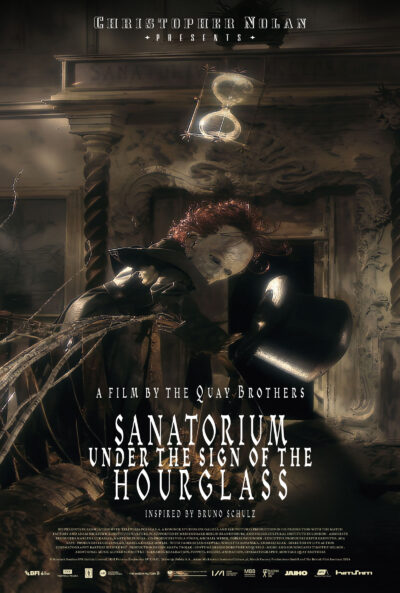
This 2025 English-Polish co-production, “Presented” by Christopher Nolan, may well be the magnum opus of the American born, London based Stephen and Timothy Quay, a.k.a. The Brothers Quay. The 75-minute SANATORIUM UNDER THE SIGN OF THE HOURGLASS aptly showcases their career-long obsessions, which include beautifully rendered stop motion animation, freeform dream-based storytelling and the writings of Poland’s Bruno Schulz.
SANATORIUM UNDER THE SIGN OF THE HOURGLASS (2025) Trailer
The Quays, who previously mined Schulz’s work for STREET OF CROCODILES (1986), based SANATORIUM UNDER THE SIGN OF THE HOURGLASS on “motifs and threads from” his similarly titled 1937 novella. In truth there’s very little Schulz to be found here (Wojciech Has’s HOURGLASS SANATORIUM provided a more faithful rendering of Schulz’s universe), but the film offers a powerful dose of undiluted Quay madness.
It begins in black and white live action, with an auctioneer (Tadeusz Janiszewski) stationed at the Carpathia Sanatorium, a secluded clinic in the Carpathian mountains. There the auctioneer examines the “Maquette for the Sepulchre of a Dead Retina,” an ornate wooden box containing a tiny drawer housing the retina of its deceased owner. Set into the outside of the box are seven lenses, each providing a view of one of the final images beheld by the dead man’s eye. When positioned correctly, the sun’s rays strike the retina, which has the effect of setting the seven images in motion—an occurrence that does indeed take place, with the images coalescing into a deeply macabre full color drama, divided into chapters (whose titles include “Provocations Uncovered in Crepuscular Corridors”) and peopled with animated puppet figures.
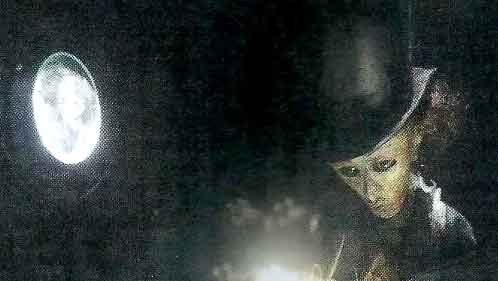
Foremost among the latter is Joseph, a top hat wearing fellow who keeps his mouth forever covered, on a train ride to the sanatorium. Seeking to visit his dying father, he finds a decaying structure with accoutrements that include dancing chalk, self-playing piano keys and a plethora of dimly glimpsed creatures. Getting an audience with the sanatorium’s head, the six-armed Doctor Gottard, takes some doing, but Joseph succeeds, with the doctor informing him his father has died; in the sanatorium, however, time flows in different directions, meaning the dead don’t stay that way for long.
Joseph’s attempts at contacting his reanimated father prove even more difficult than meeting the doctor, and I’m not sure if he truly succeeds or not, as at around the halfway point an already bizarre film goes completely batshit. The auctioneer, through whose eyes the whole thing is unfolding, goes to sleep, with his dreams coloring an account that grows increasingly phantasmagoric.
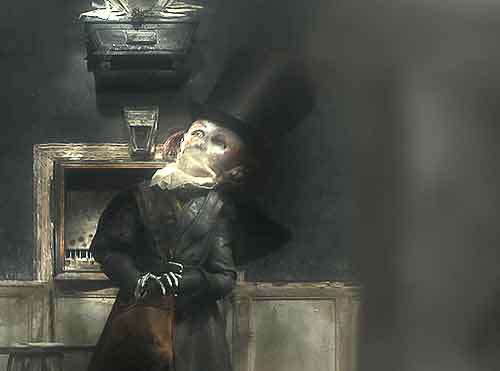
The imagery, as we’ve come to expect from the Quays, is dazzling in its technical proficiency and surreal detail (the sight of a clock topped by a severed hand is about as odd as any I’ve seen). Here the stop motion animation with which the Quays made their name is mixed with the live action of their feature films INSTITUTE BENJAMENTA (1995) and THE PIANO TUNER OF EARTHQUAKES (2004). The blend isn’t entirely seamless (unsurprisingly, it’s the animated portions that resonate the most), although the suitably dreamy and discordant score by Timothy Nelson goes some way toward holding it all together.
Traditional storytelling is something the Quays never had much interest in. Here narrative clarity takes a back seat to the imagery, and is further muddled by frequent aspect ratio shifts (to indicate that the entire thing is being viewed through the wooden box seen in the opening scenes), extremely labored pacing and actions repeated over and over (indicating that the images seen in the wooden box are in fact moving still frames). Multiple viewings are required for even a partial understanding, but keep in mind that over-analyzing the Quays can lead to a dead end (as was forewarned in INSTITUTE BENJAMENTA, a film whose core drama hinged largely on reflections of sunlight in a goldfish bowl).
No, this isn’t an easy or viewer-friendly viewing experience, but the artistry with which it was constructed is undeniable. I say it’s worth getting lost in, but I can also understand wanting to see TRON: ARES in its place.
Vital Statistics
SANATORIUM UNDER THE SIGN OF THE HOURGLASS
British Film Institute
Directors/Editing: Stephen Quay, Timothy Quay
Producers: Lucie Conrad, Izabela Kiszka-Hofilk
Screenplay: Stephen Quay, Timothy Quay
(Based on stories by Bruno Schulz)
Cinematography: Bartosz Bieniek
Cast: Tadeusz Janiszewski, Allison Bell, Andrzej Klak, Wioletta Kopanska, Zenaida Yanowsky